
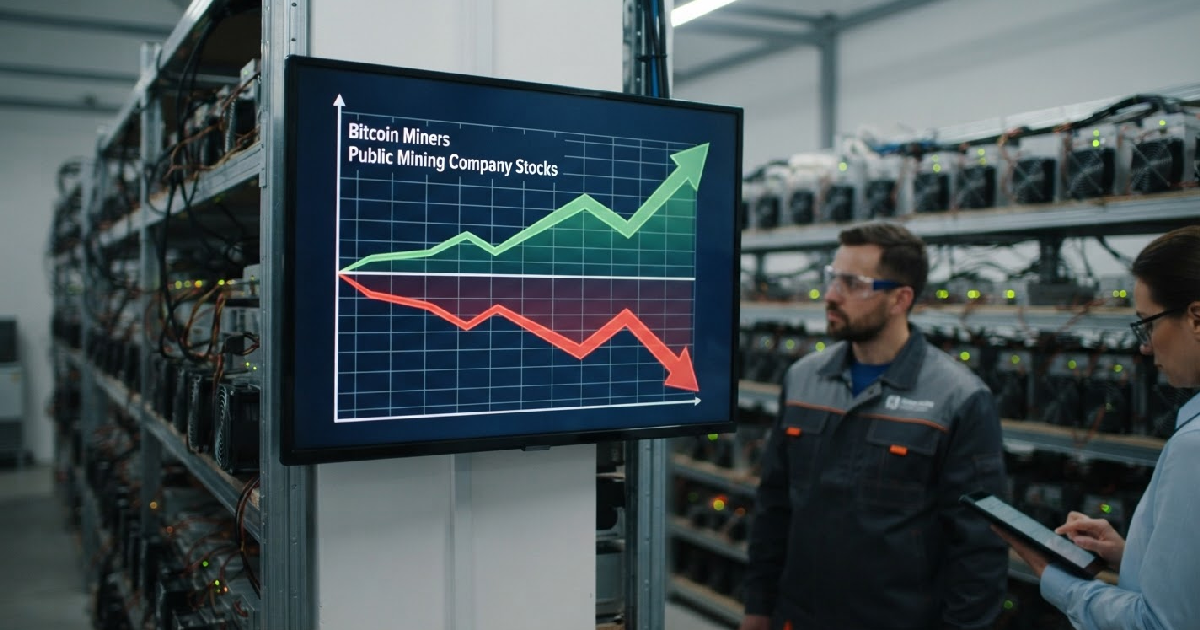

Bitcoin miners have largely continued to hold onto their digital assets, significantly reducing transfers to exchanges, even as public mining company stocks plummet and their financial health worsens. This critical divergence, highlighted by data from analytics firm CryptoQuant and market intelligence platform Artemis, suggests a potential easing of selling pressure on Bitcoin (BTC) despite challenging industry conditions.
During the week of July 12, 2026, Bitcoin briefly climbed above $65,000, buoyed by favorable inflation data, before settling back towards $64,000. Beneath this price volatility, miners are demonstrating an unexpected reluctance to offload their holdings, defying traditional expectations given their current financial strain.
Bitcoin miners tighten supply amid financial stress
Despite a deteriorating financial outlook for the sector, Bitcoin miners significantly curtailed their transfers of BTC to exchanges. CryptoQuant’s Miner to Exchange Flow metric shows a nearly 36% decline, dropping from 1,825.86 BTC on July 1, 2026, to 1,173.66 BTC on a seven-day Simple Moving Average. This reduction in immediately available exchange supply could act as a crucial buffer for Bitcoin’s price.
The industry’s financial health is undeniably precarious. CryptoQuant’s Miners’ Financial Health Index, which aggregates mining revenue, fees, and issuance, registered near 29% at press time. Historically, readings between 10% and 30% have signaled bear-market conditions, typically prompting miners to sell reserves to cover operational costs.
This restraint is notable, especially considering the average cash production cost for publicly traded mining companies in Q4 2025 rose to approximately $79,995. JPMorgan estimates current production costs are around $78,000. With BTC trading near $64,000, roughly 20% of miners are currently operating unprofitably, adding further pressure to their balance sheets.
Mining stocks dive as BTC price steadies
Adding another layer to the complex picture, publicly listed Bitcoin mining stocks collectively shed 12% over the past month. This stark contrast emerged even as Bitcoin’s price recovered, rising from $58,624 on July 1, 2026, to $63,999 at press time.
While publicly listed Bitcoin mining stocks collectively lost 12% over the past month, individual performances varied significantly. Iris Energy (IREN) absorbed some of the steepest losses, down 20.1% over the same period. Meanwhile, Cipher Mining (CIFR) actually saw its stock rise by 5.2%, outperforming the S&P 500’s 1.5% gain.
The market’s perception of these companies has shifted, with many now trading more like Artificial Intelligence (AI) infrastructure companies. Investor enthusiasm in the AI and semiconductor sectors has cooled, directly impacting mining stocks that are increasingly tied to chip supply chains and compute demand. This pivot away from pure Bitcoin proxies means their stock performance no longer perfectly mirrors BTC’s trajectory.
The AI pivot and broader market forces
The pressure on profitability intensified significantly after the fourth Bitcoin halving on April 20, 2024, which slashed the block reward for miners from 6.25 BTC to 3.125 BTC. This event drastically increased the cost of mining each Bitcoin, making diversification essential for survival.
In response, many mining firms have actively diversified their revenue streams. They’ve pursued GPU co-location and cloud service deals with hyperscalers, accumulating over $70 billion in contracts. Iris Energy, for instance, secured a substantial $9.7 billion deal with Microsoft for 76,000 NVIDIA GB300 GPUs, illustrating this strategic shift towards high-performance computing (HPC) services.
This reorientation has reshaped the investment thesis for mining stocks. Investors are now weighing these companies based on their AI commitments and data center capabilities, rather than solely on their Bitcoin production. This explains why some mining stocks are falling while Bitcoin holds firm; the underlying drivers for each are increasingly distinct.
Implications for Bitcoin’s supply and future trajectory
The current holding pattern by Bitcoin miners, reflected in the reduced exchange flows and a Bitcoin Miners’ Position Index (MPI) of -1.1 (a signal of accumulation), could have meaningful implications for Bitcoin’s supply dynamics. With less BTC being immediately available for sale on exchanges, a key source of selling pressure is alleviated.
This is particularly relevant as Bitcoin attempts to reclaim the $65,000 mark. The dollar value of Bitcoin held in miner wallets has also increased by $4.7 billion, from $71.5 billion to roughly $76.2 billion. While much of this increase reflects Bitcoin’s price appreciation, the sheer volume of 1.1938 million BTC held by miners represents a significant latent supply that, for now, remains off the market.
Historically, miner selling has often correlated with market downturns, as firms liquidate holdings to cover operational expenses or upgrade equipment. The present scenario, where miners are resisting this urge despite bear-market financial conditions, suggests a strategic long-term view. They might be anticipating a more substantial price recovery or are confident in their diversified revenue streams to weather the current climate without resorting to widespread selling.
Evolving network difficulty and hash rate dynamics
The broader Bitcoin network has also seen significant adjustments. Mining difficulty fell 5% to 127.17T on July 11, 2026, following a 10.09% drop on June 14, which marked the second-largest decline of 2026. Cumulatively, difficulty has fallen approximately 18% from its November 2025 peak of around 155T.
This reduction in difficulty directly correlates with a declining hash rate, which stood at approximately 127 EH/s leading into the July 11 adjustment. Lower difficulty means it’s easier for miners to find blocks and earn rewards, offering some relief from the post-halving squeeze.
This dynamic might also contribute to miners’ ability to hold their BTC, as some of the immediate pressure to sell for operational costs is lessened.
The current environment highlights a more mature and resilient Bitcoin mining industry. Miners are navigating intense financial pressure and a highly competitive landscape by diversifying operations and demonstrating a willingness to hold rather than capitulate. Their collective decision to curb selling, while their public equities struggle, paints a complex but ultimately supportive picture for Bitcoin’s immediate supply outlook.