
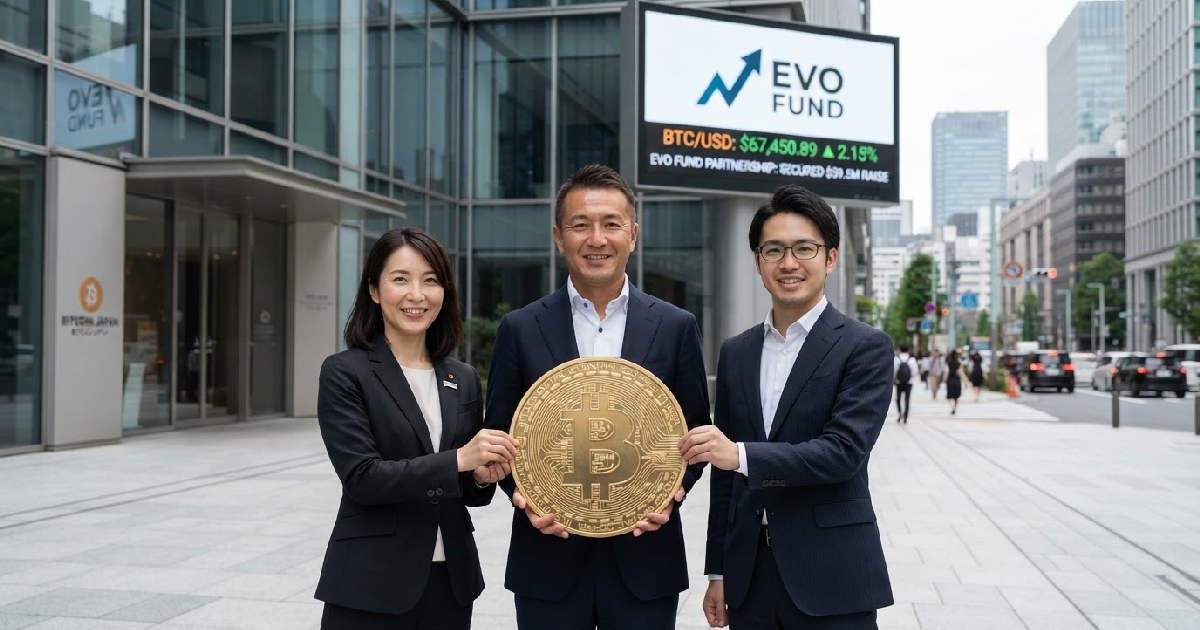

Bitcoin Japan, the Tokyo-listed company formerly known as apparel wholesaler Marusho Hotta, has secured a substantial financing package with the Cayman Islands-based EVO Fund. This deal, valued at approximately 9.66 billion yen, or $59.5 million, aims to finally facilitate the company’s first Bitcoin acquisition.
A dedicated 662 million yen ($4.08 million) from these proceeds is specifically earmarked for Bitcoin purchases, marking a pivotal step in the firm’s strategic pivot towards digital assets.
Financing structure and conditional Bitcoin allocation
The company, which still holds no Bitcoin despite its name change, announced the successful fundraising on July 17, 2026. This move signals Bitcoin Japan’s serious intent to build a digital asset treasury, a strategy it adopted last year. The board approved the financing after an independent committee deemed it necessary and appropriate under Tokyo Stock Exchange listing rules.
The financing package from EVO Fund combines a 1.5 billion yen ($9.2 million) zero-coupon convertible bond and a second series of stock acquisition rights. These rights could generate an additional 8.2 billion yen ($50 million) if exercised over roughly 12 months, based on the initial exercise price.
Both instruments feature moving-strike pricing, starting at an initial conversion and exercise price of 138 yen, with a floor of 69 yen.
EVO Fund has previously utilized this structure, sometimes described as Japan’s version of an at-the-market equity facility, to finance other Japanese companies’ Bitcoin accumulation. However, Bitcoin Japan’s allocation for Bitcoin is not immediate or guaranteed. Bitcoin sits fourth in the company’s funding priority list within the planned proceeds.
The upfront bond proceeds will first fund private equity investments. Subsequently, allocations for rare-earth mining and a robot-as-a-service business will be made. Bitcoin Japan’s ability to acquire its earmarked 662 million yen ($4.08 million) in Bitcoin hinges on EVO Fund exercising enough warrants to cover these preceding investments.
This conditional funding structure reflects a cautious, phased investment strategy, with deployment scheduled between August 2026 and February 2028. It highlights the complexities public companies face when integrating digital assets into their treasury while managing diverse investment interests.
Past attempts and strategic nuances
This isn’t Bitcoin Japan’s first effort to acquire the world’s largest cryptocurrency. A previous warrant program with Macquarie in December 2025 aimed to raise 5.715 billion yen ($35.1 million) but only generated 3.095 billion yen ($19.1 million). Due to a decline in the company’s stock, Bitcoin received none of those proceeds.
Instead, those December proceeds went towards two artificial intelligence (AI) infrastructure positions. These included a fund interest corresponding to 100,800 SpaceX shares, valued at about 2.8 billion yen ($17.2 million) as of June 30, and a 1.17 billion yen ($7.2 million) position in robotics startup Figure AI.
Bitcoin Japan, which maintains it has yet to buy any Bitcoin since adopting its treasury strategy last year, emphasizes its focus on “long-term intrinsic value per share.” The company stated that “Bitcoin holdings are not a KPI,” indicating a broader investment philosophy beyond just crypto accumulation.
Metaplanet’s precedent and regulatory tailwinds
Bitcoin Japan’s strategic shift mirrors that of Metaplanet Inc., another Tokyo-listed firm that has become Asia’s largest public corporate Bitcoin holder. Metaplanet transformed from a hotel business into a Bitcoin-focused treasury company, accumulating over 40,000 BTC by Q1 2026, often through similar financing mechanisms with EVO Fund.
Metaplanet’s journey provides a roadmap, albeit one with financial complexities. It reported substantial unrealized valuation losses on its Bitcoin holdings due to Japanese mark-to-market accounting rules, including a 102.2 billion yen ($660 million) unrealized loss in fiscal year 2025. These accounting nuances remain a key consideration for Japanese firms holding volatile assets.
The renewed corporate interest in Bitcoin comes amidst a more accommodating regulatory environment in Japan. On July 15, 2026, Japan’s parliament passed an amendment reclassifying cryptocurrency as a “financial asset.” This legislative change, set to take effect around fiscal year 2027, fosters greater institutional adoption.
Reforms to corporate tax on unrealized crypto gains, effective from fiscal year 2023-2024, have also made holding Bitcoin on corporate balance sheets more attractive. These changes address a major disincentive, potentially encouraging more Japanese firms to follow the lead of Bitcoin Japan and Metaplanet.
Bakkt’s backing and financial outlook
Bakkt Holdings, the digital asset platform backed by Intercontinental Exchange, is Bitcoin Japan’s largest shareholder. Bakkt acquired approximately 30% of the company’s voting rights last August and subsequently installed its International President, Phillip Lord, as CEO of Bitcoin Japan. Akshay Naheta serves as Chairman.
Bakkt will also lend EVO Fund up to 2 million shares, representing about 2.7% of outstanding shares, at no fee through August 2027. This loan is limited to hedge sales against actual warrant exercises. Investor Michael Lerch indirectly owns 100% of EVO Fund’s voting rights.
Despite its forward-looking strategy, Bitcoin Japan reported its eighth consecutive annual operating loss for the fiscal year ending March 2026. The company posted an operating loss of 462 million yen ($2.8 million) on revenues of 2.96 billion yen ($18.2 million). This financial backdrop makes the success of its digital asset pivot, including the eventual Bitcoin acquisition, particularly crucial.