
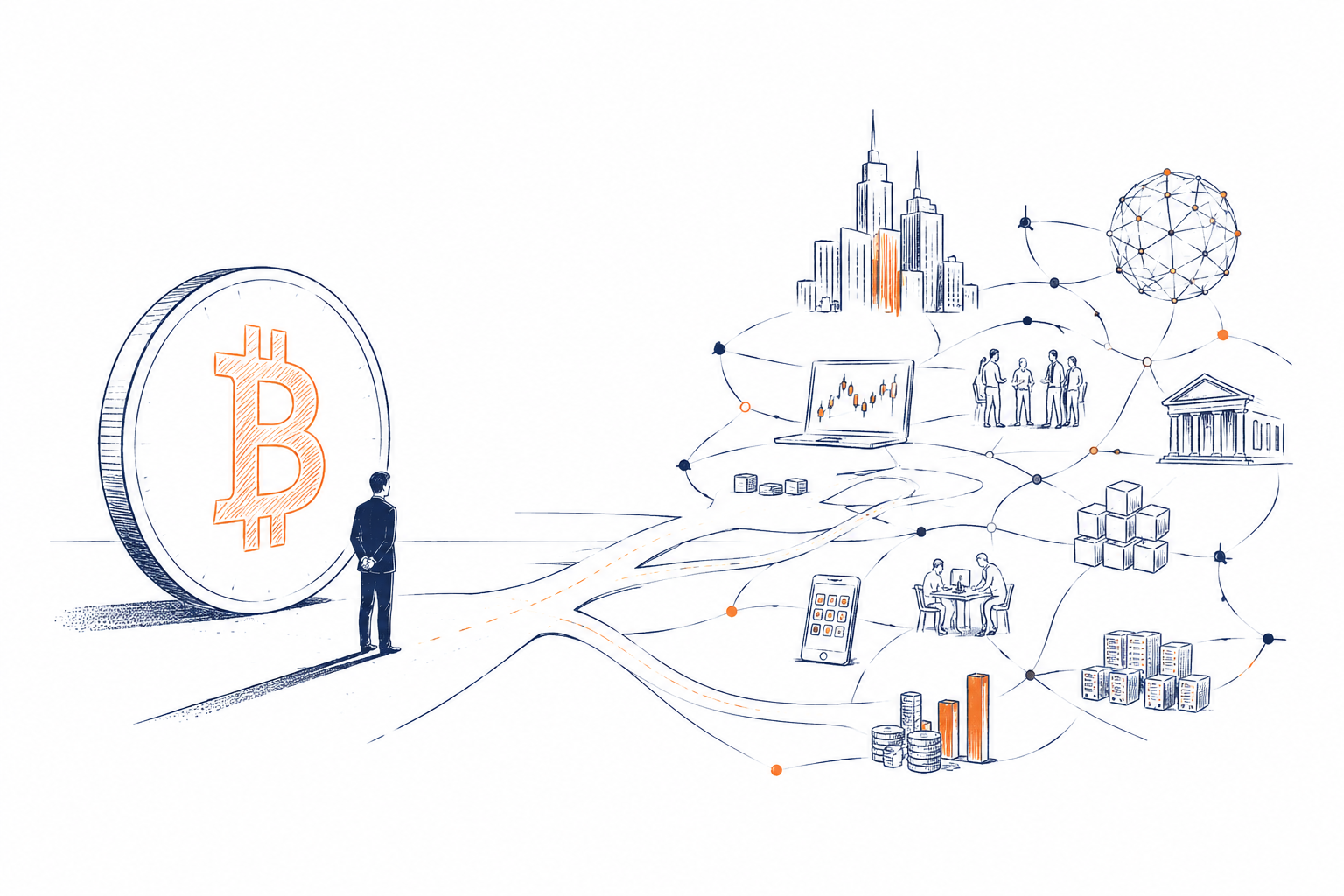

Bitcoin has never been more important to the cryptocurrency industry.
At the same time, it has never explained less about where the industry is heading.
That apparent contradiction reflects one of the biggest structural shifts taking place across digital assets today.
As Bitcoin cements its position as a global financial asset, much of the industry’s momentum is coming from somewhere else. Stablecoins are becoming payment infrastructure. Asset managers are bringing tokenized funds to market. Banks are building blockchain-based settlement systems. Technology companies are competing to provide the rails for the next generation of financial services.
Bitcoin remains the market’s anchor.
But it is no longer the only force driving its evolution.
Bitcoin has moved into a different phase
For much of its history, Bitcoin’s biggest challenge was proving it belonged in the financial system.
It had to survive repeated market cycles, attract institutional investors and establish itself as more than a speculative experiment.
That debate has largely been settled.
Spot Bitcoin ETFs have opened the asset to traditional investors. Public companies continue adding Bitcoin to their balance sheets, while asset managers increasingly treat it as a long-term allocation rather than a niche investment.
Bitcoin is no longer fighting for legitimacy.
It is defending the position it has already earned.
Innovation has shifted beyond Bitcoin
While Bitcoin matured, the rest of the crypto industry expanded in different directions.
The biggest developments of recent years have come from stablecoins, tokenized real-world assets, institutional blockchain infrastructure and networks designed to support financial applications.
Circle is building payment infrastructure around USDC.
BlackRock is expanding tokenized investment products.
JPMorgan continues developing blockchain-based financial systems.
Visa is increasing its involvement in stablecoin settlement.
Ethereum has strengthened its role as a platform for financial applications, while Solana is competing for payment flows and consumer-facing services.
Viewed individually, these developments seem unrelated.
Taken together, they point to an industry whose future is no longer defined by Bitcoin alone.
Crypto’s economy has become more diverse
Bitcoin still sets the tone for the market.
Its price continues to influence sentiment, liquidity and institutional interest.
But an increasing share of economic activity now comes from businesses and protocols that are solving entirely different problems.
Stablecoin issuers generate revenue from payment infrastructure.
Tokenization platforms are bringing traditional financial assets onto blockchain networks.
Developers compete to build applications rather than simply attract Bitcoin holders.
Growth is no longer concentrated around a single asset.
It is spread across an expanding ecosystem of networks, infrastructure providers and financial services.
Bitcoin’s success made this possible
There is a certain irony in this transition.
Bitcoin did not become less central because it failed.
It became less dominant because it succeeded.
By establishing itself as crypto’s leading financial asset, Bitcoin created room for the rest of the industry to specialize.
Different networks now compete on technology.
Infrastructure companies compete on financial services.
Institutions compete on tokenization, payments and digital asset custody.
Bitcoin remains the foundation of the crypto market.
But the industry’s next chapter is increasingly being written by the ecosystem that has grown around it, rather than by Bitcoin alone.