
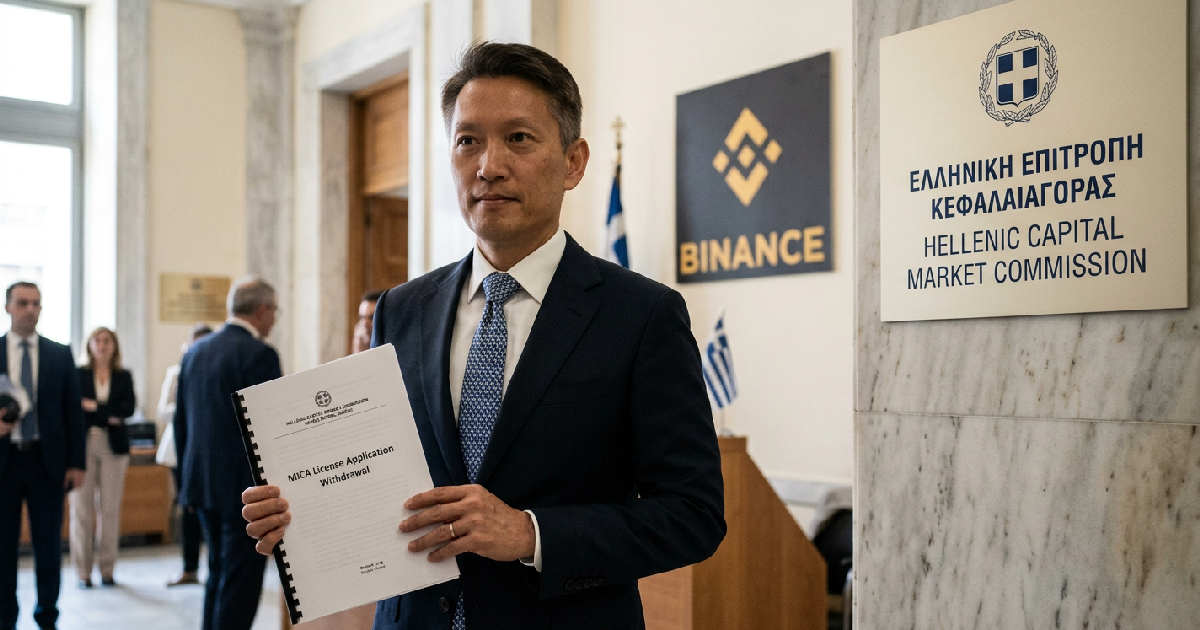

The global cryptocurrency exchange Binance has officially withdrawn its Markets in Crypto-Assets (MiCA) license application with the Hellenic Capital Market Commission (HCMC) in Greece. CEO Richard Teng confirmed the decision on June 24, 2026, as a critical European regulatory deadline looms for the platform.
The company withdrew its application after reviewing the status and prolonged timeline of the review process in Greece. Management concluded the delay no longer served user interests and chose to pursue authorization in a different EU member state. The strategic shift leaves the platform rushing to reorganize operations before its current permissions expire.
Regulatory pressure mounts before the critical European compliance deadline
The regulatory stakes are high for the 27-nation bloc, which represents roughly 450 million potential users. Under the new rules, firms without authorization must begin winding down EU operations immediately. The sudden pivot comes at a time when volatile crypto market liquidation analysis shows increased sensitivity to regulatory adjustments.
The decision follows 18 months of active engagement between Binance and the Greek capital markets regulator. The exchange established a Greek holding company in December 2025 and submitted its formal application in January 2026. Ultimately, the lack of a formal decision from the regulator forced an unexpected change in corporate strategy.
External pressures may have also influenced the withdrawal. Reports from Reuters on June 16, 2026, indicated that the HCMC was leaning toward rejecting the bid entirely. Regulators across multiple European states have reportedly pushed back against the platform’s recent licensing attempts.
Authorities in Ireland, Latvia, and Greece faced resistance regarding the exchange\’s complex global structure. Past money-laundering penalties and an institutional risk-taking culture also raised persistent concerns among local watchdogs. These compounding factors effectively stalled progress despite the exchange employing roughly 1,500 compliance staff globally.
Platform routes resources to alternative European jurisdictions
With the cross-border grace period ending on July 1, 2026, the company has exactly one week to adapt. National licenses held by the platform in France and Italy are also expiring within days. Competitors such as Coinbase and Kraken already hold MiCA licenses and continue onboarding European clients.
To avoid legal uncertainty, lawyers are working to transfer the documentation package to an undisclosed EU member state. Although the new target remains unnamed, industry observers point to France as a potential alternative. This shift occurs amidst broader market changes, including fresh interest in spot BNB ETF filing updates.
Gillian Lynch, Binance’s Head of Europe and the United Kingdom, confirmed that the platform is not leaving the region. “Binance is not leaving Europe,” Lynch stated, adding that the firm may just have a different pathway. She emphasized that if the Greek option fails, the company is looking at other alternatives.
User safety assurances and operational adjustments for European clients
CEO Richard Teng sought to reassure customers regarding asset safety during the structural migration. “Your funds remain safe and secure,” Teng stated in an official company update. He noted that the firm remains committed to securing a MiCA license in the coming months.
The exchange has launched automated email campaigns and push notifications to inform affected clients. These messages provide step-by-step instructions to minimize service disruption for European account holders. Some users may experience updated terms of service or restricted access to specific features during the transition.
The technical restructuring must occur rapidly to prevent operational gaps after the July cutoff. The company previously claimed that the HCMC completed its initial review and found the application compliant. However, without a final localized approval, those findings do not authorize compliance across the single market.