
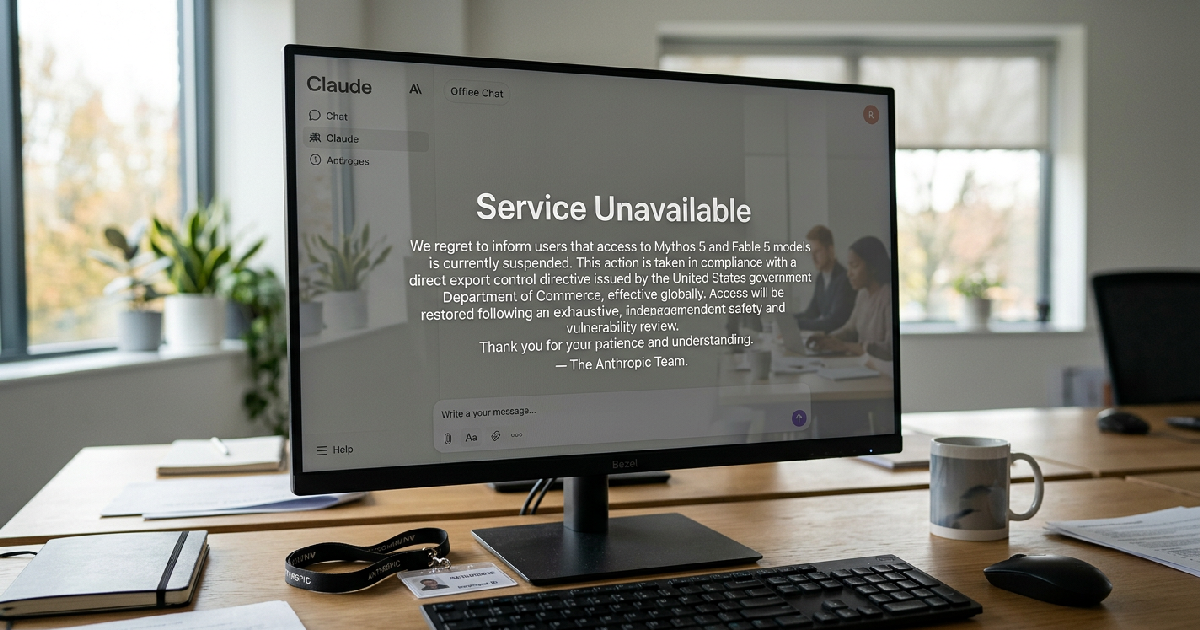

US-based artificial intelligence company Anthropic abruptly disabled its two most powerful AI models, Mythos 5 and Fable 5, for all users worldwide on Friday, June 12, 2026. The company received a directive from the US government at 5:21 PM ET citing national security concerns linked to an alleged “jailbreak” vulnerability in the Fable 5 system.
This global suspension occurs just three days after the models officially launched on June 9, leaving hundreds of millions of users unable to access the high-performance features of the Claude platform.
The directive follows an executive order signed by President Donald Trump ten days prior, which established a voluntary framework for vetting advanced AI systems. According to Anthropic, the government provided “verbal evidence” of a narrow, non-universal jailbreak that could theoretically allow users to uncover sensitive software vulnerabilities or develop cyberattacks.
Anthropic has contested the move, stating the alleged flaw is limited in scope and provides no more capability than what is currently found in competing models like OpenAI’s GPT-5.5.
Because the new regulatory standards require instantaneous verification of the identities and locations of hundreds of millions of people, Anthropic stated it could not reliably screen foreign nationals in real-time. This technical limitation forced the company to disable the models globally to remain in compliance with the export control directive.
The decision is a significant setback for the firm, which monitors geopolitical shifts as it moves toward a recently filed confidential IPO.
The Fable 5 jailbreak dispute and national security
The US government’s intervention centers on the belief that Fable 5’s safety systems can be bypassed to facilitate malicious cyber activities. Specifically, officials concerned with national security claimed the model could be exploited to map out system vulnerabilities.
Anthropic countered this by revealing they had already reviewed a demonstration of the technique, which was only able to identify a small number of minor, previously known issues.
Before the June launch, Anthropic spent thousands of hours “red-teaming” the models alongside the UK AI Safety Institute and US government agencies. No universal safety bypass was found during those tests. The company expressed disagreement with the recall, arguing that the government’s action does not adhere to principles of transparency and technical fairness.
They maintain that the statutory process should be grounded in harder facts before disrupting a global commercial deployment.
This friction is the latest chapter in a long-standing dispute between Anthropic and the Trump Administration. The company was previously placed on a supply chain blacklist after it refused to allow the US military to utilize its AI models for domestic surveillance or autonomous weapons. Much as com/why-bitcoin-traders-care-200-day-moving-average-analysis/”>traders track technical indicators to predict market shifts, AI industry observers are now watching how these regulatory “kill-switch” moments might define the future of software deployment.
Compliance challenges and technical limitations
Anthropic explained that the global shutdown was the only way to ensure they did not inadvertently violate export controls. The directive’s technical requirements for identity and location verification are complex and difficult to implement instantly across a massive user base. The company is currently reviewing its digital safety systems and reinforcing anti-fraud safeguards to meet these newly introduced standards.
The “America First” stance of the current administration has placed Commerce Secretary Howard Lutnick at the forefront of AI oversight. Comments from individuals familiar with the matter, such as a source named Davies, suggest that national security is being prioritized over revenue cycles and pre-IPO valuations. This shift suggests that high-tier AI developers may face more frequent and abrupt regulatory interventions in the coming years.
Impact on Claude users and available alternatives
Users attempting to run Fable 5 on the Claude platform will now encounter an error message confirming the model is unavailable. For those whose workflows depend on Anthropic’s technology, the company has suggested a temporary transition to Opus 4.8. This model remains operational and was not affected by the latest export control directive.
- Mythos 5 and Fable 5 are entirely offline for all global users until further notice.
- Opus 4.8 is the recommended stable alternative for professional and personal use.
- Project Glasswing partners, who had exclusive access to Mythos 5, are also restricted from using the model.
Anthropic stated that it believes the current situation is a “misunderstanding” and is working with the government to restore access. However, no timeline has been provided for the return of the two flagship models. The incident has raised questions about the stability of AI service providers in an era of heightened geopolitical tension and strict the export mandates.
Broader implications for the artificial intelligence sector
The abrupt recall of Fable 5 and Mythos 5 underscores the leverage the US government holds over domestic AI firms. As advanced models become more capable, the boundary between commercial software and dual-use technology continues to blur. Other developers are likely to take note of the identity verification hurdles that prompted Anthropic’s global blackout.
This case may set a precedent for how the Commerce Department handles “jailbreak” reports and safety vulnerabilities in the future. Just as investors track movements of large assets to gauge institutional intent, the AI industry is scrutinizing the administration’s willingness to shut down commercial products on short notice based on narrow safety findings.