
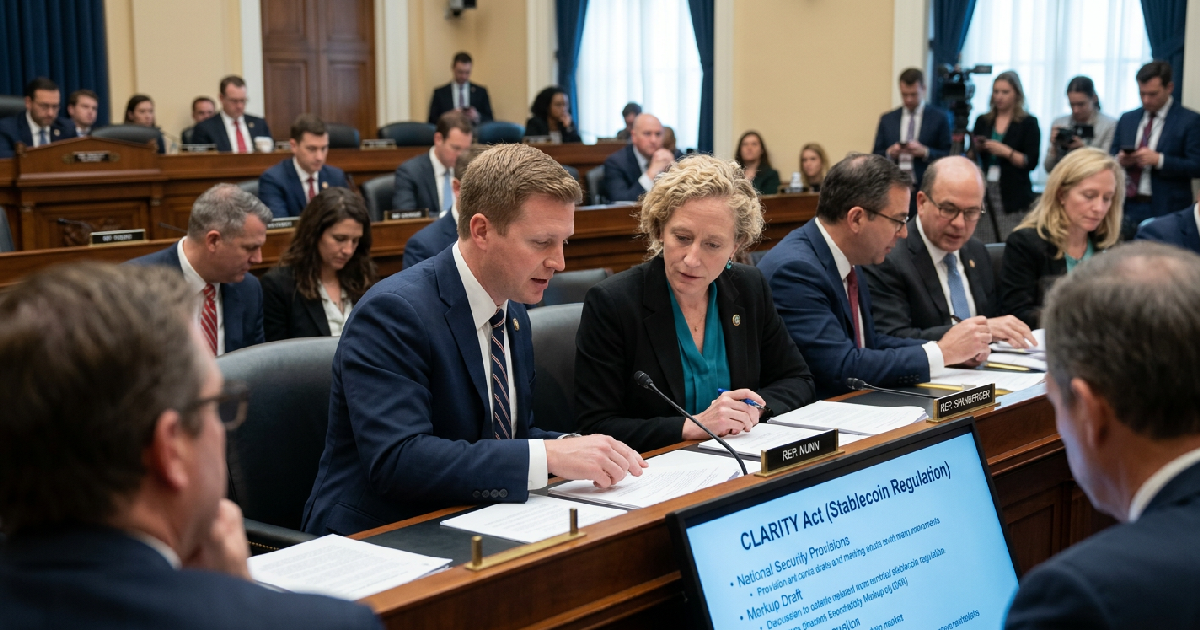

The House Financial Services Committee is expected to begin a critical review process for the CLARITY Act in the coming days, representing a major step toward defining the regulatory boundaries for the digital asset industry in the United States. Sponsored by Representative Zach Nunn and Representative Abigail Spanberger, the bipartisan bill aims to address national security concerns while providing oversight for stablecoins and blockchain infrastructure.
This session is a significant moment for proponents of the bill who have long argued that the lack of a clear legal framework hinders innovation and exposes the domestic economy to external risks. By advancing to the markup stage, the legislation enters a phase where committee members can debate, amend, and ultimately vote on the bill’s language before it potentially moves to the House floor for a full vote. The drive for legislative progress comes as Bitcoin leads crypto fund inflows as CLARITY Act hopes grow, suggesting that institutional investors are closely monitoring the political trajectory of the bill.
Industry advocates believe that formalizing these rules will provide the certainty required for traditional financial institutions to deepen their engagement with digital assets. But the path to a final vote remains complex as lawmakers balance national security interests with the need for technological growth. The committee is expected to scrutinize how the bill handles foreign influence in American digital infrastructure.
National Security and Stablecoin Regulation
At its core, the CLARITY Act focuses on mitigating the influence of foreign adversaries within the American digital ecosystem. The bill includes provisions that would reportedly prohibit federal employees from using certain foreign-developed blockchains and would mandate stricter reporting requirements for stablecoin issuers. These measures are designed to ensure that the U.S. dollar remains the dominant peg for global digital commerce in an increasingly multipolar world.
And while the focus remains on security, the bill also attempts to solve the long-standing jurisdictional dispute between the Securities and Exchange Commission (SEC) and the Commodity Futures Trading Commission (CFTC). By creating a defined category for “payment stablecoins,” lawmakers hope to move away from the “regulation by enforcement” approach that has characterized the last few years of the industry. This shift is seen as essential for the long-term outlook for tokens like XRP and other assets currently navigating legal uncertainty.
The timing of this legislative push is notable as other efforts face similar hurdles. For instance, the Senate Banking Committee has faced warnings of obstacles regarding stablecoin bill votes, highlighting a broader, yet fractured, congressional attempt to finalize crypto rules before the next election cycle. The lack of a unified approach between the House and Senate continues to be a point of concern for market analysts.
Market Sentiment and Internal Friction
Market participants have reacted with cautious optimism to the news of the upcoming committee activity. Traders are looking for signals that the bill can maintain its bipartisan support through the amendment process. Any significant watering down of the bill’s core provisions could dampen the recent momentum seen in digital asset markets as investors seek clarity on how decentralized networks will be governed.
But the road ahead is not without tension. Some consumer advocacy groups have raised concerns that the CLARITY Act might not go far enough in protecting retail investors from the volatility and potential de-pegging risks associated with private stablecoins. Conversely, some tech-heavy factions in the House argue that strict national security bans on specific blockchains could inadvertently stifle open-source development and drive talent to more permissive jurisdictions.
As the debate intensifies, it is clear that the outcome will impact more than just stablecoins. A successful committee vote would provide a template for how the U.S. handles decentralized technology more broadly. The result of these deliberations could influence the speed at which institutional capital enters the space.
What to Watch During the Committee Session
During the upcoming sessions, observers are expected to watch for specifically targeted amendments regarding the definition of “decentralization” and the timeline for implementation of the new rules. If the committee can navigate these hurdles without losing bipartisan consensus, the act could become one of the more significant pieces of financial technology legislation in recent memory.
The House Financial Services Committee, led by Chairman Patrick McHenry, has prioritized these digital asset bills as part of a departing legacy. Following the markup, the bill’s progress will depend heavily on the legislative calendar and the appetite of the Senate to take up a companion version of the act in the coming months. For now, the industry remains in a holding pattern, waiting to see if the proposed framework can survive the rigorous amendment process.