
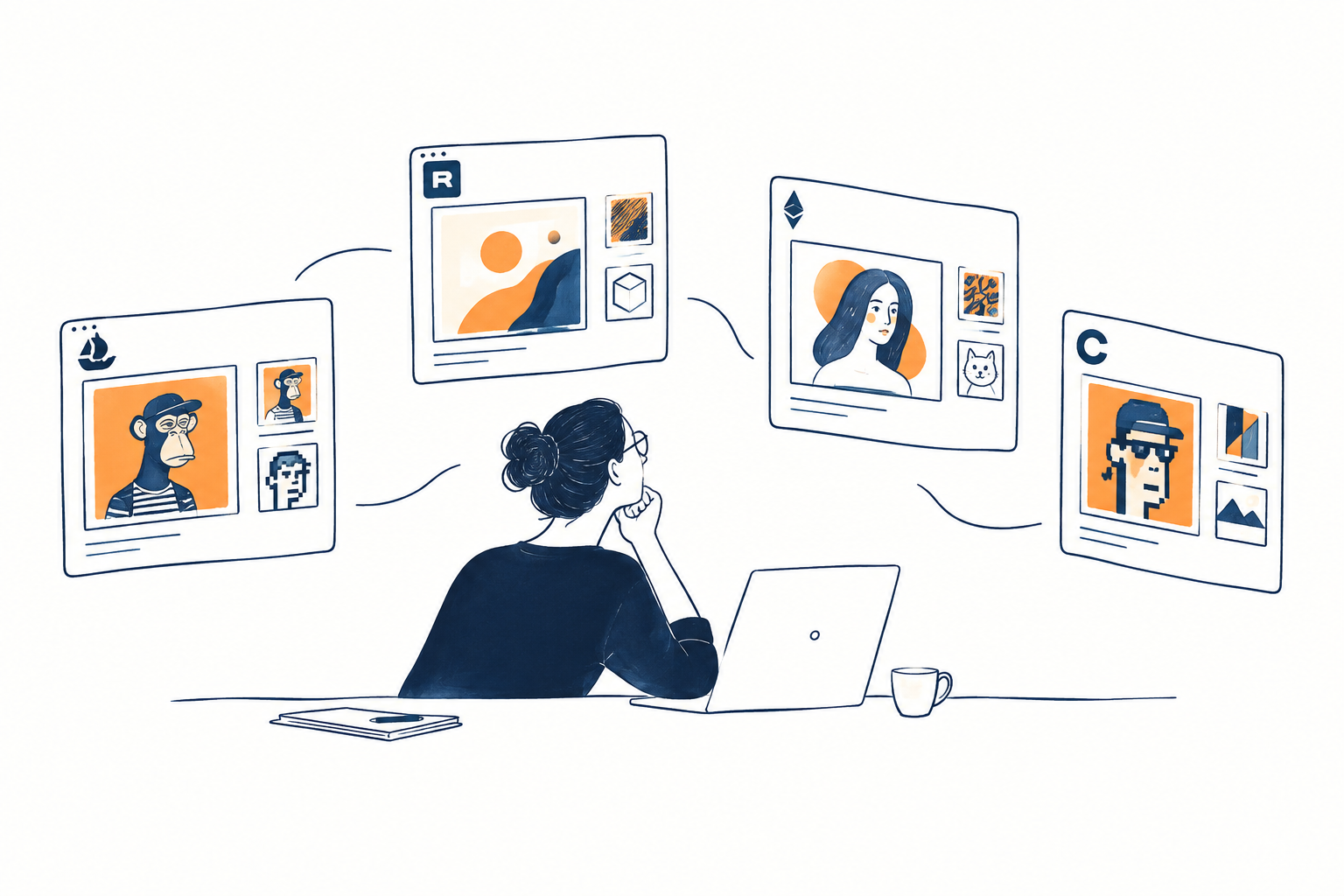

An NFT can be minted on a blockchain and still encounter a very different market depending on where it is listed.
One platform may look like a vast catalogue of digital collectibles. Another feels closer to a contemporary art gallery, with fewer works and more emphasis on the artist behind them. A third is built for people watching bids, prices and collection activity almost in real time.
They are all NFT marketplaces, but they are not trying to solve exactly the same problem.
Why NFT marketplaces can feel like different markets
At the most basic level, an NFT marketplace connects people who want to buy, sell or trade non-fungible tokens, unique blockchain-based assets that can represent digital art, collectibles, game items and other forms of ownership or access.
But the technology underneath is only part of the experience.
The interface determines what users see first. Search and filtering affect what they discover. Auctions, offers and fixed-price listings create different ways to negotiate. Ranking systems can push some collections into view while leaving others buried.
The audience matters, too.
A collector looking for a single digital artwork may care about the artist’s background and the story around a piece. Someone trading NFTs frequently may care far more about execution speed, market depth and tools for handling several purchases.
The marketplace, then, is not just the place where the transaction happens. It is part of the market around the NFT.
Three marketplace models help explain the difference
NFT platforms do not fit perfectly into fixed categories, and some increasingly overlap. Still, three broad models make the landscape easier to understand.
General-purpose marketplaces are designed for breadth. OpenSea and Rarible are useful examples because they bring together different kinds of NFTs and assets from multiple blockchain ecosystems. OpenSea currently supports a large range of networks, while Rarible also operates across multiple chains.
The attraction is obvious: one destination can offer a large amount of choice. The trade-off is that discovery becomes a filtering problem. With more collections, creators and listings competing for attention, finding a specific type of asset can require more work.
Curated digital-art marketplaces take a different approach. SuperRare positions its marketplace around curated digital artwork and collector discovery, giving the artist, the work and the surrounding presentation a more prominent role.
That changes the buying experience. Instead of navigating a huge catalogue primarily by price or collection, a collector may encounter the market through artists, exhibitions, profiles or curated selections.
Then there are trading-focused marketplaces. Blur explicitly positions itself for professional NFT traders and emphasises faster execution, portfolio tools and activity across marketplaces.
These platforms are designed around a different rhythm. The objective is less about browsing slowly and more about comparing bids and offers and executing transactions efficiently.
The models are not mutually exclusive. A marketplace can add new chains, change its interface or introduce new trading features without abandoning its original audience.
The important point is that the structure of the platform reflects the behaviour it wants to encourage.
The same NFT can experience a different market depending on where it trades
Suppose the same NFT is available through two platforms. The token and its ownership record on the blockchain have not changed. Yet the people who encounter it, the way it is presented and the tools available around the transaction may be completely different.
On a general-purpose marketplace, it might appear beside thousands of unrelated collections. Its visibility depends on search, filters, rankings and user activity.
On a curated art platform, the same work may be understood primarily through its creator, artistic context and relationship with other works.
On a trading-oriented platform, it may instead become part of a stream of prices, bids, offers and collection-level activity.
This can affect price discovery — the process through which buyers and sellers collectively establish the market price.
The NFT itself has not changed. The environment around it has.
That is why it is misleading to think of NFT marketplaces as interchangeable shop windows.
A bigger catalogue does not necessarily mean a more liquid market
There is an easy assumption that a marketplace with more NFTs must offer a better market. More listings appear to mean more choice, and more choice appears to mean more opportunities to trade.
But catalogue size and liquidity are different things.
Liquidity describes how easily an asset can be bought or sold without a large gap between the price a seller wants and the price a buyer is prepared to pay. In NFTs, that can be difficult because individual tokens are not identical.
A collection can contain thousands of NFTs while only a small fraction attract active demand. An item may have a listing price for weeks without finding a buyer willing to transact at that level.
That makes collection-level activity more informative than a marketplace’s headline number of listings.
A specialised marketplace can therefore have fewer assets while concentrating a more relevant group of buyers and sellers. A broad marketplace can offer enormous visibility without guaranteeing that any particular NFT will have a deep pool of demand.
For newcomers, this is one of the most useful distinctions to understand: the size of the shop tells you little about how easy it will be to sell what you own.
Fees matter, but they are not the whole cost
Marketplace fees are another visible difference, but focusing on a single percentage can give an incomplete picture.
An NFT transaction can involve marketplace fees, creator royalties and blockchain transaction fees, often called gas fees. The precise combination depends on the platform, the collection and the network used.
That means the price shown beside an NFT is not always the same as the total amount a buyer will spend.
For sellers, the reverse is true. The amount received after a sale can be affected by platform charges and any applicable creator payments.
The useful habit is to understand the full transaction cost before comparing platforms. Fees can change, which is another reason an evergreen article should focus on the structure rather than a permanent ranking.
The blockchain can narrow the choice before the marketplace does
An NFT also belongs to a particular blockchain ecosystem.
Ethereum has historically hosted a large share of NFT activity, while other networks have developed their own collections, communities and marketplaces. Some platforms now support multiple chains, but that does not make those ecosystems interchangeable.
The blockchain can affect transaction fees, wallet compatibility, speed and where a particular collection has the most activity.
For a buyer, the first question may therefore be simple: which blockchain is this NFT actually on?
That matters because a wallet or marketplace that supports one network may not automatically support another, and moving assets between ecosystems can require additional tools or transactions.
The marketplace is a layer of market infrastructure
A blockchain records ownership and transactions, but it does not by itself decide how people discover an NFT, which collections receive attention or how easily buyers and sellers find one another.
Marketplaces add that layer.
They create interfaces for discovery, mechanisms for listing and bidding, systems for displaying activity and, in some cases, tools designed for particular types of participants. Those choices can influence where liquidity gathers and how prices are formed.
A collector interested in digital art may value curation and artist discovery. Someone looking for a wide variety of collectibles may value breadth. A highly active trader may place more weight on execution tools and market activity.
The relevant difference is not simply which marketplace has more NFTs. It is what kind of market the platform has been designed to create.
The token may live on a blockchain, but the market around it is shaped by the platform where buyers and sellers meet.