
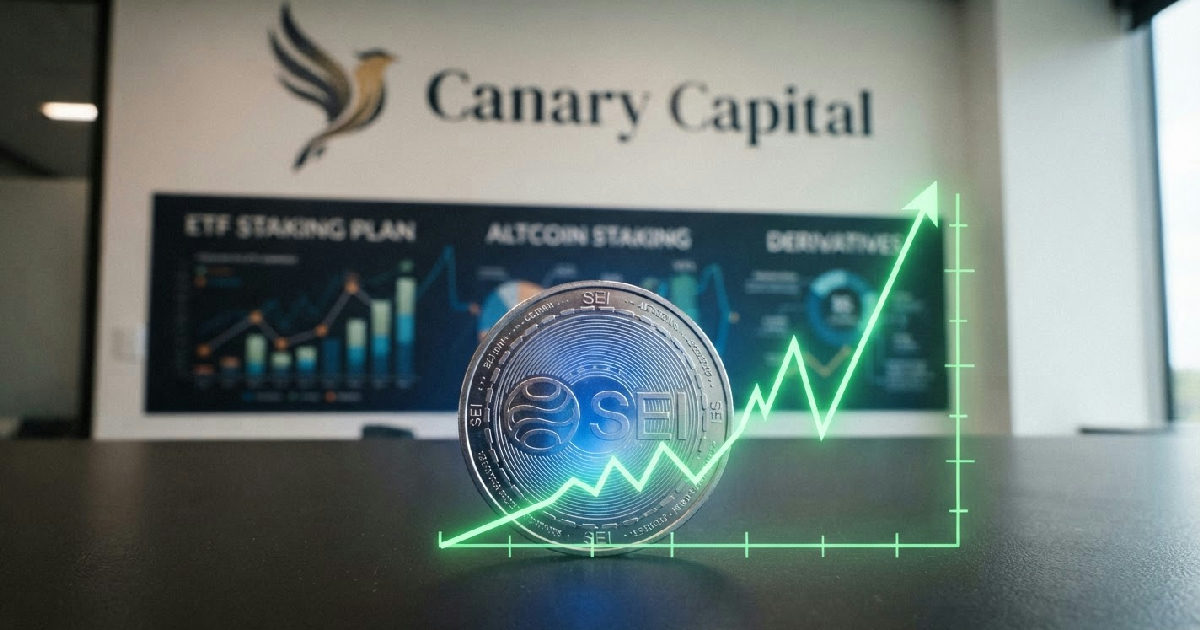

The SEI token has witnessed a sharp 25% price surge in the last 24 hours, climbing to $0.06285. This significant uptick follows news surrounding Canary Capital’s amended S-1 filing for a proposed Staked SEI Exchange Traded Fund (ETF).
The filing outlines a strategy to stake roughly 90% of the ETF’s SEI holdings, a move that could dramatically tighten the token’s liquid supply. This development has injected new momentum into SEI after weeks of trading below the $0.052 resistance level, signaling a potential shift from consolidation.
Canary Capital’s ETF and the SEI token surge
Canary Capital’s recent regulatory filing, Amendment No. 2 to its S-1 registration statement on September 21, 2026, details a plan that aims to fundamentally alter the supply-demand balance for the SEI token. The core of this amendment is the commitment to stake approximately 90% of the ETF’s SEI holdings.
This aggressive staking strategy means that a substantial portion of tokens acquired by the ETF would be removed from open circulation. Such a move is designed to reduce the available tradable supply, which, in theory, could amplify price responses to new demand. It creates a distinctive approach within the DeFi market.
The impact of this proposed structure is amplified by existing market conditions. Currently, about 4.2 billion SEI tokens, or approximately 42% of the total circulating supply of 10 billion, are already locked in staking. The ETF’s plan would add to this existing illiquidity, potentially creating a significant supply squeeze.
Moreover, all future staking reward payments associated with the ETF’s holdings will be reinvested directly into the fund. This mechanism is intended to increase the overall yield for investors, offering a compounding effect without the complexities of direct staking management.
Market Reaction and Valuation Concerns
The immediate market reaction to Canary Capital’s proposal was a substantial SEI token surge. The token’s price soared over 25% within 24 hours, breaking past the $0.052 resistance that had capped its value for weeks. This price movement was accompanied by a significant increase in trading activity.
Daily trading volume for SEI surged by 289% to $203.44 million, according to CoinMarketCap data. This volume spike suggests broader market participation beyond speculative interest, reflecting renewed confidence in the token’s prospects.
However, the rapid breakout has pushed SEI’s price well beyond its prior trading range, leaving minimal support above the $0.052 mark. The Relative Strength Index (RSI) climbed to 87.64, indicating that the token’s momentum has reached extreme overbought levels. This imbalance could make sustained gains challenging for buyers.
Maintaining the price above $0.052 will be crucial for validating the upward trendline. Should the price drop below this level, demand might struggle to absorb the selling pressure, potentially reversing recent gains. It underscores the delicate balance in staking mechanisms within rapidly moving markets.
Derivatives Activity and ETF Narrative
While the proposed ETF has generated considerable sentiment, activity in the derivatives markets continues to play a significant role in SEI’s current momentum. Open Interest (OI) for SEI futures currently sits near $95 million, with funding rates remaining moderately positive around 0.01%.
These figures suggest that many traders are positioning themselves for further price appreciation, indicating a bullish bias. Yet, derivatives markets can also amplify reversals, meaning that a sudden shift in sentiment could lead to exaggerated downward movements.
It’s important to note that the proposed ETF has not yet received regulatory approval, nor has it begun attracting actual capital inflows. The current premium in SEI’s price is largely driven by expectations surrounding the ETF, rather than direct demand from the fund itself.
A sustained rally would ideally be supported by a stronger shift toward spot trading, providing a firmer foundation for the token’s price. Without such underlying spot demand, any fading optimism about the ETF’s approval could prompt leveraged traders to exit their positions, putting substantial pressure on SEI’s recent gains.
Custody and Broader Implications for Altcoin ETFs
Canary Capital’s ETF proposal also designates BitGo as the sole custodian for its SEI holdings. This choice simplifies operational management for the fund, but it centralizes custody exposure, a factor that institutional investors will likely scrutinize carefully. Concentrated custody can introduce single points of failure, despite BitGo’s reputation.
This initiative from Canary Capital signals a growing trend within the broader cryptocurrency landscape: the increasing integration of altcoins into traditional financial products like ETFs. As more firms explore ways to bring diversified crypto exposure to mainstream investors, the structure of these products becomes critical.
The emphasis on staking within an ETF structure, as seen with Canary Capital’s proposal, could become a template for future altcoin ETFs. It represents an innovative approach to managing token supply dynamics while simultaneously offering yield generation. However, the regulatory path for such products remains complex.
The Securities and Exchange Commission (SEC) continues to deliberate on various cryptocurrency-related financial products. The approval of a staked altcoin ETF would mark a significant milestone, potentially paving the way for similar offerings across other proof-of-stake blockchain assets. Such approvals could redefine how institutions interact with the altcoin market.
While the immediate future of Canary Capital’s Staked SEI ETF depends on regulatory clearance, its filing has undeniably brought the SEI token into sharper focus. The rally demonstrates the market’s responsiveness to innovative financial structures that promise to manage supply and enhance yield, even if those promises are still contingent on future events.