
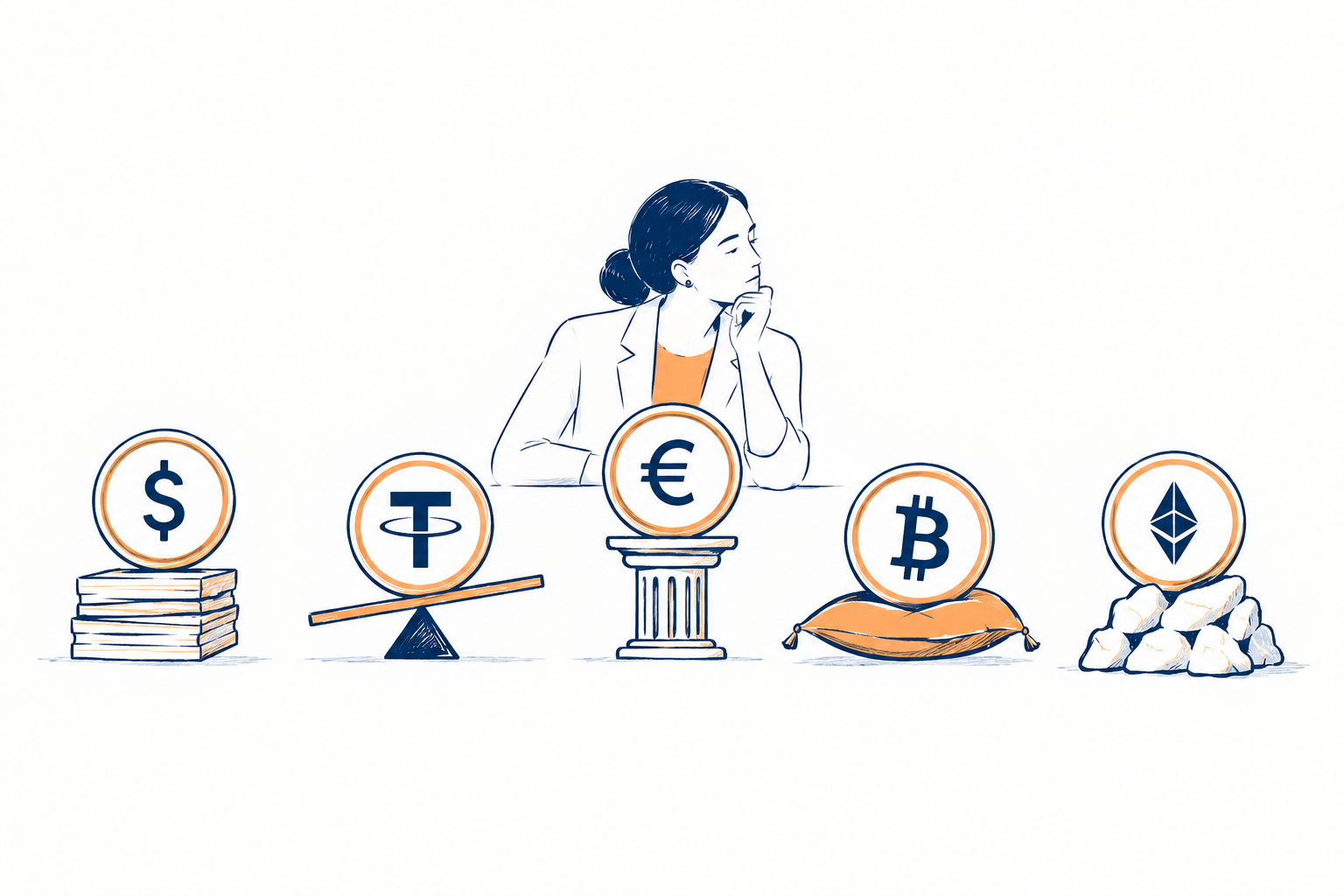

A stablecoin can look deceptively simple on a trading screen. US$1 goes in, US$1 comes out. Yet two tokens sitting at almost the same price can rely on entirely different machinery to keep it there.
One may be backed by cash and short-term government securities held by an issuer. Another may lock crypto assets into smart contracts and require more collateral than the value of the stablecoins created. A third may try to defend its peg through programmed supply changes and market incentives. There are also tokens tied to physical commodities such as gold.
When market conditions become difficult, the mechanism underneath the peg is what determines where the pressure appears in the different types of stablecoins.
A stablecoin can target the same dollar in very different ways
Most stablecoins aim to track a reference asset, usually the US dollar. The central challenge is keeping the token close to that reference while allowing it to move across blockchain networks and markets.
The broad categories are usually separated by what supports the token or how its peg is maintained.
Fiat-backed stablecoins rely on reserves of traditional financial assets. Crypto-backed stablecoins use digital assets as collateral, normally with an additional buffer. Algorithmic stablecoins use programmed rules and incentives rather than a conventional reserve structure. Commodity-backed tokens link their value to physical assets such as gold.
The distinction sounds technical, but it answers a practical question: what has to keep working for the token to remain close to its target?
Fiat-backed stablecoins put the reserve at the centre
This is the model most people encounter first. USDC and USDT are prominent examples of dollar-referenced stablecoins whose issuers maintain reserves intended to support the tokens in circulation.
The basic arrangement is straightforward. The issuer creates tokens and holds reserve assets designed to cover the corresponding liabilities. Those reserves can include cash, bank deposits and short-dated US government securities. Circle, for example, says USDC is backed by highly liquid cash and cash-equivalent assets, with the majority of its reserve held through structures including the Circle Reserve Fund.
The token itself lives on a blockchain. The reserve does not have to.
That creates an interesting trade-off. The structure can be relatively easy to understand because there is a conventional pool of assets behind the digital token. But users must also rely on the issuer, its banking and custody arrangements, the quality of the reserve assets and the information provided about them.
In other words, the blockchain may make the token transferable and auditable, but it does not automatically make the reserve transparent or risk-free.
This is also why “backed by dollars” should not be read as “guaranteed to behave exactly like cash”. The stability of the token depends partly on how the off-chain financial system around it functions.
Crypto-backed stablecoins put collateral under pressure
Crypto-backed models move more of the mechanism onto the blockchain.
Instead of a company holding enough traditional assets to match the tokens issued, users or protocols lock digital assets into smart contracts as collateral. Because assets such as Ether can fall sharply in price, these systems generally require more collateral than the amount of stablecoins created.
Imagine a protocol requiring 150% collateralisation. To generate US$100 of stablecoins, a user might need to lock US$150 worth of crypto assets. The additional buffer is there to absorb some of the collateral’s volatility.
DAI is a well-known example of a decentralised, collateral-backed stablecoin. Its underlying system allows users to generate DAI against approved collateral held in protocol vaults, with risk parameters determining how much debt can be created against each asset.
This design changes the risk rather than removing it.
If the collateral falls too quickly, the system may need to liquidate positions to protect the stablecoin. That makes the health of the protocol’s collateral, price feeds and liquidation mechanisms critical. A large market sell-off can put all three under stress at the same time.
The attraction of this model is that the rules and collateral can be managed through blockchain-based infrastructure rather than relying entirely on a central issuer. The cost is a more complicated system that has to manage volatility continuously.
Algorithmic stablecoins make demand part of the equation
Algorithmic stablecoins take a different route. Rather than relying primarily on a conventional reserve, they use smart contracts, token issuance and redemption rules, or other incentives to influence supply and demand around a target price.
The idea is elegant. If the token trades below its intended value, the mechanism changes the supply or creates incentives designed to push it back towards the peg. If it trades above the target, the process works in the other direction.
The difficult part is that the mechanism ultimately depends on people continuing to participate in it.
TerraUSD, or UST, became the clearest warning of what can happen when that confidence breaks. In May 2022, UST lost its dollar peg and the value of UST and related Terra assets collapsed. The US Securities and Exchange Commission later said the episode wiped out about US$40 billion in market value nearly overnight.
The lesson is not simply that algorithms are unreliable. It is that a stablecoin can depend on a functioning market for the very assets and incentives that are supposed to stabilise it.
That creates a particularly important distinction between transparency and resilience. A mechanism can be visible in code and still be vulnerable when users rush for the exit at the same time.
Commodity-backed tokens change the meaning of stable
Not every stablecoin tries to track a fiat currency. Some are designed to represent physical commodities held in reserve, with gold being the most recognisable example.
Pax Gold, or PAXG, represents one fine troy ounce of London Good Delivery gold held in professional vaults, according to Paxos. Its value therefore follows the market price of gold rather than staying fixed at US$1.
That makes “stablecoin” a slightly misleading label if it is interpreted as “an asset that never moves”. A gold-backed token can fluctuate because gold itself fluctuates.
What makes the structure interesting is the bridge between an off-chain asset and an on-chain representation. The holder gets a token that can be transferred using blockchain infrastructure, while the underlying value depends on the existence, custody and legal structure surrounding physical gold.
Once again, the token is only as straightforward as the arrangement supporting it.
The real difference between stablecoin types is where the risk sits
Comparing stablecoins by asking which one is “safe” misses the most useful part of the analysis.
The better question is where each model places its dependence.
With fiat-backed stablecoins, attention belongs on the issuer, reserves, custodians, banking relationships and redemption process.
With crypto-backed stablecoins, the key issues shift towards collateral quality, overcollateralisation, oracle pricing and liquidation.
With algorithmic designs, the mechanism depends more heavily on incentives, market demand and the ability of the system to function during a rush to sell.
With commodity-backed tokens, the important link is between the token and the physical asset — including custody, reserves and redemption arrangements.
The same $1 target can therefore hide very different failure points.
That is the central paradox behind the different types of stablecoins: reducing one form of dependence can introduce another. A model that relies less on a traditional issuer may need more collateral.
A model that avoids conventional reserves may become more dependent on market incentives. A token that puts a real-world asset on-chain still needs someone to hold that asset in the physical world.
So when a new stablecoin appears, the most useful question is not simply whether it is trading at $1.
Ask what supports that price, who controls the mechanism, and what is supposed to happen if a large number of holders try to leave at once.
The answer reveals the architecture — and the risk — behind the word “stable”.