
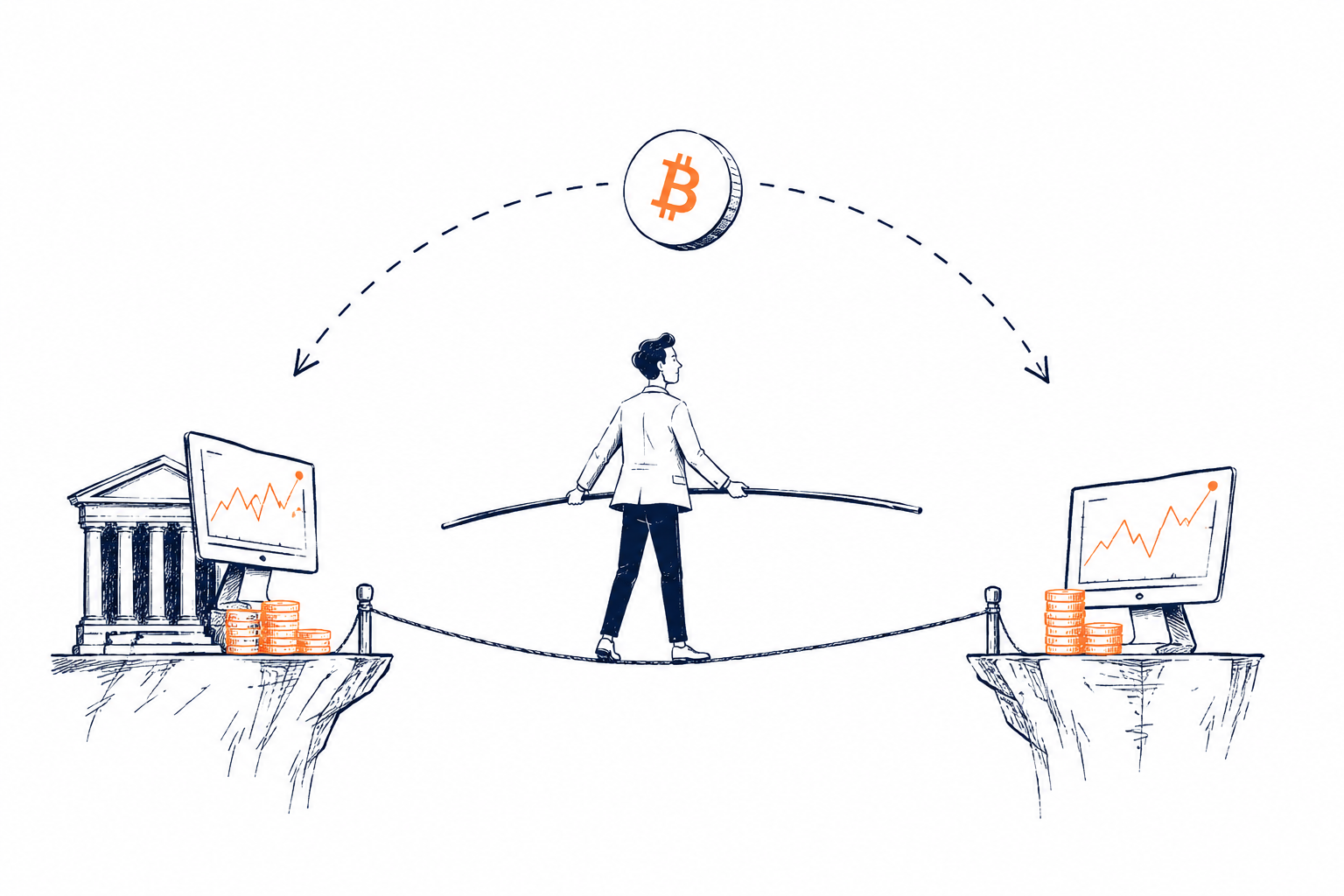

A Bitcoin trader sees two prices on two exchanges. One says $70,000; the other says $70,200.
At first glance, the opportunity seems almost embarrassingly simple. Buy on the cheaper exchange, sell on the more expensive one and keep the difference.
That basic idea is crypto arbitrage. The complication is that the $200 visible on the screen is not necessarily $200 of profit.
The prices shown by trading platforms are not guarantees that an order of any size can be executed at exactly that level. Fees, liquidity, slippage and execution speed can all change the result. That is why arbitrage is less about spotting a price gap than determining whether the gap is large enough, and available long enough, to actually capture.
The same Bitcoin can trade at different prices
There is no single exchange that sets a universal Bitcoin price.
Crypto assets trade across many centralised exchanges, decentralised exchanges and other venues. Each has its own buyers and sellers, trading volume, available liquidity and order book. Differences between those markets can therefore emerge even when they involve the same asset.
Suppose Bitcoin is available to buy for $70,000 on one exchange while traders are willing to pay $70,200 on another.
That $200 difference is a price discrepancy. An arbitrage trader attempts to exploit it by buying at the lower price and selling at the higher one, ideally at nearly the same time.
The idea is not unique to cryptocurrency. Arbitrage exists in traditional financial markets as well. Crypto simply provides an environment where assets trade continuously across a large number of fragmented markets, creating more opportunities for prices to temporarily diverge.
But seeing two different prices is only the beginning.
The price on the screen is not necessarily the price you get
Imagine that the cheaper exchange displays Bitcoin at $70,000. That does not necessarily mean you can buy 1 BTC for $70,000.
Perhaps only 0.05 BTC is available at that level. The next sellers are asking $70,050, $70,100 and $70,180. A larger market order would move through those offers, producing a higher average purchase price.
This is slippage: the difference between the price a trader expects and the price at which the trade is actually executed.
The same issue applies to the sale on the other exchange. A headline price of $70,200 is only useful if there is enough demand at that level to absorb the quantity being sold.
That makes the order book more important than the single price displayed at the top of an exchange interface. Liquidity determines how much can actually be traded without moving the market materially. Large orders in thin markets can experience significant slippage, reducing or even eliminating the apparent arbitrage opportunity.
The question, therefore, is not simply: “Where is Bitcoin cheaper?” but “How much can I buy at that price, and what price will I actually receive when I sell the same amount?”
That distinction is the heart of crypto arbitrage.
The real calculation happens after the trade begins
A price gap only becomes interesting when it survives the costs of capturing it.
A simplified way to think about the calculation is:
Price difference − trading fees − slippage − other costs = potential net result
Trading fees are the most obvious cost, but they are not necessarily the only one. Cross-exchange arbitrage may also involve withdrawal fees, blockchain transaction costs and currency conversion costs.
The timing of those costs matters too.
If a trader buys Bitcoin on Exchange A and then has to transfer it to Exchange B before selling, the arbitrage is exposed to whatever happens during that transfer. By the time the Bitcoin arrives, the original price difference may have disappeared.
That is one reason more sophisticated arbitrage operations may keep funds distributed across several platforms. Instead of waiting for Bitcoin to move from one exchange to another, the trader can use capital that is already available on both sides.
Kraken, for example, notes that traders looking to arbitrage may keep capital on platforms where opportunities are likely to appear, while also warning that leaving funds on centralised platforms introduces counterparty risk.
This solves a timing problem, but it creates another one: capital has to be allocated in advance, and funds sitting on an exchange carry their own risks.
Why an arbitrage opportunity can vanish before you capture it
Crypto arbitrage is extremely sensitive to execution speed.
Suppose one trader notices Bitcoin trading below its price elsewhere. They buy on the cheaper market and sell on the more expensive one. Their actions increase demand on the first exchange and supply on the second, pushing the two prices closer together.
Other traders, algorithms and market makers may be doing exactly the same thing.
The opportunity therefore contains a built-in paradox: the people trying to profit from the price difference are also helping remove it.
This is one reason large, highly liquid markets may offer fewer obvious discrepancies than a casual price comparison suggests. Competition tends to compress them quickly.
Execution can fail in smaller ways, too. The purchase may go through while the sale is only partially filled. One exchange may respond more slowly than expected. An API connection may fail. A withdrawal may be delayed.
In that situation, the trader can end up holding an asset they intended to sell immediately.
The position is no longer the clean, market-neutral trade that appeared on the spreadsheet.
Crypto arbitrage takes more than one form
The basic cross-exchange trade is the easiest version to understand: buy an asset in one market and sell it in another.
But the same principle can appear in other forms.
Triangular arbitrage looks for inconsistencies between three trading pairs on the same platform. Instead of moving between exchanges, a trader might exchange asset A for B, B for C and then C back into A. If the prices do not line up perfectly, the sequence may create a discrepancy.
There is also intra-exchange arbitrage, where differences can exist between related products on one platform. A common example is a relationship between spot and futures prices.
These strategies all follow the same underlying logic: two prices that should be closely related temporarily diverge.
The important point is that more sophisticated structures do not eliminate the basic problem. They can make execution even more demanding because several trades have to work together.
Where bots fit into crypto arbitrage
The speed required by arbitrage is one reason automation has become so closely associated with it.
A crypto arbitrage bot can monitor multiple markets, compare prices and submit orders automatically. That can be useful when an opportunity exists for only a short period and a human trader cannot reasonably react quickly enough.
But automation does not create the opportunity.
A bot cannot make an illiquid order book liquid. It cannot remove exchange fees. It cannot guarantee that both sides of a trade will execute. And it can introduce its own risks, including API failures or security problems if third-party software is given inappropriate account access.
In other words, a bot mainly solves the problem of speed and monitoring. The underlying economics of the trade remain unchanged.
Does crypto arbitrage actually carry less risk?
Crypto arbitrage is often described as lower risk than a trade based purely on predicting whether Bitcoin will rise or fall.
There is some logic behind that description. A trader attempting to buy and sell the same asset in different markets is less dependent on correctly forecasting its overall direction.
But lower directional exposure is not the same thing as low risk.
An arbitrage trade can still face liquidity problems, execution errors, exchange failures, transfer delays and unexpected costs. The clearest example is a failed second leg: if the trader buys Bitcoin but cannot complete the corresponding sale, they are temporarily exposed to Bitcoin’s price movement.
There is also platform risk. Capital held on an exchange is exposed to that platform’s operational and counterparty risks, while decentralised markets introduce a different set of considerations involving smart contracts, wallet infrastructure and liquidity pools.
Kraken explicitly describes crypto arbitrage as not risk-free and highlights issues including limited liquidity, withdrawal restrictions and execution speed.
The real opportunity is smaller than the price gap suggests
The most misleading part of crypto arbitrage is also the easiest to understand.
A trader can look at two exchanges and immediately see a difference. What takes more work is discovering whether that difference survives contact with the market.
Consider the $200 gap again.
If fees consume $60, slippage costs another $70 and the sale is partially executed, the apparent $200 opportunity has little resemblance to the final outcome. Add a transfer cost or delay and the economics can change again.
That is why professional arbitrage is fundamentally a problem of execution rather than simple price comparison.
The opportunity is not the difference between two numbers.
It is the difference between two executable prices after the costs and risks required to connect them.
And that helps explain the larger role arbitrage plays in crypto markets. When traders exploit price discrepancies, they push fragmented markets towards greater alignment. In decentralised markets, arbitrageurs can even help bring the price of a liquidity pool back in line with the wider market after trading moves it away from that level.
The irony is that a successful arbitrage trader is looking for an inefficiency that other traders are simultaneously trying to erase.
That is what makes crypto arbitrage both appealing and difficult. The interesting part is not finding Bitcoin at two different prices. It is proving that the difference is real, tradable and large enough to survive everything that happens between the two screens.