
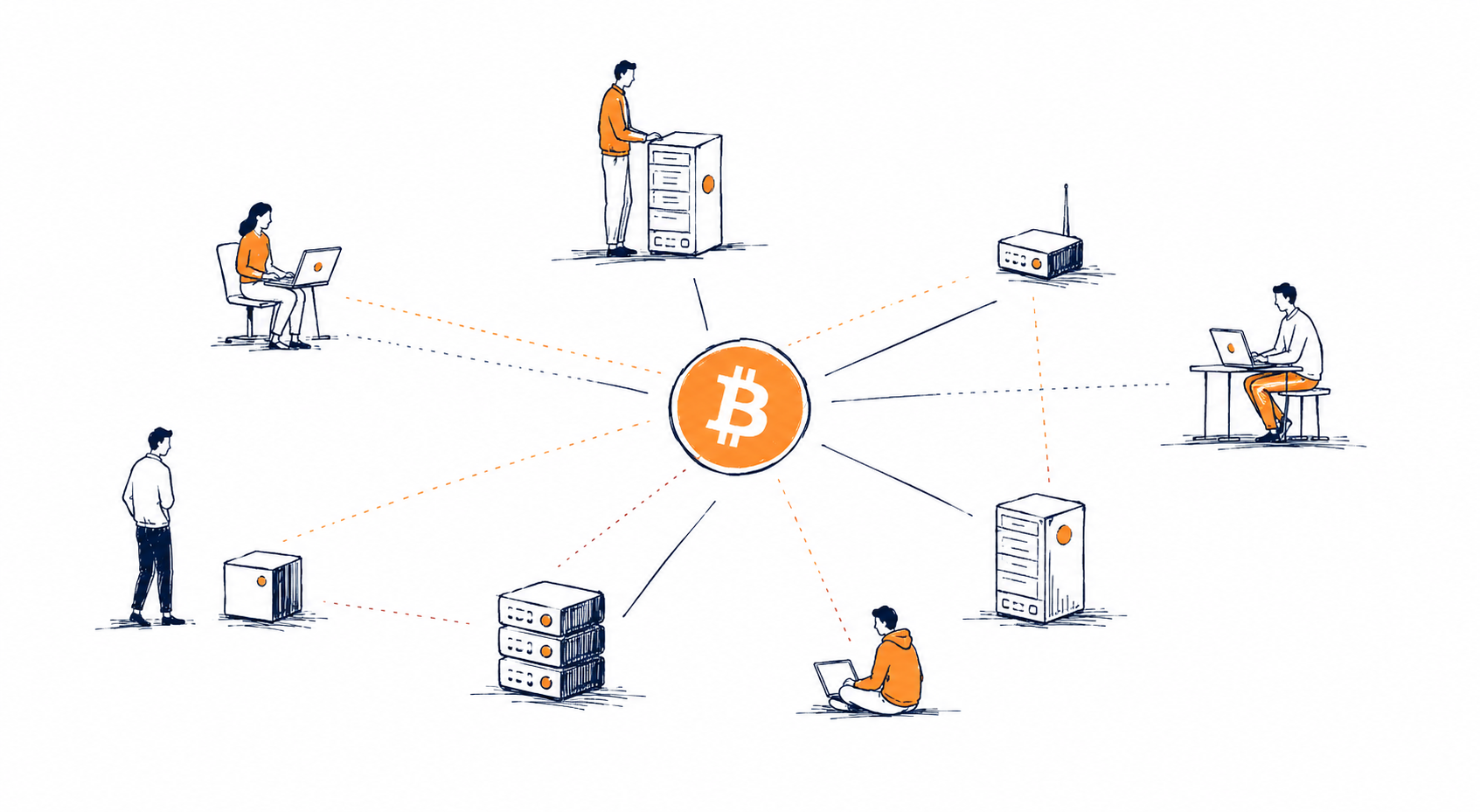

If Bitcoin miners produce new blocks, who decides whether those blocks actually follow the rules? The answer leads to one of the most misunderstood parts of the network: nodes.
A Bitcoin node is software that connects to the peer-to-peer network and handles blockchain data. But not every node stores or verifies information in the same way. Some independently validate the blockchain and retain large amounts of its history. Others reduce their storage requirements, while light clients make a different trade-off between convenience and verification.
Understanding the types of Bitcoin nodes matters because nodes are where Bitcoin’s rules are checked in practice. Mining adds a candidate block to the network; nodes determine whether that block is valid according to the rules they enforce.
Why miners do not have the final say over Bitcoin’s rules
It is tempting to think that miners control Bitcoin because they compete to produce the next block. Their role is important, but it is narrower than that.
Miners collect transactions and use Proof of Work to compete for the right to add a candidate block to the blockchain. Once that block is broadcast, other participants can check whether it is valid.
A full node does not have to accept a block simply because a miner spent enormous amounts of computing power producing it. It checks the block against Bitcoin’s consensus rules, including whether transactions have valid signatures, whether coins are being spent twice and whether the block follows the protocol’s rules for creating new bitcoin.
That distinction explains why “miner” and “node” should not be treated as synonyms.
A miner can run a full node, and many miners do, but running a full node does not mean mining. Someone can validate Bitcoin’s rules without competing to produce blocks.
That separation is one of the clearest ways to understand how Bitcoin avoids putting every decision in the hands of the participants with the greatest computing power.
Full nodes are the baseline for independent verification
Among the different types of Bitcoin nodes, the full node is the most important starting point.
A full node downloads blocks and transactions and independently verifies them rather than simply trusting a third party’s summary. It can also relay valid information to other nodes, helping maintain the peer-to-peer network.
This changes the user’s relationship with Bitcoin.
Checking a balance through an exchange or blockchain explorer means relying on that service to provide accurate information. A full node brings more of the verification process onto the user’s own machine.
That does not make a full node a magical source of truth. It still follows the software and consensus rules it is configured to use, and it receives information from other peers. Its important advantage is that it can independently reject data that does not comply with those rules.
This is why full nodes are closely connected to Bitcoin’s decentralisation. They allow participants to verify the network themselves rather than simply accepting whatever information a central service provides.
And there is an important nuance here: full node does not automatically mean “stores every Bitcoin block ever created”.
Pruned nodes reduce storage without giving up full validation
Storage is one of the practical barriers to running a node. Bitcoin’s blockchain contains a large and growing history of blocks, but not every node operator needs to keep all of that historical data locally.
This is where pruned nodes come in.
A pruned node is still a full node. It validates the blockchain, but after older block data has been processed, it can remove some of that historical information to reduce the amount of disk space required. Bitcoin’s developer documentation explicitly describes pruned nodes as full nodes.
The distinction matters because “pruned” can sound like a weaker version of a full node. It is better understood as a storage configuration.
The node still performs the core validation required to follow Bitcoin’s consensus rules. What changes is how much historical block data it keeps available afterwards.
For someone who wants to run their own node without dedicating substantial storage to the complete historical chain, that can be a useful compromise.
Archive nodes keep the blockchain’s history available
Archive nodes sit at the other end of that storage trade-off.
An archive node is a full node that keeps the complete blockchain history and can provide older blocks to other participants.
The practical difference between an archive node and a pruned node is therefore mainly about historical data.
Both are capable of validating Bitcoin’s blockchain. The archive node simply retains the historical record rather than discarding older block data after validation.
That distinction is worth spelling out because it prevents a common misconception: “full node” and “archive node” are not necessarily competing categories.
In fact, an archive node is a type of full node, and a pruned node is also a type of full node.
The real difference is how much history the node keeps.
Light clients make a different trade-off
Not every device has the resources — or the need — to download and independently validate the complete blockchain.
Light clients use a different verification model. One example is Simplified Payment Verification, or SPV, which was designed to allow clients to work with much less blockchain data than a full node. Bitcoin’s technical documentation distinguishes full-node validation from SPV clients for precisely this reason.
Instead of downloading and validating the entire chain locally, a light client can rely on information obtained from full nodes, including block headers.
The trade-off is straightforward: lower storage and processing requirements in exchange for less independent verification.
For a smartphone or another resource-constrained device, that can be a sensible design choice. But a light client cannot reproduce the same level of local validation as a full node because it does not hold and check the full blockchain in the same way.
So “light” does not mean “bad” or “insecure by definition”. It means the user is choosing convenience and lower resource requirements over maximum local verification.
The most independent node is not always the most practical one
Once the different categories are placed on the same map, the choice becomes easier to understand.
A full node is the natural option for someone who wants to verify Bitcoin independently. A pruned full node offers that core validation while reducing storage demands. An archive node keeps the complete historical record available. A light client requires fewer resources but depends more heavily on other nodes for information.
There is no universal winner.
The useful question is not which type sounds most powerful, but how much of Bitcoin’s data and rules do you want to verify for yourself?
That is also why node terminology can become misleading. The labels describe different technical arrangements, but the underlying issue is really one of verification.
The bigger issue is not where Bitcoin is stored, but who can check it
The different types of Bitcoin nodes reveal a broader trade-off inside the network.
More complete infrastructure gives a participant greater ability to verify Bitcoin locally, but maintaining more data requires more storage and technical resources. Lighter systems reduce those costs, but increase reliance on other participants.
This creates a tension that is easy to miss when decentralisation is discussed only in terms of the number of miners.
Bitcoin does not require every user to operate an archive node. What matters is that independent participants can verify the rules and communicate valid information across the network.
That brings us back to the distinction between miners and nodes.
Miners compete to produce the next block. Full nodes check whether that block is actually acceptable. Pruned nodes perform that validation while retaining less historical data. Light clients participate with a smaller local footprint by relying more heavily on other nodes.
For anyone trying to understand how Bitcoin can function without a central administrator, that is the part worth remembering.
The blockchain is not decentralised simply because thousands of computers hold copies of it. Its deeper strength comes from the fact that participants can independently check whether the network is following its own rules — and they do not all need to trust the same intermediary to tell them what those rules mean.