
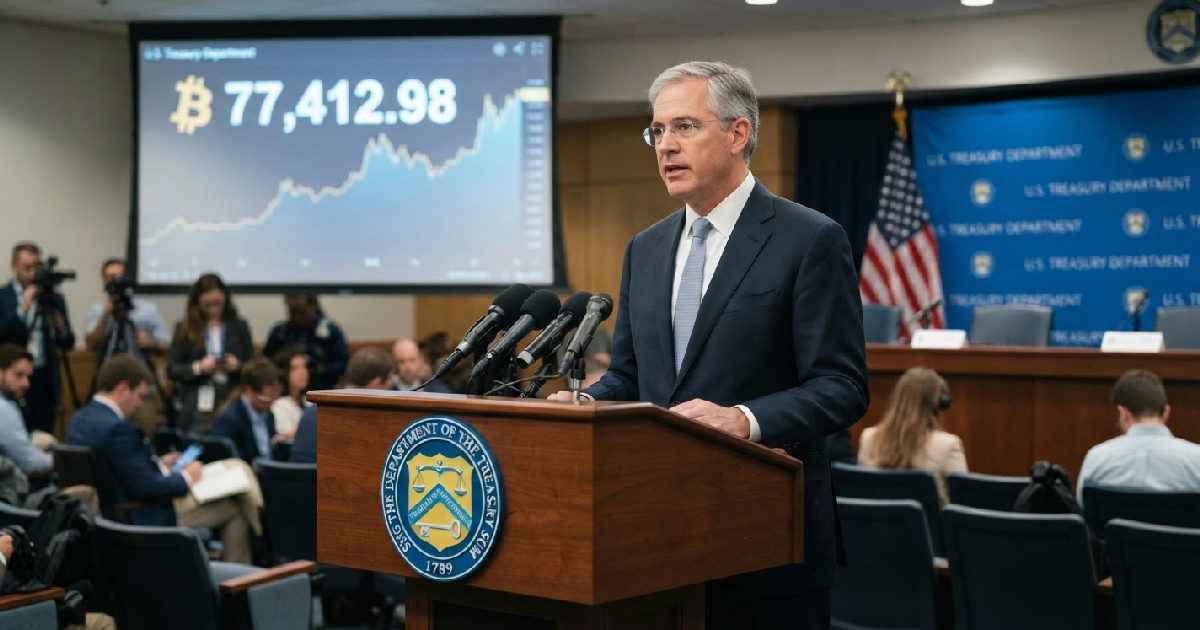

US Treasury Secretary Scott Bessent on Sunday, August 23, 2026, declared an “economic D-Day” against Iran, setting the stage for what he termed “the single greatest financial offensive ever marshalled against an adversary.” This aggressive new posture by the United States aims to sever Iran’s economic lifelines.
Meanwhile, Bitcoin has demonstrated notable resilience, holding above the $77,000 mark early on August 24, 2026, amidst the escalating geopolitical tension.
Treasury Secretary Scott Bessent pressures Iran
Bessent outlined the offensive in an opinion piece for the Financial Times and on the social media platform X, stating that the objective is to isolate the Iranian regime until “Tehran stands alone.” This significant move comes with a stark warning: any nation providing financial support to Iran will face “tremendous economic consequences” and risk becoming a “global pariah.”
The “economic D-Day” officially began at dawn on Monday, August 24, 2026, with specific measures expected to be announced later today at 14:00 ET (18:00 GMT). Secretary Bessent also plans a news conference in Israel at 8 p.m. local time. This coordinated offensive seeks to utilize “every agency, every authority and action” available to the US administration.
President Donald Trump, according to Bessent, has already “dismantled Iran’s military capabilities, destroyed nearly 100 percent of its military factories, and buried its nuclear program.” Bessent added that the US is “now entering the endgame,” suggesting a final push to cripple the Iranian economy. He claimed that President Trump has already “decimated Iran’s economy” to historic levels of weakness and inflation.
The Iranian Secretary of the National Security Council, Mohsen Rezaee, quickly responded to the US declaration. He warned that if the “economic war” persists, Tehran would halt all oil exports from the Gulf, including critical passages like the Strait of Hormuz. Rezaee also stated that Iran would consider any country supporting US sanctions as having committed “an act of war,” raising concerns about regional stability.
Bitcoin defies geopolitical turbulence
Against this backdrop of heightened international conflict, Bitcoin has shown a surprising level of stability. Early Monday, the leading cryptocurrency traded around $77,370.40, according to FXEmpire, and $77,388.53 per CoinStats. This holds a critical psychological level above $77,000, suggesting that global tensions might not be immediately translating into widespread crypto sell-offs.
Bitcoin’s recent price action has been volatile but generally upward trending before this latest geopolitical development. The asset surged past $76,000 and even approached $80,000 by August 21, 2026. Its peak in mid-May 2026 saw prices around $82,700, though it did dip to $57,950 on July 1, marking its lowest in 21 months.
The cryptocurrency had stabilized in the low-to-mid $60,000s, specifically around $64,000, throughout early August. Then, from August 19-20, Bitcoin experienced an approximate 8% overnight jump, pushing it above $69,000 and briefly touching $71,500. This resilience suggests underlying demand, possibly from institutional players.
Institutional interest supports prices
Recent data underscores this institutional appetite, with Bitcoin ETFs attracting a substantial injection of $608 million in a single day. This steady inflow helps buffer the market against broader economic or political shocks. Many investors view Bitcoin as a potential hedge against traditional financial instability, particularly during periods of geopolitical uncertainty.
But the market isn’t without its skeptics. While some analysts project significant upside, others caution that the rally could be premature. Still, Polymarket prediction data suggests a 60.7% chance Bitcoin reaches $80,000 by August 2026, and a 64.5% probability of maintaining $75,000 support, indicating a generally bullish short-term outlook.
Broader market sentiment and outlook
While the focus remains on the “economic D-Day” and Bitcoin’s reaction, the wider US economic landscape also plays a role in market sentiment. The July PCE price index is projected to rise by 0.1% month-on-month, following a 0.1% decline in June. The annual PCE rate is forecast at 3.6%, slightly down from 3.7%.
Core PCE, excluding food and energy, is expected to increase by 0.2% from the prior month, with an annual forecast of 3.3%. These inflation metrics often influence Federal Reserve policy and, by extension, the broader investment environment, including crypto markets. For some, Bitcoin offers a hedge against global debt crisis concerns, adding to its appeal.
Looking ahead, the US Senate left for recess on August 8, 2026, without a floor vote on the CLARITY Act, which could bring further regulatory clarity to the crypto space. A vote is now scheduled for September 15, 2026.
This legislative timeline means market participants are awaiting further guidance on how digital assets will be regulated, even as Bitcoin climbs past $69,000 on other macro factors.