
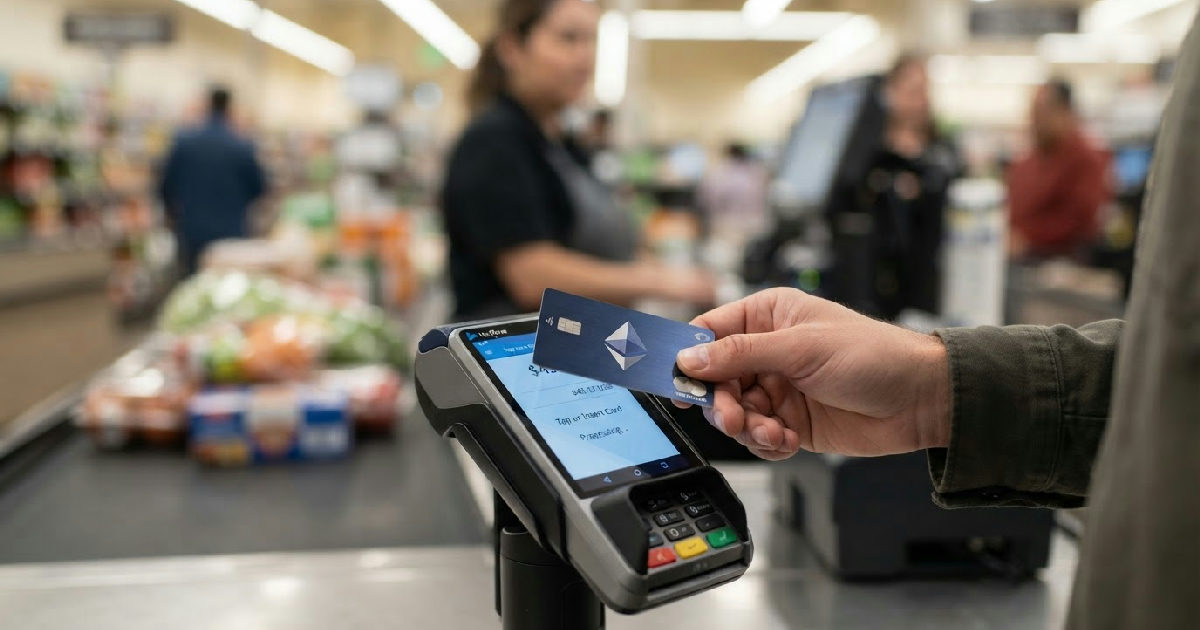

Crypto card spending has surged past the $1 billion mark, reaching an impressive $1.04 billion in July 2026. This monumental leap represents more than a threefold increase year-over-year from $306 million in July 2025.
The significant growth signals a profound shift in how digital assets integrate into daily commerce. It’s overwhelmingly fueled by dollar-backed stablecoins, which now underpin 70% of the over 10 million transactions tracked last month.
Stablecoins solidify their role in everyday crypto card spending
Dollar-backed stablecoins have emerged as the preferred funding mechanism for crypto card users. This trend clearly demonstrates their growing utility beyond mere speculative trading.
In July, USDC alone accounted for 50.8% of the total spending volume, while USDT contributed another 20.3%. This marks a notable rise in USDT’s transactional prominence, up from roughly 7% of volume just a year ago.
Such figures underscore a clear trend: stablecoins are transitioning from digital dollar holdings to practical, transactional currencies. They are increasingly used for routine purchases like groceries, ride-hailing services, and various subscriptions.
These cards effectively bridge the gap between blockchain assets and traditional retail infrastructure. They allow users to spend digital funds wherever conventional payment networks are accepted, with real-time conversion to local fiat currency at the point of sale.
Key stablecoins and card providers leading the charge
The stablecoin market shows a clear preference for specific assets, concentrating the lion’s share of activity in a few key players. While many stablecoins exist, USDC and USDT dominate this rapidly expanding payment sector.
Similarly, the ecosystem of crypto card providers is expanding but with significant market concentration. A handful of platforms are handling the bulk of the transaction volume, driving much of this recent growth. RedotPay, EtherFi, and KAST together accounted for approximately 77% of the tracked total in July.
RedotPay, for example, generated $395.1 million of July volume, and its customer base has grown over 33% in the past six months to exceed 8 million users. EtherFi generated $100.3 million of July volume, a substantial increase from below $10 million in July 2025.
Other prominent card providers include Binance, Kraken, Gnosis Pay, and BitPay. BitPay, described as the first major US crypto card, accepts payments wherever Mastercard is accepted. These platforms are crucial for facilitating the growing adoption of digital asset use in daily life.
StraitsX, a Visa partner, reported a 40-fold increase in transaction volume on its card infrastructure between Q4 2024 and Q4 2025. This underscores the rapid scaling of these services. EtherFi CEO Mike Silagadze confirmed that their $100.3 million represents card purchase volume.
The infrastructure supporting increased crypto card usage
The operational backbone for this burgeoning sector relies heavily on existing payment infrastructure and increasingly on scalable blockchain solutions. Traditional financial players like Visa are crucial enablers of this expansion.
Visa stated in June 2026 that it had more than 160 stablecoin-linked card programs globally. These programs are either already live or currently under development. This extensive network provides the necessary rails for stablecoins to flow into the mainstream financial system.
Meanwhile, underlying blockchain networks are evolving to handle this increased transaction load. Optimism, an Ethereum Layer 2 solution, processed approximately 29% of tracked crypto card spending in July. This highlights its role in facilitating efficient transactions.
Solana and Base, another Ethereum L2, each carried about 19% of the volume. This data clearly highlights the shift towards more efficient, lower-cost chains for everyday transactions. Gnosis accounted for about 2% of the volume.
Why everyday spending matters for crypto adoption
This surge in everyday crypto payments signifies a maturation of the digital asset space. It moves crypto beyond mere speculation and into practical utility for consumers. Thomas Gregory, VP of Payments and Fiat at Binance, told CoinDesk that “The real measure of crypto’s progress is not simply how many people own digital assets, but how useful those assets become in everyday life.”
Latin American markets are particularly illustrative of this trend. In Brazil, Oobit users averaged about 20 transactions monthly. Grocery spending accounted for 35% of local activity, showing real-world utility.
Argentine users similarly favored stablecoins, with 72% of Oobit payments made using USDT and 41% for food items. This demonstrates a clear need for reliable value storage and spending in regions facing economic volatility and illustrates broader market movements.
StraitsX further confirmed this pattern, reporting a 600% increase in gross transaction value in lower-GDP markets between March 2025 and February 2026. This compares to a 150% rise in higher-GDP markets, suggesting stablecoin-funded cards provide significant benefits where traditional financial systems may be less stable or accessible.
Bridging the gap between holding and spending
Despite the rapid growth in crypto card spending, a notable disparity still exists between the volume of stablecoins held and the amount spent. Coinbase, for instance, holds $20 billion of USDC across its products.
A Coinbase spokesperson also indicated that about 16% of combined transaction volume across its credit and debit cards involved USDC. This suggests that for many users on larger platforms, stablecoins still serve primarily as a store of value or for larger transfers, rather than immediate daily expenditures. This nuance is crucial for understanding the full scope of adoption for self-custody solutions.
Still, the direction of travel is clear: crypto companies and payment networks are continuously refining products to make spending stablecoins as seamless as possible. StraitsX CEO Tianwei Liu told CoinDesk that “The underlying stablecoin balance is increasingly just another way to fund a familiar card experience,” normalizing digital asset use in daily life.