
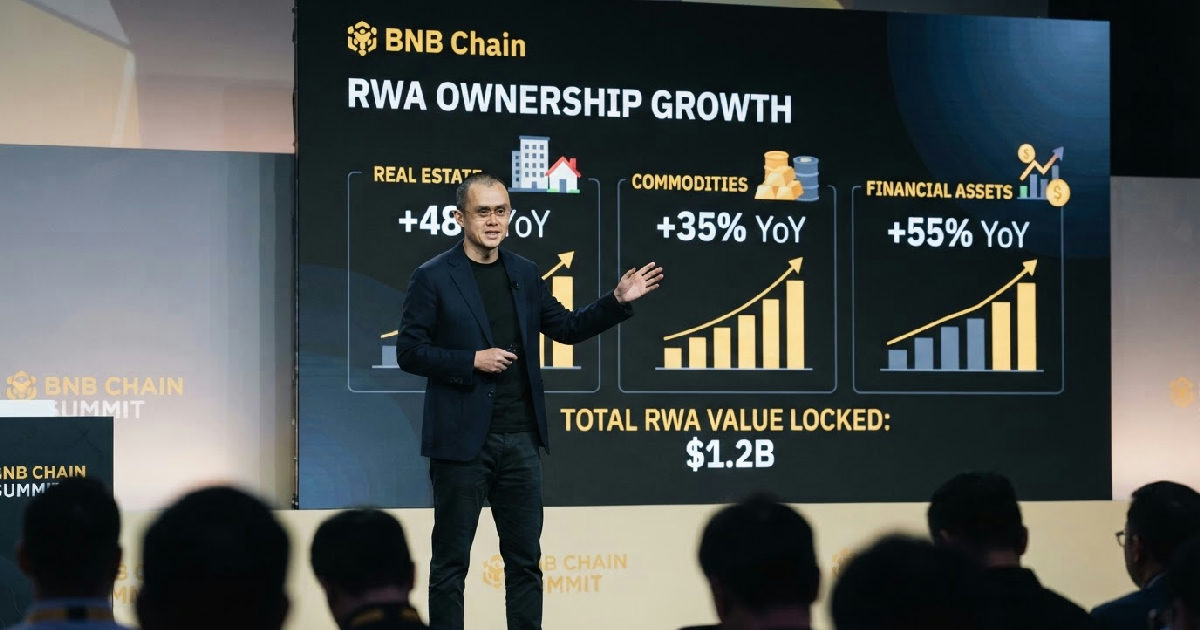

BNB Chain has seen a significant surge in tokenized real-world asset (RWA) ownership, with Binance founder Changpeng Zhao (CZ) advocating for the tokenization of “everything” on 2026-08-21. This rapid expansion positions BNB Chain as a leader in the nascent RWA space, attracting nearly 776,000 holders as of August 19, 2026, according to RWA.xyz data.
The network has experienced a remarkable 320% increase in tokenized asset holders over the past 30 days, signaling a growing appetite for blockchain-backed traditional assets. This momentum aligns with CZ’s long-term vision for crypto, where he sees tokenization as a critical mechanism for countries to secure foreign direct investment (FDI) and raise capital.
BNB Chain RWA ownership growth
The growth figures for BNB Chain’s RWA segment are compelling. Over the last 30 days, the number of tokenized asset holders on the network climbed by 320%, pushing the total close to 800,000. This places BNB Chain at the forefront of tokenized asset ownership, surpassing platforms like Robinhood and Solana in this specific metric.
This isn’t just a steady climb; it’s an acceleration. BNB Chain crossed the 300,000 RWA holder threshold around August 6-8, 2026, then quickly surpassed 400,000 less than a week later. Between August 14 and August 17, the chain added another 124,000 holders in just 72 hours, averaging 1,700 new RWA participants hourly.
Despite leading in holder count, BNB Chain still trails in Total Value Locked (TVL) for RWAs. Ethereum currently dominates RWA TVL with $16.52 billion, whereas BNB Chain sits in second place with $5.64 billion. This distinction highlights the difference between broad participation and the value of assets being tokenized across networks.
CZ’s vision and the drive for tokenization
Binance founder Changpeng Zhao publicly endorsed the widespread adoption of tokenization, stating on 2026-08-21 that “Let’s tokenize everything.” He emphasized his belief that “Tokenization is one of the best ways for countries to ‘raise money’ or attract FDI (Foreign Direct Investment).”
CZ acknowledged potential challenges, particularly “liquidity fragmentation,” which can arise when assets are tokenized across numerous blockchains and platforms. However, he posited that this issue can be mitigated through “interchangeability amongst different issuers,” suggesting a need for greater interoperability within the RWA ecosystem.
BNB Chain is building out a comprehensive infrastructure to support this vision. It offers compliant issuance mechanisms, on-chain settlement capabilities, and access to DeFi liquidity. The chain is designed for institutional-grade speed, boasting sub-second finality at a low transaction cost of $0.001 per transaction, all while maintaining EVM compatibility.
The platform also integrates crucial regulatory and security features. These include built-in Know Your Customer (KYC) and Anti-Money Laundering (AML) controls, alongside investor whitelisting for compliant token issuance. Furthermore, it supports institutional custody solutions via Ceffu and Fireblocks, addressing critical concerns for mainstream financial institutions.
This push for tokenization aligns with broader sentiments from traditional finance leaders. Larry Fink of BlackRock, for instance, echoed a similar perspective in his 2025 Chairman’s Letter, asserting that “Every stock, every bond, every fund, every asset can be tokenized.”
Competitive landscape and revenue generation
While BNB Chain demonstrates strong growth in RWA holder numbers, the overall market for tokenized real-world assets remains competitive. Canton Network, a privacy-enabled blockchain for regulated financial markets, currently leads the RWA tokenization segment with an impressive 79% market share. Canton also reported $11 million in revenue over the past seven days, underscoring its significant presence in institutional finance.
BNB Chain, for its part, holds tokenized stocks valued at $884 million, outpacing Ethereum’s $683 million in the same category. In terms of recent revenue, BNB Chain generated $4.5 million in the past week, placing it fifth among blockchain platforms and accounting for 12% of overall blockchain revenue within the RWA sector. This illustrates BNB Chain’s growing economic footprint in the space.
The appeal of RWA tokenization lies in its fundamental benefits. It promises to unlock liquidity in traditionally illiquid markets, allowing for fractional ownership and 24/7 trading. This transparency, security, and cost efficiency reduce issuance and transaction costs, making investments more globally accessible and programmable through smart contracts.
BNB token performance amid RWA momentum
The rising RWA adoption on BNB Chain comes as the BNB token itself has seen upward price movement. The altcoin was up 10% in the week leading up to August 21, 2026, benefiting from broader positive sentiment in the crypto market, driven in part by Bitcoin’s general uptrend.
However, technical indicators suggest caution. The Relative Strength Index (RSI) for BNB has entered the overbought zone, typically indicating that an asset may be due for a price correction. The token’s price also reached just shy of its 2026 range high of $686, suggesting strong resistance at that level.
Market sentiment appears mixed among some market participants. Any further significant rally for BNB will likely hinge on Bitcoin’s continued price momentum and broader market conditions.
Outlook for real-world asset tokenization
The push by Changpeng Zhao and the demonstrable growth on BNB Chain underscore a significant trend: the increasing convergence of traditional finance with blockchain technology through RWA tokenization. As more institutions like Franklin Templeton, BlackRock, and VanEck actively tokenize assets on BNB Chain, the ecosystem is broadening beyond cryptocurrency natives.
This expanding ecosystem is crucial for attracting Foreign Direct Investment, as CZ articulated. By offering a more efficient, transparent, and globally accessible method for asset ownership and transfer, tokenization stands to reshape how countries and companies raise capital. The ability to fractionally own assets also lowers barriers for a wider pool of international investors.
While fragmentation remains a valid concern, the solutions proposed by CZ, focusing on interchangeability and robust on-chain infrastructure, are central to overcoming these hurdles. The ongoing innovation from platforms like BNB Chain, coupled with the participation of major financial players, suggests that real-world asset tokenization is poised for continued, albeit evolving, growth.