
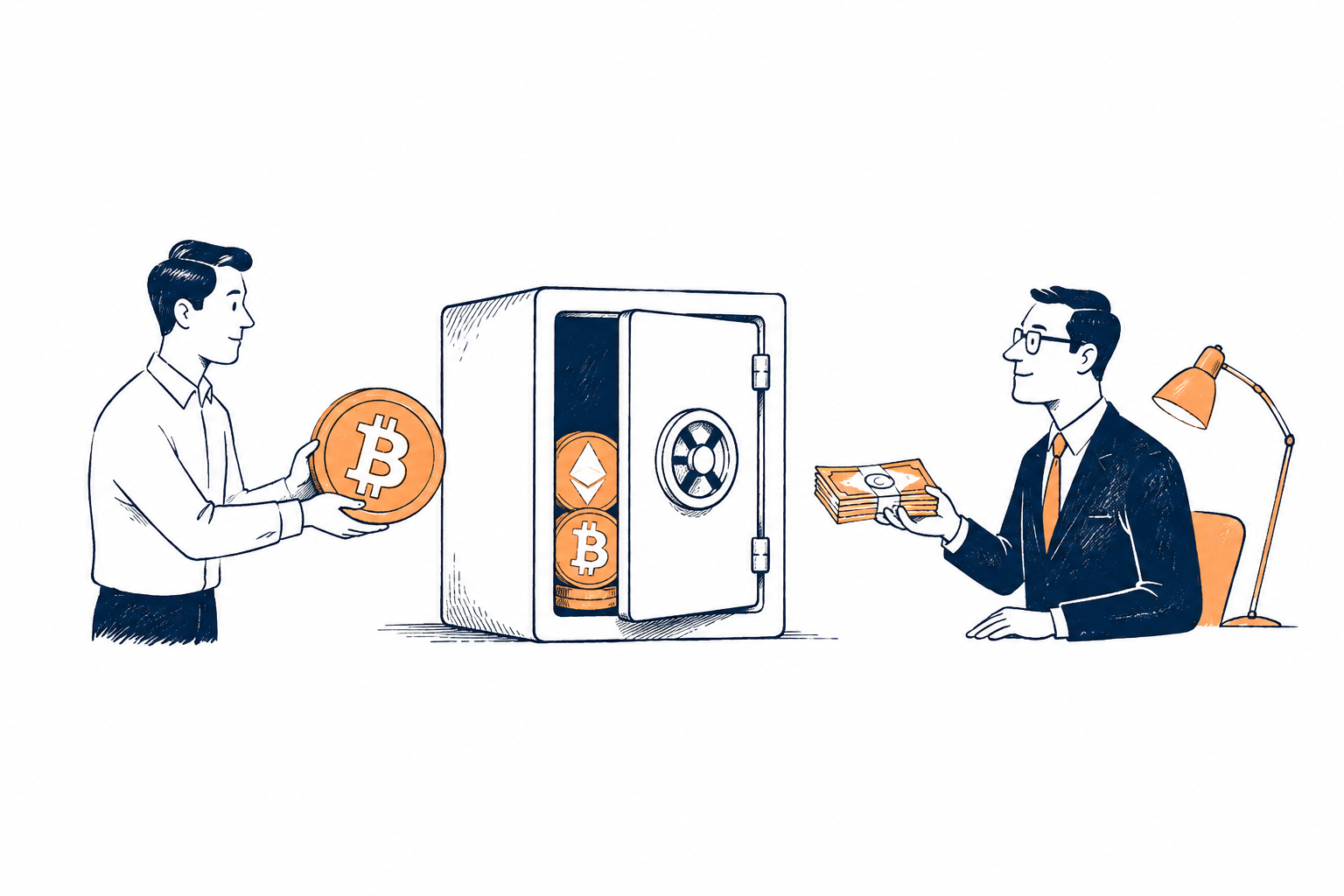

Need cash, but do not want to sell your Bitcoin? That is the basic problem crypto-backed loans are designed to solve.
Instead of selling an asset for cash, a borrower uses Bitcoin, Ether or another accepted cryptocurrency as collateral and takes out a loan against it. The attraction is straightforward: you get liquidity while keeping exposure to the asset.
But that does not mean the risk of selling has disappeared.
The fitting question is what happens when the value of the collateral falls while the debt remains. That is where loan-to-value, or LTV, becomes central — and where a crypto-backed loan starts to behave very differently from a conventional sale.
Your crypto becomes collateral, not cash
The basic structure resembles secured lending in traditional finance. A borrower provides an asset that protects the lender if the debt is not repaid. In crypto-backed lending, that asset is digital.
The amount borrowed is normally lower than the value of the cryptocurrency used as collateral. This gives the lender some protection against price volatility.
Imagine you have US$50,000 worth of Bitcoin and borrow US$20,000 against it. Your initial loan-to-value ratio is 40%.
LTV is simply the loan amount divided by the value of the collateral. It is one of the most useful figures for understanding a crypto-backed loan because it changes as the market moves.
The Bitcoin does not become less volatile because it has been pledged. Its price can still rise or fall sharply. What changes is the consequence of those movements: part of your crypto holdings is now supporting a financial obligation.
Depending on the agreement, the collateral may also be locked or held by a lender or custodian until the debt is repaid.
LTV is where the market price starts to matter
Take the same US$50,000 of Bitcoin and US$20,000 debt.
If Bitcoin falls by 20%, the collateral is now worth US$40,000. The debt, meanwhile, remains US$20,000, before interest and other costs. The LTV has therefore risen from 40% to 50%.
The borrower has not taken on more debt. The change comes from the falling value of the collateral.
That is the key mechanic behind crypto lending risks.
A lower starting LTV generally leaves more room for the cryptocurrency to fall before the position becomes problematic. A higher starting LTV provides less of a buffer.
This matters because crypto-backed loans are not affected only by the cost of borrowing. They are also affected by how much volatility the collateral can absorb before the lender’s rules are triggered.
Someone who focuses only on the interest rate can therefore miss a more important question: how much can the asset fall before the loan requires action?
What happens when your Bitcoin falls too far?
Every lender sets its own rules for deteriorating collateral, so the exact thresholds vary. But the basic sequence is similar.
As the LTV rises towards a specified limit, the borrower may receive a warning or be required to take action. Depending on the agreement, that could mean adding more collateral or repaying part of the outstanding loan.
If the market continues to move against the borrower and the relevant threshold is reached, the lender may liquidate some or all of the collateral.
This is known as crypto loan liquidation.
Liquidation is not triggered simply because Bitcoin falls in price. It depends on the relationship between the debt, the value of the collateral and the specific terms of the loan.
That distinction matters because a sharp market move can change the LTV quickly.
For a borrower, the important numbers are therefore not just the amount available to borrow. The starting LTV, the maximum permitted LTV and the liquidation threshold all help determine how much room the position has before the lender can intervene.
The paradox: borrowing can delay the sale, not remove the risk
This is the easiest part of crypto-backed lending to misunderstand.
Suppose you need US$20,000 and own US$50,000 of Bitcoin. Selling gives you the money immediately, but it also reduces your exposure to Bitcoin.
Borrowing against the Bitcoin gives you liquidity while leaving the asset in place.
That can look like a way to solve both problems at once: get the cash without giving up the cryptocurrency.
But ownership does not necessarily mean complete control over the collateral.
If Bitcoin falls far enough, the lender may have the right to liquidate the asset under the terms of the agreement. The sale is no longer simply a decision made by the owner. It becomes part of the lender’s mechanism for managing credit risk.
That creates the central paradox of a Bitcoin-backed loan.
A borrower may take the loan precisely because they do not want to sell Bitcoin, yet a sufficiently large fall can result in Bitcoin being sold anyway — potentially during a period of market stress.
The loan can therefore postpone a sale without eliminating the underlying risk of one.
The interest rate is only one part of the deal
The borrowing rate still matters. A high rate can make a loan expensive even if the collateral remains comfortably above the required threshold.
But the headline rate tells only part of the story.
Before taking out a crypto-backed loan, a borrower needs to understand the initial LTV, the maximum LTV allowed and the level at which liquidation can occur. It is also important to know whether the interest rate is fixed or variable, what additional fees apply and what happens if a payment is missed.
Custody is another part of the equation. Depending on the structure, the cryptocurrency may be held by the lender or a third party while it serves as collateral. That means the borrower is not dealing only with Bitcoin’s price risk, but also with the operational and contractual arrangements governing the asset.
None of these details automatically makes one loan better than another. They show the borrower what the trade-off actually looks like.
What a crypto-backed loan changes about your risk
A useful way to think about crypto-backed lending is that it combines two financial positions that might otherwise be separate.
You retain exposure to the cryptocurrency while also carrying a debt that must be repaid under defined conditions.
When prices are stable or rising, that structure may appear straightforward. When prices fall sharply, the two positions begin to interact.
The collateral loses value. The LTV rises. The borrower may have to add more cryptocurrency or reduce the debt. If the position reaches its liquidation threshold, some or all of the collateral may be sold.
That means the most useful question is not simply:
“How much can I borrow against my Bitcoin?” It is: “What happens to this loan if Bitcoin falls much further than I expect?”
That question gets much closer to the real risk.
Crypto-backed loans can provide liquidity without an immediate sale of the underlying asset. But the trade-off is that the market risk attached to that asset does not disappear. It becomes connected to a debt.
The real value of understanding a crypto-backed loan, then, is not knowing that you can borrow against Bitcoin. It is knowing how much room exists between the value of your collateral, the size of your debt and the point at which the lender can sell.
Keeping your crypto may be the reason for taking the loan. Whether you can keep it, however, depends on more than ownership. It depends on the market — and on the rules of the debt attached to it.