
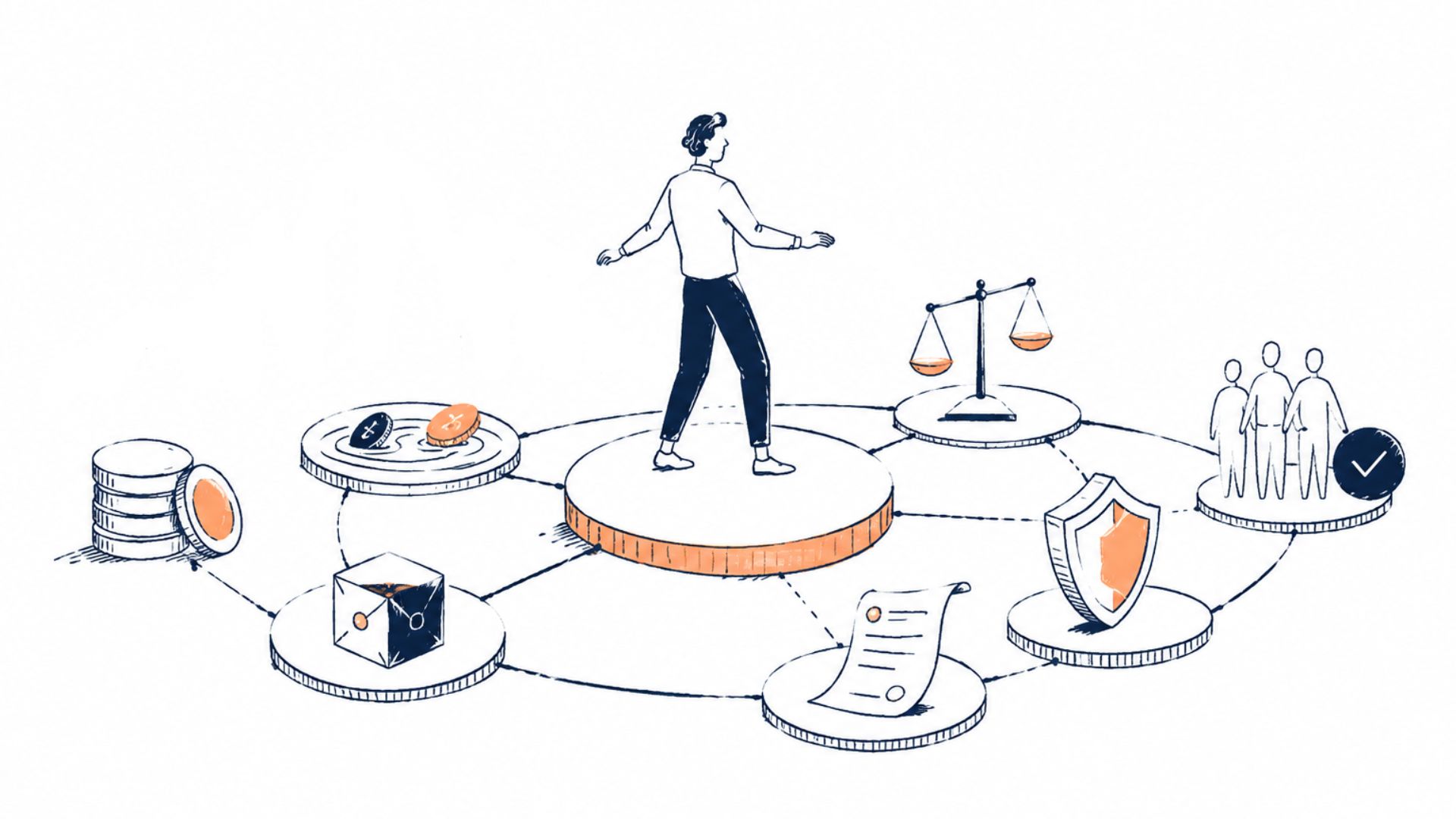

A perpetual DEX can look deceptively simple. Connect a wallet, choose an asset, select long or short, set leverage and open a position.
But that interface hides the question that matters most: when you place a trade, who is actually taking the other side?
On a centralised exchange, the answer is relatively easy to understand. The exchange operates the trading infrastructure and provides the systems needed to match orders, manage collateral and liquidate positions.
That creates very different designs. Some rely on order books, others use liquidity pools or vaults, while hybrid systems combine several mechanisms.
Understanding that infrastructure matters because it determines what happens when markets become illiquid, prices move sharply or a large number of traders are liquidated at once.
A perpetual trade starts with more than a price chart
A perpetual contract is a derivative that tracks the price of an underlying asset without having a fixed expiry date. Traders can take long positions if they expect the price to rise or short positions if they expect it to fall, usually by depositing collateral and using leverage.
Leverage is important because the position can be considerably larger than the collateral supporting it. That also means the margin available to absorb losses is smaller relative to the size of the position.
Perpetual contracts also need a mechanism to keep their price reasonably close to the underlying market. This is where the funding rate comes in.
When demand becomes heavily tilted towards one side of the market, funding payments can transfer value between longs and shorts. The exact mechanism varies between protocols, but the principle is straightforward: holding a position can create an ongoing cost in addition to any gain or loss caused by the asset’s price.
That is the first clue that the risk of a perpetual DEX is not determined by leverage alone. The way the platform finds liquidity and calculates prices can be just as important.
The same perpetual DEX interface can hide very different markets
The most important architectural difference is what happens after you submit an order.
An on-chain order book
An order-book model works in a familiar way. Traders place bids and asks, and matching orders are brought together to create trades.
The advantage is that prices can emerge directly from supply and demand within the market. The weakness is that the system needs active participants willing to provide liquidity.
That becomes particularly important during a sharp move. If market makers pull orders or spreads widen, a trader trying to close a large position may find that the available price is very different from the one visible moments earlier.
For a perpetual DEX, liquidity is therefore not just a convenience. It is part of the risk-management system.
A liquidity pool or vault
A different approach puts capital into a shared pool or vault that provides liquidity for traders.
Instead of waiting for another trader to match an order, the protocol can use this pool as the economic counterparty. Prices may be determined using external market data rather than by an internal order book.
This changes who carries the risk.
Liquidity providers are no longer simply supplying capital to facilitate trades. Depending on the protocol design, they may be exposed to the aggregate performance of traders using the system. If traders consistently profit against the pool, the economic loss ultimately has to be absorbed somewhere within that structure.
That does not necessarily mean the design is flawed. It means the role played by a traditional market maker has been redistributed.
Hybrid architectures
Some perpetual DEXs combine these approaches, using an order book for price discovery while maintaining additional liquidity or a vault that can absorb trades when the market needs support.
For the user, these systems may look almost identical. Under stress, however, the differences become much easier to see.
The oracle may matter as much as the order itself
A perpetual market cannot rely solely on its own trades to determine whether a position should be liquidated.
It needs a reference price, often supplied through an oracle — a system that brings external market information into the blockchain.
This distinction matters because the last traded price on a platform is not always the same as the broader market price.
Suppose a token trades sharply lower on one venue for a few seconds because liquidity disappears. If a protocol used that isolated move as its only liquidation reference, otherwise healthy positions could be exposed to an abnormal price.
The oracle therefore becomes part of the security model.
A trader using a perpetual DEX is not only trusting the rules of the smart contract. They are also relying on the way the protocol sources, aggregates and uses external price data.
That is one reason the phrase “non-custodial” can be misleading when treated as a synonym for “low risk”. The user may retain control of the wallet, while still depending on several pieces of infrastructure they do not operate themselves.
Liquidation is the moment the architecture is tested
A leveraged position remains open while its collateral meets the protocol’s margin requirements.
Once losses push the position below the required maintenance threshold, the liquidation process begins. The precise mechanics differ between platforms, but the objective is the same: close the position before losses become a problem for the system itself.
This is where market architecture suddenly becomes very practical.
If the position can be closed against available liquidity, the process may end there. The trader loses the collateral supporting the position, while the protocol preserves its accounting.
The harder case is a market in which there is not enough liquidity to close the position cleanly.
Now the protocol needs a second line of defence.
When the trader cannot pay, someone else has to absorb the gap
This is the part of perpetual DEX design that deserves more attention than headline leverage figures.
A protocol can use an insurance fund, a liquidity vault or another form of backstop to absorb losses that cannot be covered through ordinary liquidation.
The exact structure varies, but the economic problem is universal: if one position leaves the system with a deficit, somebody has to take the other side of that deficit.
And this is where the decentralised model becomes particularly interesting.
On a centralised exchange, traders may never see the internal machinery used to manage that shortfall. In a DEX, the mechanism is often encoded directly into the protocol and disclosed in its documentation.
In extreme situations, some systems can also use auto-deleveraging (ADL). Instead of allowing a bad debt problem to grow indefinitely, the protocol may reduce positions held by traders on the profitable side of the market.
That creates an uncomfortable possibility: a trader can be right about the direction of the market and still have part of a profitable position closed because the system needs to contain losses elsewhere.
The important point is not that every perpetual DEX uses ADL, or that one mechanism is automatically better than another. It is that a trader should understand what happens after liquidation fails, rather than stopping the analysis at the initial margin requirement.
The decentralisation trade-off is really a risk trade-off
Self-custody removes one category of exposure. The platform does not hold the user’s assets in the same way a centralised exchange does.
But the risk does not disappear. It changes shape.
A user can become exposed to smart-contract vulnerabilities, oracle failures, blockchain congestion and weaknesses in the protocol’s liquidation design. The absence of a central intermediary can also mean there is no company capable of manually reversing an error or intervening in the way a conventional financial institution might.
This is the less obvious side of decentralisation: removing an intermediary also means removing some of the functions that intermediary used to perform.
Those functions still have to exist. They are simply redistributed across software, liquidity providers, market makers, traders and automated risk systems.
What should you investigate before trading on a perpetual DEX?
The most useful questions are not necessarily about how much leverage a platform advertises.
Start with the plumbing.
Who is the economic counterparty? Is your position matched against other traders, a liquidity pool or a hybrid system?
Where does the price come from? Find out which oracle or reference mechanism the protocol uses and what happens if that data becomes delayed or abnormal.
How are liquidations executed? Look at the maintenance margin, liquidation process and the way positions are closed.
What happens when the market cannot absorb a liquidation? This is the question that reveals the real backstop: an insurance fund, liquidity providers, another mechanism, or ADL.
And finally, look beyond leverage. Funding costs, liquidity depth and execution conditions can determine whether a position that appears attractive on the chart remains viable once the infrastructure underneath it starts working against you.
A perpetual DEX is therefore not simply a decentralised version of a futures exchange. It is a different way of distributing the functions that keep a derivatives market running.
The wallet tells you who controls your funds. The interface tells you how to place the trade. Neither tells you, by itself, who carries the risk when the market stops behaving normally.
That answer is hidden in the architecture — and for anyone trading perpetual contracts, it is arguably the most important part to understand.