
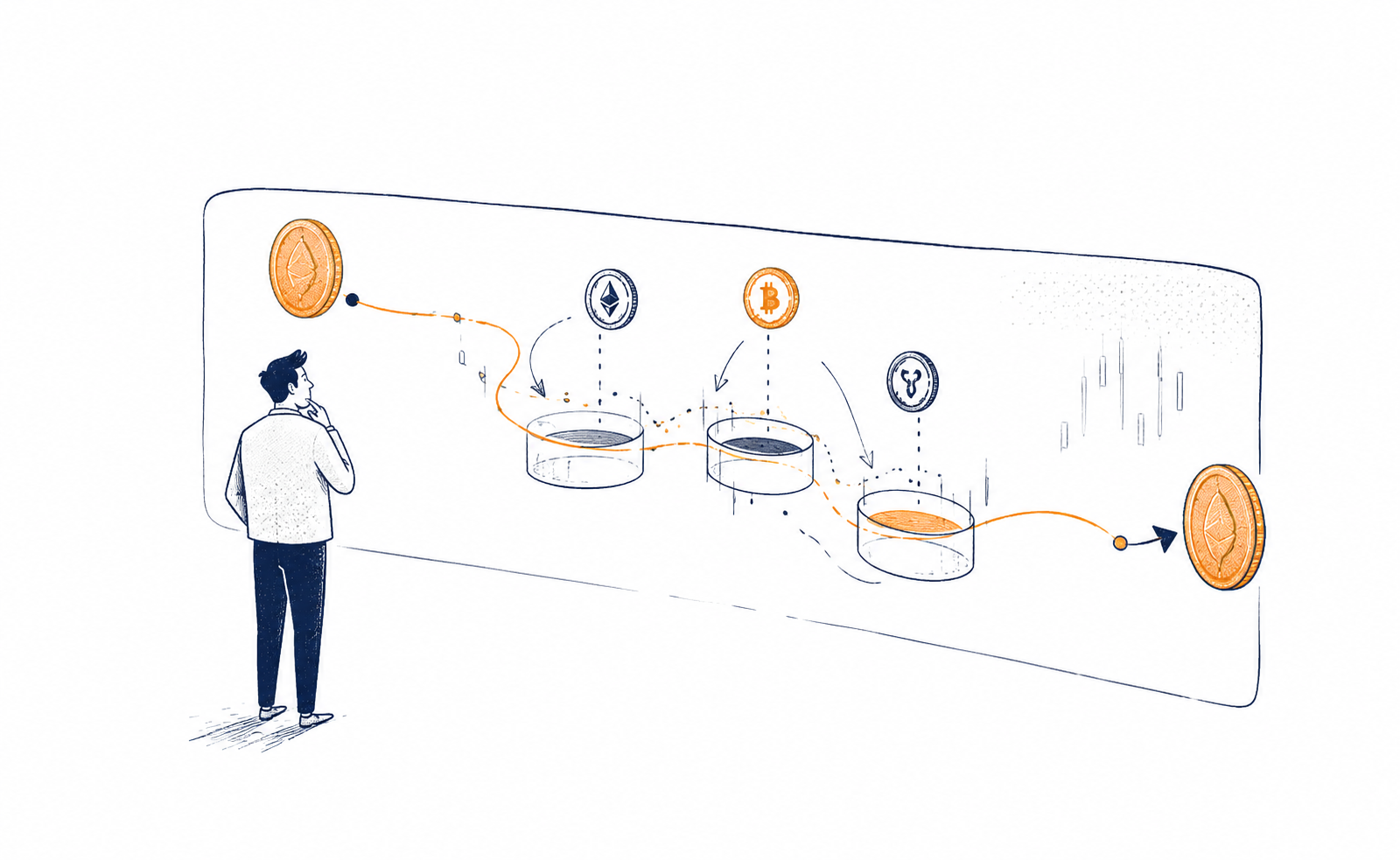

You confirm a crypto swap at one price, only to receive a slightly different amount when the transaction is completed. It can feel as though a hidden fee has appeared. Usually, that is not what happened.
The difference is known as slippage in crypto: the gap between the price you expected when placing a trade and the price at which it was actually executed.
That sounds straightforward, but the mechanics behind it are easy to misunderstand. Slippage can come from a moving market, limited liquidity or the size of your own order. On decentralised exchanges (DEXs), it can also be affected by the way transactions are processed on-chain.
That is why a swap that looks simple on the surface can produce a different result by the time it reaches the blockchain.
The price shown on screen is not necessarily the execution price
A quoted price is a snapshot. An executed trade is an event that happens afterwards.
Consider a token trading at £2.00 when you prepare a swap. Between seeing that price and having the transaction executed, other traders may buy or sell the same asset. The available liquidity may change. On a blockchain, the transaction may also have to wait before it is included in a block.
By the time the swap is executed, £2.00 may no longer be the relevant market price.
This is one source of slippage. If the final price is worse for you, the slippage is negative. If the market moves in your favour before execution, it can also be positive.
That distinction matters because slippage is not simply another trading fee. A network fee is charged for processing a transaction. A trading fee is charged by the exchange or protocol according to its pricing model. Slippage describes the difference between the expected and actual execution conditions.
The size of that difference depends heavily on what happens between those two moments.
Liquidity can make a small swap surprisingly expensive
Not every crypto market has enough liquidity to absorb trades at the same price.
Liquidity refers, broadly, to how much of an asset is available to buy or sell without moving its price significantly. A highly liquid market can usually absorb larger orders with relatively little disruption. In a thin market, even a modest trade can push the available price away from the one initially displayed.
This becomes particularly important on DEXs that use automated market makers (AMMs). Rather than matching buyers and sellers through a traditional order book, an AMM uses liquidity pools to determine the price available for a swap.
Suppose a pool contains a relatively small amount of two tokens and a trader attempts to remove a sizeable portion of one of them. The trade changes the balance of the pool. The next units may therefore be available at a progressively less favourable price.
This brings us to a concept often confused with slippage: price impact.
Price impact is the effect of your own order on the market price. Slippage is the difference between what you expected and what you actually received.
The two can occur together, but they are not interchangeable.
A useful way to think about it is this: price impact asks, “What did my order do to the available price?” Slippage asks, “How different was the final execution from what I expected?”
Why slippage, price impact and spread are different problems
These terms often appear together on a DEX interface, which makes it tempting to treat them as different names for the same cost. They are not.
Price impact comes from your own trade changing the price available to you.
Slippage is the difference between the expected and actual execution price.
Spread is the gap between the prices available to buyers and sellers in a market.
Imagine buying a token in a relatively thin market. The spread may already mean that the price available to buy is higher than the price available to sell. Your order could then move the market further because it is large relative to available liquidity. While the transaction is being processed, the wider market could move again.
The final result reflects several different forces, even though a user may simply see that they received less than expected.
That is why looking only at the final amount and labelling the entire difference “slippage” can lead to the wrong diagnosis.
Slippage tolerance is a limit, not a discount
This is where many DEX users encounter the term directly.
Slippage tolerance sets the maximum amount of adverse price movement you are prepared to accept before the swap is rejected rather than executed.
Suppose you set a 1% tolerance. If the execution conditions move beyond that threshold in the wrong direction, the transaction may fail rather than complete at a worse price.
This creates a trade-off.
A very tight tolerance gives you stronger protection against an unexpectedly bad execution, but it also increases the chance that the swap will fail. A wider tolerance makes successful execution more likely, but gives the transaction more room to settle at a worse price.
That means increasing the setting simply because a swap keeps failing is not a harmless technical adjustment. You are effectively agreeing to accept a wider range of possible outcomes.
There is no single slippage tolerance that makes sense for every token or every market. The right setting depends on liquidity, volatility, transaction size and the conditions of the particular trade.
Where MEV enters the picture
There is another reason execution can become less favourable, particularly on blockchains where pending transactions can be observed before confirmation.
This is part of the broader phenomenon known as maximal extractable value (MEV). In some cases, participants can use information about pending transactions to rearrange or place transactions around them.
A well-known example is a sandwich attack. A searcher spots a large DEX transaction, places a trade before it and another afterwards, taking advantage of the price movement created by the user’s transaction. The result can be a worse execution for the original trader. Ethereum’s documentation notes that users caught in these trades experience increased slippage and poorer execution.
But this distinction is important: high slippage does not prove that a sandwich attack occurred.
A trader can experience substantial slippage simply because the market moved, the pool had limited liquidity or the order itself was large relative to the market.
MEV is therefore better understood as an additional way execution can deteriorate, rather than as the definition of slippage itself.
How to tell what caused the difference
The most useful approach is to look at the trade before focusing on the final number.
Start with the price impact shown by the platform. If a relatively small order already produces significant impact, liquidity is probably the main issue.
Then consider the size of the transaction. A trade that consumes a large share of available liquidity is naturally more difficult to execute at a single price. Splitting a large trade into smaller transactions can sometimes reduce that effect, although additional network or trading costs may offset the benefit.
Volatility matters too. If an asset is moving quickly, the price displayed when you start a swap may simply be outdated by the time the transaction is executed.
On platforms that support them, limit orders can provide another form of control by specifying the price at which you are willing to trade. The trade-off is obvious: greater price certainty can mean no execution at all.
The practical question, then, is not “What slippage percentage should I always use?” It is:
What is causing the difference between the price I expected and the price I received?
That question leads to a much more useful diagnosis.
Sometimes the answer is a moving market. Sometimes it is insufficient liquidity. Sometimes your order is large enough to move the available price. And in certain cases, transaction ordering and MEV can make the result worse.
Slippage in crypto sits at the intersection of all these factors because a quoted price is only a momentary view of the market. The real test happens when that quote has to become an actual trade.
That is also why a lower slippage tolerance is not automatically “safer”, just as a higher one is not automatically “better”. One gives you more protection against a bad price at the cost of failed execution; the other gives the transaction more freedom to complete.
Once that trade-off becomes clear, slippage stops looking like a mysterious charge attached to a swap. It becomes what it really is: a measure of how difficult it was to turn the price you saw into the trade you actually received.