
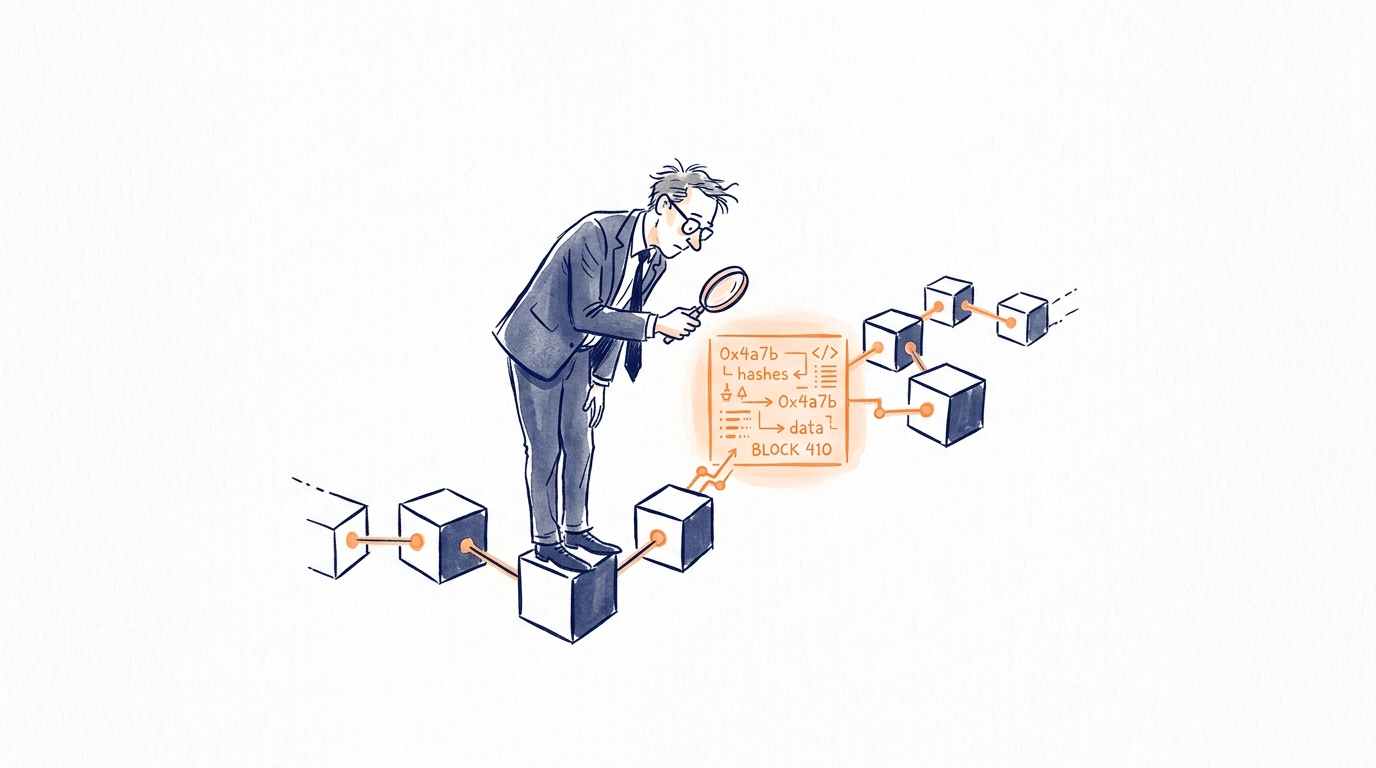

There is a temptation to treat crypto compliance software as a shopping list. Find a provider that offers KYC, another that monitors wallets, perhaps a third for the Travel Rule, connect the APIs and move on.
That is rarely how the problem works.
A crypto exchange, wallet provider or tokenisation platform may have to answer several different questions about the same customer and transaction. Who is the customer? What is the source of the funds? Has the wallet interacted with known illicit activity? Does the transaction need information to be exchanged with another regulated business?
Those are related questions, but they are not the same technical problem. That is the key to evaluating crypto compliance providers without comparing products that were never designed to do the same job.
Start with the architecture, not the provider
The most useful way to think about crypto compliance is as a series of connected layers.
The first is identity. KYC, or Know Your Customer, verifies an individual, while KYB, Know Your Business, does something similar for companies. These systems can check identity documents, business records and other information used to establish who is actually behind an account.
Then comes transaction risk.
KYT, or Know Your Transaction, applies monitoring to blockchain activity itself. Rather than asking who the customer is, it asks what the money has interacted with and whether those movements create a risk for the business.
That distinction matters because a perfectly legitimate customer can still receive funds from a risky wallet.
Blockchain transaction monitoring therefore looks at information that traditional customer onboarding cannot provide. Providers can assess exposure to sanctioned entities, known criminal services and other risk categories, while also tracing how funds move across wallets and networks. Chainalysis and TRM Labs, for example, position transaction monitoring as a continuous component of digital-asset compliance rather than a one-off check.
Then there is a third problem: communication between businesses.
The same transaction can require several compliance checks
Imagine a customer deposits Bitcoin into an exchange.
The exchange first needs to know something about the customer. That is the identity layer.
It may then assess the incoming address and the transaction history. That is the blockchain-monitoring layer.
But if the customer later withdraws funds to another regulated crypto business, the exchange may also need to comply with the Travel Rule, which concerns the exchange of specified originator and beneficiary information between relevant businesses.
The asset still moves through the blockchain. The customer information does not.
This is why Travel Rule infrastructure should not automatically be treated as another name for KYC or KYT. The functions sit next to each other rather than replacing one another. Sumsub describes the Travel Rule as the part of the compliance process dealing with information exchange between VASPs, while Notabene specialises in this business-to-business layer.
For an operator building a compliance stack, this distinction is more useful than memorising a list of regulatory acronyms.
Some providers are broad platforms. Others are specialists.
Once the layers are clear, the market becomes easier to understand.
Some crypto compliance providers are built around identity and onboarding. Sumsub, for instance, combines KYC, KYB, AML screening, transaction monitoring and Travel Rule capabilities in a single platform, positioning the product as an integrated compliance stack.
That kind of approach can be attractive to a business that wants fewer integrations and a faster route from product development to launch.
Other companies have built their reputations around blockchain intelligence.
Chainalysis, TRM Labs and Elliptic all operate in this part of the market, offering tools for transaction monitoring, wallet screening, investigations or broader blockchain analytics. Chainalysis, for example, says its KYT product supports monitoring across more than 400 networks, while TRM emphasises continuous monitoring and configurable risk rules. Elliptic similarly positions blockchain analytics as part of financial-crime risk management and compliance.
The important point is not that one category is better.
It is that a provider can be excellent at a problem that is only one part of your operation.
Why “all-in-one” does not automatically mean better
For a young crypto business, simplicity has real value.
Every external provider means another contract, another API, another data flow to maintain and another system that has to work when something goes wrong. An integrated platform can reduce that operational burden.
But consolidation comes with a trade-off.
A business with more complex risk requirements may want greater control over how transaction data is analysed, which chains are covered, how alerts are configured and how investigations are handled. In that case, a modular architecture — with specialist providers connected through APIs — can offer more flexibility.
The trade-off is familiar in software generally: fewer components can make a system easier to operate, while specialised components can give it more precision.
The right choice therefore depends less on how many features appear on a provider’s website and more on what your compliance team actually needs to control.
The questions to ask before choosing a provider
This is where procurement should become more technical.
Start with coverage. Which blockchains, tokens and transaction types can the system actually monitor? Coverage matters because a provider that performs well on Bitcoin and Ethereum may not offer the same depth across every network your business supports.
Then look at risk intelligence. Does the provider simply flag addresses, or can it explain why a transaction is considered risky? Can your compliance team distinguish direct exposure from indirect exposure and investigate the path of funds?
The quality of the data matters just as much as the interface.
Next, examine integration. A compliance product that looks impressive in a demonstration may become much less useful if it cannot connect cleanly to your onboarding system, wallet infrastructure, case-management tools or internal databases.
There is also the question of false positives. A system that flags everything as suspicious may appear conservative, but it can quickly overwhelm a small compliance team. Good monitoring is not just about finding more alerts. It is about producing signals that analysts can actually investigate.
Finally, consider regulatory and geographic coverage. A provider suitable for one market may not support the operational requirements of another. Travel Rule requirements, for example, vary across jurisdictions, so businesses operating internationally need to understand exactly where their chosen provider supports them.
The real decision is how much of the stack you want to own
The most useful question to ask a compliance provider is not “How many features do you have?”
It is “Which part of our compliance process will you own, and which parts will remain ours?”
That distinction becomes increasingly important as a Web3 business grows.
A smaller operation may reasonably prefer an integrated provider that handles several functions through one system. A larger exchange or institutional platform may instead combine identity verification, blockchain intelligence and Travel Rule infrastructure from different specialists.
Neither model is automatically safer.
The real risk lies in assuming that a single dashboard creates a complete compliance programme, or that adding more vendors automatically makes one stronger.
Crypto compliance is ultimately an exercise in connecting different types of information: the identity of the customer, the history of the asset and the institutions involved in the transfer.
The best crypto compliance providers are therefore not necessarily the ones with the longest feature list. They are the ones that fit cleanly into the architecture your business actually needs — and make the gaps between those layers visible rather than hiding them.