
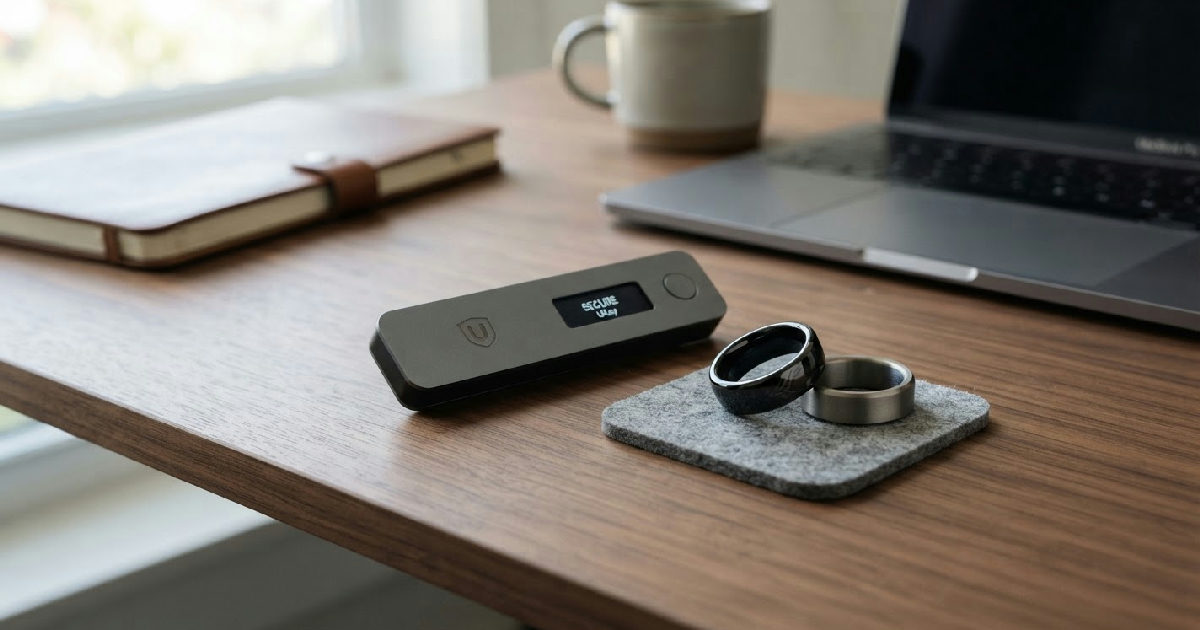

Hong Kong-based UKEY LIMITED is rolling out its new line of UKey hardware wallets, including the UKey Core 26 and UKey Seed Ring, designed to embed digital asset security more seamlessly into everyday life. The company aims to simplify self-custody by segmenting daily account access from critical tasks like transaction signing and seed phrase recovery.
The UKey Core 26 is set for a Q3 2026 launch, with the UKey Seed Ring having been revealed on July 9, 2026.
UKey Core 26: bridging security and daily use
This initiative directly addresses a common paradox in digital security: crucial tools often remain unused due to their inconvenience. UKey’s strategy is to shorten the distance between robust hardware security and daily use, making these devices feel more approachable and integrated into a user’s routine.
The UKey Core 26 stands out as a core component of UKey’s self-custody workflow, functioning as a touchscreen hardware wallet for secure signing and transaction review. Its design language reflects a move towards more refined consumer electronics, away from the often utilitarian aesthetic of traditional security devices.
The Space Black edition, for instance, features a 3.5-inch color touchscreen and a dark metal frame, lending it a confident and precise feel.
Beyond aesthetics, the Core 26 boasts a four-chip security architecture and an EAL6+ secure-chip level, ensuring hardware-level security isolation for private-key storage. It supports versatile connectivity options, including Bluetooth, USB, and QR-based connections.
When paired with the UKey Wallet app, the system creates a two-layer security flow: the app handles everyday access and transaction requests, while the Core 26 maintains control on the device, allowing users to independently review and confirm transaction details on its screen before signing.
Intuitive interaction for enhanced security
A clear, independent screen is paramount for a hardware wallet, acting as a crucial security interface. The Core 26’s intuitive interaction model is designed to encourage users to thoroughly examine transaction details, rather than treating the device as a mere black box for quick confirmations.
This approach moves the security burden from complex rules to verifiable workflows, aligning with UKey’s philosophy that “Digital asset security should not require users to memorize increasingly complex rules.”
UKey stated that critical risks should instead be moved into workflows that users can verify and confirm. This design principle means the Core 26 is a dedicated hardware solution for private-key protection and device-side signing, integrated more seamlessly into daily use. However, it’s worth noting that as of August 2026, the hardware devices are not yet available for purchase, with official sales announcements still pending.
UKey Seed Ring: wearable recovery for seed phrases
Complementing the Core 26, the UKey Seed Ring reimagines seed-phrase backup and wallet recovery as a wearable accessory. Revealed on July 9, 2026, the Seed Ring is crafted from high-strength black ceramic, making it scratch-resistant and suitable for daily wear.
Its minimalist design means it looks more like an everyday item than a piece of specialized electronic equipment. A 925 silver chain is also included, offering the option to wear it as a pendant.
Functionally, the Seed Ring operates on a battery-free passive NFC design. It only draws power and can be read when held close to a compatible NFC-capable device, ensuring no continuous operation or remote connections. Crucially, the Seed Ring cannot initiate transactions, generate wallets, store private keys for signing, or execute transfers.
Its role is strictly defined: securely assisting with seed phrase recovery by holding recovery-related data like indexes and checksum-style information, not the full seed phrase in clear form.
Redefining recovery mediums
This focused restraint is a deliberate design choice, as the Seed Ring does not attempt to miniaturize an entire hardware wallet. Instead, it isolates the recovery task from the self-custody process, providing a form factor that is easier to carry and conceal than traditional paper or metal backup methods.
While paper seed phrases are vulnerable to environmental damage, and metal plates, though durable, aren’t always convenient for portability, the Seed Ring offers a different trade-off, serving as a wearable, close-at-hand recovery medium.
The anticipated UKey Zero Ring and future possibilities
UKey’s product roadmap hints at further innovations with the appearance of the “Zero Ring” in the footer of its website and store as of August 14, 2026. While official product pages, technical specifications, feature descriptions, or release dates for the Zero Ring remain unannounced by UKey, its presence has sparked speculation.
The most prominent association is that it could function as a lightweight, everyday hardware form for transaction signing, creating a cohesive product family where the Seed Ring handles backup and the Zero Ring handles signing.
However, it’s important to stress that this is currently an association, not a confirmed UKey product plan. Practical questions regarding how such a ring would verify its holder, display transaction details, handle lost devices, or integrate with the existing UKey Wallet, Core 26, and Seed Ring, are yet to receive official answers.
The market already features ring-shaped crypto hardware wallets like the Tangem Ring, which provides NFC transaction signing in a zirconia ceramic form factor with an EAL6+ certified secure element chip. This indicates a broader industry trend towards integrating security into smaller, more accessible wearables.
Evolution of hardware wallets in a wearable world
The cryptocurrency hardware wallet market is clearly evolving beyond the traditional “screen and buttons” format, with cards and rings emerging as viable alternatives. This shift addresses two critical aspects of security: availability and habit.
A hardware wallet that is readily accessible, whether as a card in a wallet or a ring worn daily, significantly reduces the friction of using hardware confirmation for routine authorizations. This encourages consistent use of security mechanisms, which often falter when they require extra preparation.
Moreover, the understated design of products like the Seed Ring and potentially the Zero Ring offers a less obvious advantage: they don’t overtly signal their function as security devices. For users who frequently travel or interact with Web3 services in diverse settings, this lower-profile form factor provides a distinct benefit.
But a lighter form factor doesn’t diminish security responsibilities. For signing devices without independent screens, clarity on transaction information display, user authentication, authorization target verification, and lost-device protocols becomes even more crucial. Convenience is only truly valuable when these security boundaries are clearly defined.
UKey product lineup at a glance
Here’s a breakdown of UKey’s current and anticipated hardware wallet products and related ecosystem components:
UKey’s strategic direction is transparent: to make hardware security more integrated and user-friendly. The Core 26 maintains the expected independent interaction and device-side confirmation of a robust hardware wallet, while the Seed Ring provides recovery capabilities in a discreet, wearable ceramic accessory.
The potential UKey Zero Ring, should it materialize as a signing device, would complete a picture of distinct roles within the ecosystem: Core 26 for comprehensive transaction scrutiny, Seed Ring for backup, and Zero Ring for frequent, lightweight authorizations.
Ultimately, the challenge for UKey isn’t simply to make smaller hardware, but to ensure a lightweight form factor can coexist with an unequivocally clear and dependable security flow.
This ongoing evolution in hardware wallet design, aiming to move security tools from the drawer to daily wear, represents a compelling development for the crypto industry and is certainly worth close observation as these products reach the market.