
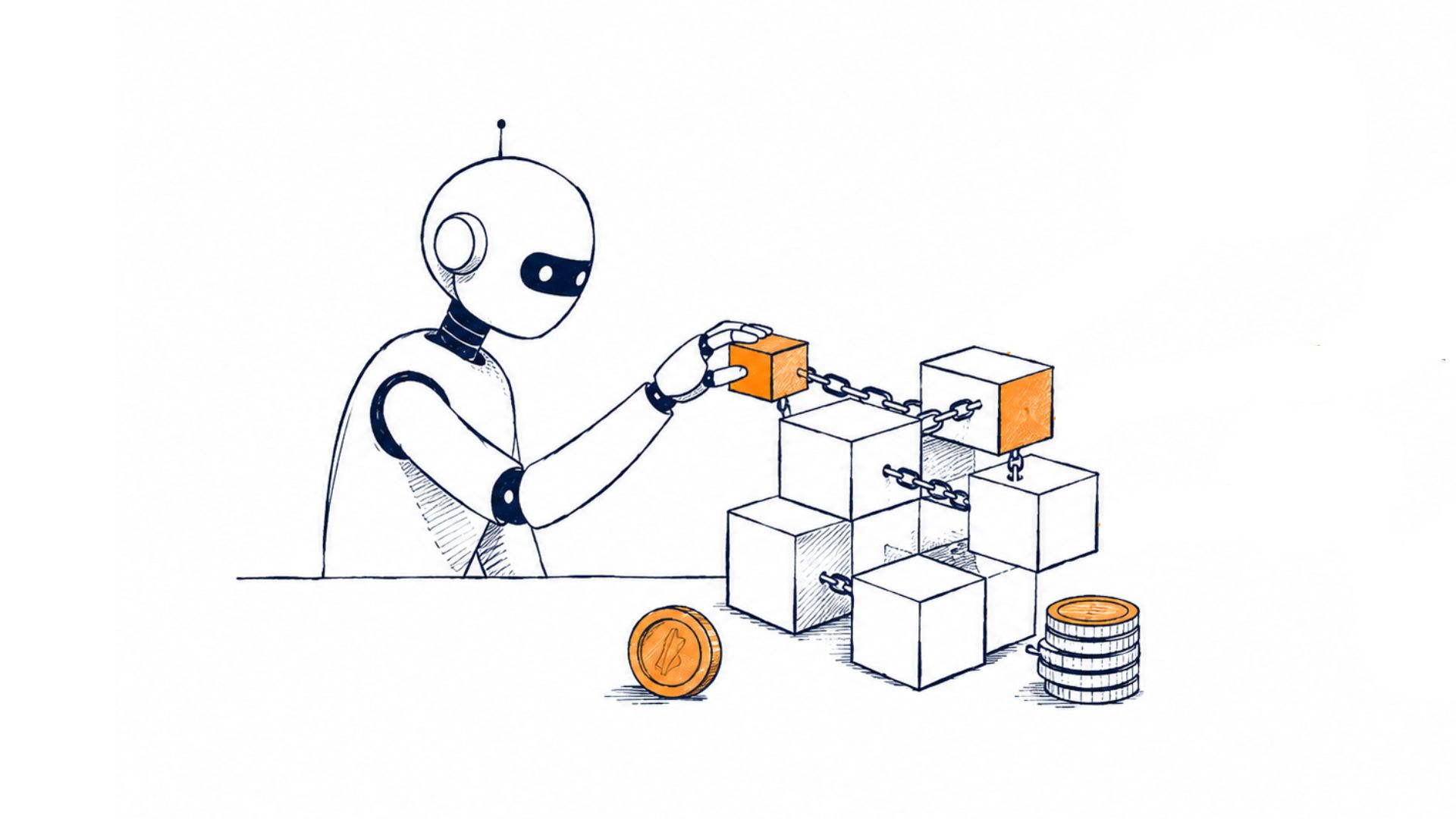

An AI agent can already search for information, compare options and carry out a sequence of tasks with little human intervention. But there is a point at which its autonomy runs into an old problem: money.
Imagine asking an AI agent to organise a business trip. It could find a flight, compare hotels, book transport and choose travel insurance. Yet paying for those services still normally requires a person or company to authorise the transaction.
That gap between being able to make a decision and being able to act economically on it is one reason AI agents and blockchain are increasingly discussed together.
Blockchain is not inherently necessary for artificial intelligence. An AI model can operate perfectly well without cryptocurrency. The more interesting question is what happens when software needs to hold value, pay for services and transact with other software without asking a human to approve every step.
That is where blockchain becomes potentially useful.
AI agents can act autonomously, but they were not designed to have a bank account
There is an important distinction between an AI chatbot and AI agents.
A chatbot generally responds to a request. An agent can pursue an objective by deciding which actions to take along the way.
For example, a chatbot might recommend three hotels. An agent could search availability, compare prices, select an option according to a set of rules and complete the booking.
The more complex these tasks become, the more likely they are to involve paid services.
An agent might need to purchase computing power, access a database, pay for an API, obtain a piece of licensed data or hire another software agent to complete part of a task.
This creates a problem that has little to do with the intelligence of the system itself.
Traditional financial infrastructure assumes that an account belongs to a person or a legally recognised organisation. Opening and operating that account involves identity checks, permissions and an institution responsible for processing transactions.
An autonomous software agent does not fit neatly into that framework.
It can be created in seconds, replicated thousands of times and operate continuously. Requiring a human to approve every payment would undermine much of the autonomy that makes agents useful in the first place.
A crypto wallet gives an AI agent a way to hold and move value
This is where blockchain changes the equation.
A cryptocurrency wallet can hold digital assets and send them directly to another wallet. It does not need to be opened in the same way as a traditional bank account, and transactions can be executed programmatically.
For an AI agent, that creates something close to a native financial identity.
The agent can have a wallet, receive funds, pay for a service and maintain a record of its transactions on a public blockchain.
Stablecoins make the idea particularly relevant to automated payments. These are cryptoassets designed to maintain a relatively stable value against another asset, most commonly a fiat currency such as the US dollar.
Consider an AI agent that suddenly needs additional computing capacity. Instead of waiting for a person to approve a purchase, it could select a provider, obtain the required resources and make a payment using a digital asset.
The same basic mechanism could apply to data, storage, APIs or other digital services.
The important point is not that cryptocurrencies make AI smarter.
They give autonomous software a mechanism for moving value.
Blockchain solves one problem, but it does not make AI trustworthy
This distinction is easy to miss.
A blockchain can help AI agents make a payment. It cannot guarantee that the agent should have made that payment in the first place.
Suppose an agent is instructed to find the cheapest cloud-computing provider. It could successfully execute a blockchain transaction and still choose the wrong provider because it misunderstood the user’s instructions or relied on inaccurate information.
The transaction would be valid. The decision could still be wrong.
This creates a second layer of infrastructure around autonomous AI: identity, permissions and accountability.
An agent may need limits on how much it can spend, which services it can use and which transactions require human approval. Businesses may also need to know which software agent initiated a transaction and who ultimately bears responsibility for its actions.
Blockchain can provide part of the financial record, but it cannot answer all of those questions by itself.
That is why the relationship between AI agents and blockchain is more complicated than simply giving an AI a crypto wallet.
The real opportunity is not AI paying humans, but software paying software
The most interesting use case may emerge when both sides of a transaction are autonomous systems.
Today, digital commerce usually has a person somewhere in the loop. A user chooses a service, approves a purchase and pays for it.
An agentic economy could work differently.
One AI agent might need a specialised translation service and hire another agent to provide it. A third could supply data, while another provides the computing power required to process that information.
Each service could potentially be paid for automatically.
This is where machine-to-machine payments become more interesting than simply using crypto as another payment option.
Imagine a network of specialised agents. One analyses financial data, another translates documents, another verifies information and another provides temporary computing resources. Rather than operating as a single large application, they could interact as independent economic actors.
Small payments could occur between them whenever a service is requested.
Traditional banking systems can process automated payments, of course. The question is whether they are well suited to a world in which potentially millions of software agents need to transact with one another across borders, continuously and without a conventional customer relationship.
Blockchain offers characteristics that are attractive in this context: programmable transactions, digital ownership and a settlement system that does not necessarily depend on the same banking infrastructure on both sides.
That does not make it the inevitable answer. It makes it one of the infrastructures worth testing.
Why blockchain may matter more as AI becomes more autonomous
The significance of blockchain therefore depends on how far AI agents actually move beyond today’s automation.
If agents remain tools that always require humans to approve financial decisions, traditional payment systems may be sufficient for many applications.
But if agents increasingly operate independently — negotiating services, purchasing resources and interacting with other agents — the financial architecture around them becomes more important.
An autonomous system needs more than intelligence.
It needs an identity that other systems can recognise, access to resources, rules governing what it can do and a way to settle transactions.
Blockchain can provide some of these components, particularly the financial layer.
That is also why stablecoins are relevant to the discussion. An agent that is paid in a highly volatile asset would face an additional problem: the value of its budget could change significantly while it is operating. A stable digital asset can make automated transactions easier to reason about.
But even then, the infrastructure is only part of the challenge.
The biggest barrier may be trust, not technology
There is a paradox at the centre of the agentic economy.
The more autonomous AI becomes, the more useful it is to remove humans from individual decisions. Yet the more financial authority an agent receives, the harder it becomes for people and businesses to accept that autonomy.
Giving an AI permission to organise a calendar is relatively low risk.
Giving it permission to spend money is different.
Giving it permission to negotiate contracts, purchase services or transfer assets without approval is a much bigger step.
That means the adoption of AI agents and blockchain will depend on systems that can constrain autonomy rather than simply maximise it.
Spending limits, transaction policies, verifiable identities and mechanisms for human intervention may become just as important as the blockchain itself.
The technology therefore faces an unusual test: it needs to make autonomous transactions possible while giving users enough control to trust them.
Blockchain could become the financial layer for autonomous software
AI does not need blockchain to function. The more precise argument is that autonomous AI may need new financial infrastructure if software is going to become an active participant in the digital economy.
Blockchain is one candidate for that infrastructure because wallets can give agents a way to hold and transfer digital assets, while stablecoins can support relatively predictable automated payments.
The bigger experiment, however, is still ahead.
If AI agents remain sophisticated assistants, the existing financial system may continue to handle most transactions behind the scenes. If they become independent economic actors that routinely buy services, sell capabilities and negotiate with one another, the internet may need a financial layer designed around software rather than people.
Blockchain does not solve that entire problem. It may simply provide one of the missing pieces.
And that distinction matters. The future of the agentic economy will not be determined by whether an AI can send a crypto transaction. It will depend on whether people can build enough trust, control and accountability around autonomous software to let it spend money in the first place.