
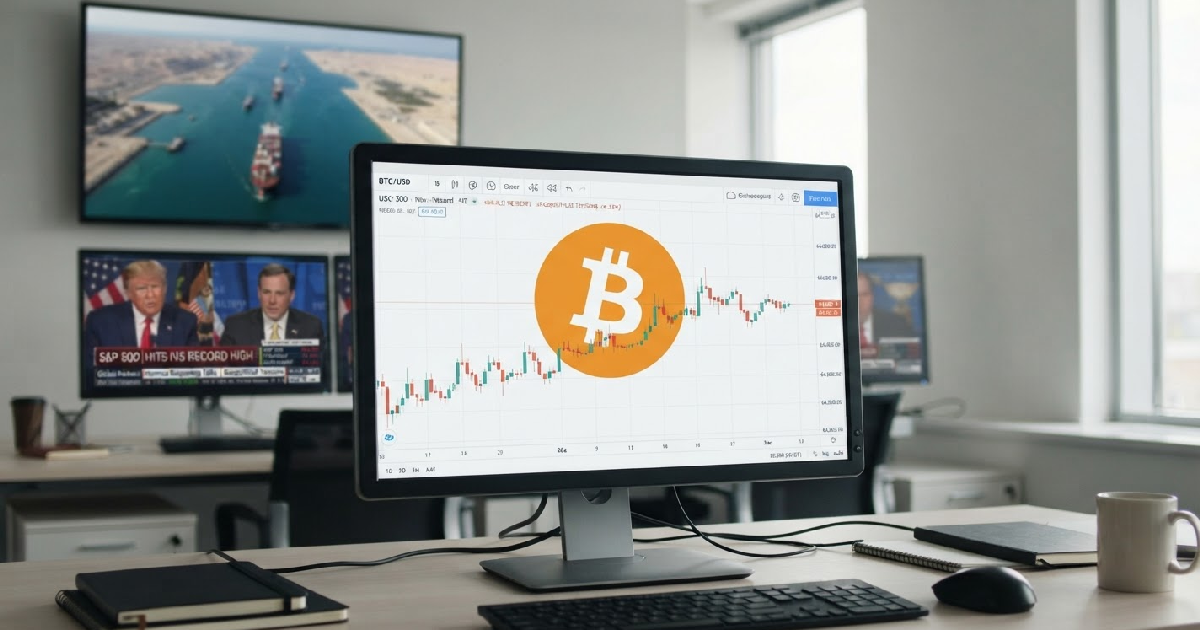

Bitcoin holds $64,000 on Tuesday, August 4, 2026, as market optimism drives traditional assets higher.
The intertwined movements underscored the increasing correlation between digital assets and global geopolitical developments, with US Treasury Secretary Scott Bessent and US President Donald Trump confirming ongoing dialogues.
Hormuz reopening drives global market optimism
The market rally stems from reports suggesting a breakthrough in negotiations to resume oil traffic through the crucial Strait of Hormuz, easing long-standing US-Iran tensions. This development prompted an immediate reaction in global oil markets, with both West Texas Intermediate (WTI) and Brent crude falling by 4.8% and 4.6% respectively, reaching their lowest levels since July 13, 2026.
The prospect of the Strait of Hormuz reopening emerged as a primary driver of market sentiment, directly impacting both equities and the Bitcoin price. US Treasury Secretary Scott Bessent indicated that traffic through the strait could resume as early as Wednesday, August 5, 2026.
Bessent told CNBC there’s “a chance we may have a deal today or tomorrow” to normalize the situation amid ongoing talks in the US-Iran conflict. President Donald Trump echoed this, stating the waterway could reopen “as soon as tomorrow.”
Key details of the emerging Strait of Hormuz deal
Regional officials in Oman confirmed progress in talks with Iran regarding the strait’s reopening. Under the proposed agreement, ships would reportedly navigate the Persian Gulf via an Iranian-controlled route for entry and an Omani-controlled route for exit.
This structure would include service fees for security and maritime environmental preservation. Any final deal is also linked to the lifting of the US blockade on Iran’s ports, though negotiations are reportedly still fluid.
Conflicting statements on the strait’s status
Despite the prevailing market optimism, not all parties presented a unified front on the strait’s future. Iran’s Foreign Ministry spokesperson, Esmail Baghaei, stated on Sunday, August 2, 2026, that the Strait of Hormuz “will in no way return to the status it was before February 28.”
Baghaei emphasized that while talks with Oman are ongoing, they are not specifically focused on reopening the crucial waterway. This indicates potential complexities and differing interpretations of any agreement.
Bitcoin holds steady as S&P 500 hits record
While the S&P 500 surged, Bitcoin maintained its position above a key psychological level. BTCUSD climbed to $64,176 on Bitstamp, registering maximum daily gains of approximately 1% as traditional markets reacted positively to the geopolitical news.
The S&P 500 index reached a new record high of 7,713, with its market capitalization hitting $70 trillion for the first time. This staggering figure is roughly equivalent to the combined Gross Domestic Product (GDP) of the US, China, and Japan, reflecting the immense scale of the current equity rally.
Equities market momentum and Federal Reserve policy
The S&P 500’s climb has been rapid, having previously crossed the 7,000 level in January 2026. Its market capitalization grew from $67.8 trillion on May 29, 2026, to over $69 trillion by June 2, 2026, and the total US stock market capitalization reached $75.3 trillion as of July 1, 2026.
More than ten S&P 500 constituents are now individually valued at over $1 trillion. Analysts suggest the resolution of the Hormuz closure is also influencing market expectations for future Federal Reserve policy decisions, with CME Group’s FedWatch Tool indicating a 56.7% probability of a 0.25% rate hike at the September meeting.
Intertwined destinies for crypto and traditional finance
The day’s trading patterns reinforced the growing correlation between the cryptocurrency market and traditional equities. A record-breaking performance in stock markets often creates favorable conditions for digital assets, a trend that appears to be strengthening.
The current S&P 500 rally is significantly driven by a concentrated group of large-cap technology stocks. This scenario suggests that broader market stability and growth, even if concentrated, continue to provide a supportive backdrop for Bitcoin and other cryptocurrencies.