
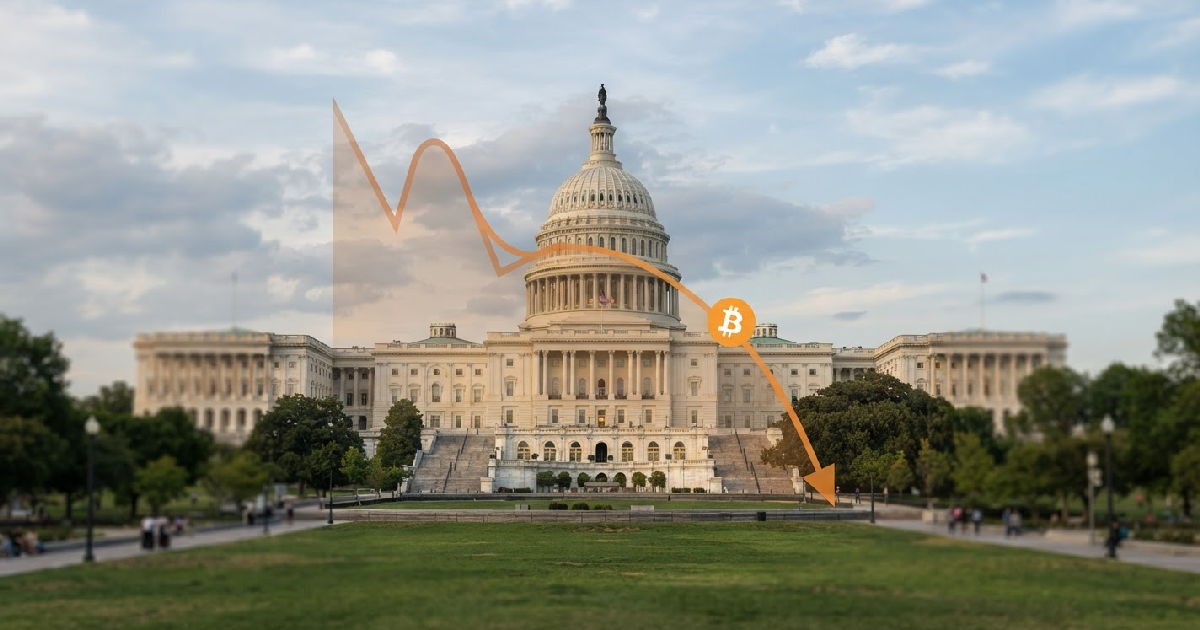

After a period hailed as the cryptocurrency industry’s regulatory triumph in Washington, a stark reality has set in for market participants regarding Washington crypto policy. Bitcoin, which soared above $126,000 on October 6, 2025, buoyed by the prospect of mainstream institutional acceptance, now trades around $62,600 as of August 3, 2026.
This nearly 50% decline unfolds despite the United States government moving decisively to support the digital asset sector, rather than cracking down on it.
Washington embraces digital assets
The prevailing sentiment among many in the industry was that regulatory clarity and institutional access would inevitably lead to sustained growth and higher prices. However, the market’s retreat, occurring even as Washington delivered on many of the industry’s key legislative and enforcement desires, challenges this fundamental assumption. It suggests that while legal barriers can be removed, actual demand and economic utility aren’t guaranteed outcomes.
The regulatory landscape for cryptocurrencies in the United States underwent a dramatic transformation following Donald Trump’s return to office. His administration wasted little time in signaling a friendlier stance, notably with a January 2025 executive order. This directive endorsed the lawful use of public blockchains and stablecoins, established a presidential working group, and aimed to position the US as a leader in digital assets.
A subsequent executive order in March 2025 solidified this commitment by establishing a Strategic Bitcoin Reserve. This policy directed federal agencies to retain Bitcoin confiscated by the government, rather than auctioning it off, and explored ways for the nation to acquire more through budget-neutral strategies.
This move lent an unprecedented level of official legitimacy to Bitcoin, a significant shift from previous narratives that often framed digital assets through the lens of money laundering or sanctions evasion.
The Securities and Exchange Commission (SEC) also pivoted its approach. It launched a dedicated crypto task force and began dismantling many of the aggressive litigation campaigns inherited from the prior commission. By February 2025, the high-profile case against Coinbase was dismissed, followed by similar actions involving Kraken, Consensys, Cumberland, and Binance.
By April 2026, the agency confirmed it had dismissed seven crypto-related cases initiated by its former leadership, signaling a clear change in enforcement strategy. This regulatory easing provided a tangible reduction in legal uncertainty for major crypto firms operating within the US.
Congress, too, contributed to the new framework, passing the GENIUS Act in July 2025. This legislation established clear reserve, licensing, and disclosure requirements specifically for payment stablecoins, addressing a long-standing gap in federal oversight.
Simultaneously, the Federal Reserve eased special notification requirements for banks engaging in crypto activities, and the Office of the Comptroller of the Currency affirmed that national banks could offer custody and execution services for digital assets.
These collective actions delivered nearly every regulatory win the crypto industry had lobbied for. Executives gained confidence to plan product development without the constant threat of federal court, and companies considering a US launch could now operate with much greater legal predictability. But this political victory didn’t translate directly into sustained investor enthusiasm.
Institutional capital retreats from Bitcoin
Despite these significant regulatory advancements and increased institutional access, the Bitcoin market struggled to maintain its earlier momentum. Just four days after hitting its all-time high of over $126,000 in October 2025, a global risk shock triggered a massive deleveraging event. This led to more than $19 billion in positions being liquidated within 24 hours across October 10 and 11, marking a violent downward correction.
While the initial crash could be attributed to broader market forces and excessive leverage, the subsequent nine months saw a persistent weakness that regulatory clarity couldn’t counteract. By July 1, 2026, Citigroup estimated that US spot Bitcoin Exchange Traded Funds (ETFs) had recorded approximately $3.3 billion of net outflows for the year.
This prompted the bank to revise its 2026 ETF inflow forecast from $10 billion down to zero, alongside a reduced 12-month Bitcoin price forecast of $82,000.
The once-hyped institutional appetite, which these ETFs were designed to tap, simply wasn’t there to sustain prices at higher levels. This was mirrored in the performance of major exchanges. Coinbase’s second-quarter filing revealed transaction revenue of $599.2 million, a notable drop from $764.3 million a year prior.
Its monthly transacting users also fell, from 8.7 million to 7.6 million, and the company posted a $359.5 million net loss.
These figures, while not signaling a corporate collapse for Coinbase, illustrate a general contraction across the digital asset market. CryptoSlate’s midyear market review further highlighted this trend, placing Bitcoin near $58,600 at the beginning of July after a 33% annual decline, with June alone seeing ETF outflows of around $4.5 billion.
Spot ETFs were initially envisioned as the ultimate bridge to mainstream finance, making Bitcoin accessible to traditional investors through familiar accounts. While they successfully removed the complexities of private keys and specialist custodians, they also made selling frictionless. Wealth managers who once avoided Bitcoin due to custody issues can now buy and sell with ease, positioning Bitcoin alongside other liquid assets competing for capital.
This increased competition proved challenging in 2026. Cash and government bonds offered attractive yields, while inflation and interest rate uncertainty dampened enthusiasm for speculative assets. A significant portion of investor capital flowed into artificial intelligence companies, drawing funds away from crypto.
The supposed “bottomless” reservoir of institutional capital turned out to be a two-way street, where investors were as willing to sell as they were to buy, particularly when Bitcoin’s price approached or exceeded $100,000.
Corporate treasury models face harsh reality
The corporate treasury strategies, which once provided a consistent source of demand for Bitcoin, also began to unravel under market pressure. Companies like Strategy, a prominent example, had previously raised capital through stock or debt issuance. They then used these proceeds to acquire Bitcoin, banking on their equity trading at a premium to their digital asset holdings.
This model relied on a continuous investor belief that the company’s shares held value beyond its underlying Bitcoin. However, as the premium evaporated, new equity issuance became dilutive, and falling Bitcoin prices eroded the asset base supporting the entire structure. Many of these treasury vehicles started trading below the value of their crypto holdings, rendering further capital raises unattractive.
Strategy’s actions between June 29 and July 5, 2026, underscored this reversal. The company sold 3,588 Bitcoin for approximately $216 million, primarily to meet preferred-stock obligations and replenish its dollar reserves. Its SEC filing also disclosed a substantial $8.32 billion second-quarter loss on digital assets, predominantly an unrealized accounting loss due to Bitcoin’s price decline.
This sale, while not indicating a catastrophic cash burn for Strategy, was symbolically significant. It challenged the core premise of the corporate treasury boom: that these entities would be perpetual Bitcoin accumulators, never turning into sellers. CryptoSlate’s analysis of the transaction highlighted it as a critical test for a model built on years of aggressive accumulation.
Washington could grant permission for such strategies, and even emulate them through a federal reserve, but it couldn’t suspend the fundamental principles of corporate finance. Companies still face dividend obligations, rising financing costs, and the disappearance of equity premiums. These economic realities proved more potent than any regulatory endorsement.
The limits of policy and the path forward
The recent market downturn, occurring amidst a wave of favorable US crypto policy, reveals a crucial distinction: legal permission and institutional access do not automatically equate to sustained demand or economic utility. While American exchanges now enjoy greater security from litigation, banks have clearer authority for custody, and stablecoin issuers operate under a federal framework, these gains haven’t directly fueled Bitcoin’s price.
The GENIUS Act, for instance, primarily regulates payment stablecoins and dollar tokens, not Bitcoin itself. Dismissed SEC cases improve an exchange’s operational stability, but don’t compel an investment committee to increase its allocation to Bitcoin. Similarly, ETFs simplify access but don’t insulate investors from volatility or make a pension fund ignore the asset’s lack of cash flow.
Bitcoin’s fundamental value proposition continues to rest on its perceived scarcity, its role as a reserve asset, or a macro hedge. Unlike stocks, which can be valued on earnings, or bonds that pay interest, Bitcoin lacks inherent cash flow. Its price depends entirely on future buyers valuing it at a higher price, a calculus that becomes more complex as its price climbs.
Supportive government policy strengthens the argument for Bitcoin by reducing the risk of prohibition and making ownership safer. But it cannot dictate price. At $20,000, an allocator might see a compelling, asymmetric opportunity. At $126,000, they might perceive a crowded trade with substantial downside and no income.
External factors like global liquidity, real interest rates, geopolitical events, and overall risk appetite consistently prove more powerful than any favorable regulatory announcement.
The crypto industry’s long battle with Washington was largely defined by a clear adversary and measurable objectives: lobbying, funding candidates, winning court cases, and securing legislation. Having largely achieved these political victories, the path ahead demands a different kind of effort.
Now, companies must demonstrate that their products attract users even when prices aren’t soaring, that their revenues are resilient in bear markets, and that their balance sheets are robust without relying on perpetually overpriced equity. Asset managers need to show that their institutional allocations can withstand drawdowns, rather than merely materializing after rallies.
Bitcoin advocates face the challenge of persuading the next wave of buyers without the familiar promise of an impending government announcement to unlock the market. Washington has successfully reduced legal uncertainty, permitted institutional access, and even established a federal Bitcoin reserve. But it cannot, and will not, determine what the next buyer is willing to pay.