
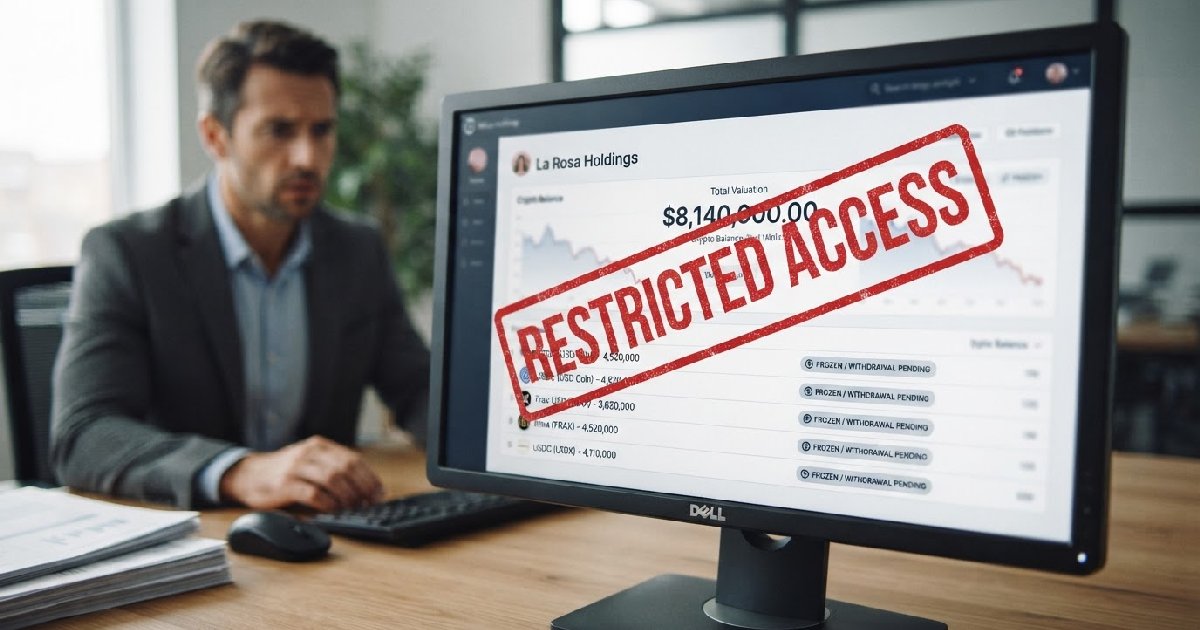

La Rosa Holdings reported an $8.14 million digital asset balance on its March 31 balance sheet, detailing its crypto holdings. 14 million digital asset balance on its March 31 balance sheet. This figure, disclosed in a delayed first-quarter filing, masks significant limitations on the firm’s actual access to its crypto holdings. The situation raises critical questions about La Rosa Holdings crypto balance and its available liquidity.
This disclosure comes amidst mounting financial distress for La Rosa. The company faces a substantial quarterly loss and has received a formal warning about its ability to continue as a going concern. It highlights the complexities and risks some companies face when integrating digital assets into their corporate treasuries.
Restrictions on digital assets grow
La Rosa Holdings’ digital asset portfolio, which primarily includes USDC and Frax USD, resides in a restricted BitGo custodial account. While the company initially reported $8.14 million in digital assets on its March 31 balance sheet, a later 10-Q filing reclassified the entire balance as restricted. This change means the full sum is not freely accessible.
An earlier company release from March 31 had described only about $3.9 million of an approximately $8.1 million reserve as restricted. However, broader financing controls now apply to the full amount. Withdrawals, transfers, and other uses depend entirely on compliance with La Rosa’s existing financing agreements.
By May 31, the company’s total digital asset holdings had grown to $10.3 million. This expansion followed the deployment of $6.7 million from initial-closing proceeds and $3.6 million from an equity line. Despite this growth, public filings have not specified how much of these expanded holdings are freely available for operational use.
Complex web of financing agreements
Access to La Rosa Holdings’ digital assets is severely constrained by a series of stringent financing agreements. A senior secured convertible note, with an $11 million principal, was issued on January 8 for a $9.9 million purchase price. By quarter-end, this note was measured at $14.57 million.
This agreement carries a 10% annual interest rate, payable monthly, and matures 24 months after issuance. Crucially, substantially all assets purchased with initial-closing proceeds are subject to a first-priority security interest under this note. Any remaining assets fall under a second-priority interest, behind a separate first lien from a February note.
An investor also holds a separate token right, adding another layer of complexity. If exercised, this right entitles the investor to 50% of tokens bought with note-closing net proceeds. It also covers 56.25% of tokens acquired with certain other financing proceeds, all without additional payment from the investor.
La Rosa Holdings has recognized a $5.35 million current liability associated with the fair value of this agreement. The combination of these liens and token rights makes calculating usable capital extremely difficult. Filings lack crucial details like token quantities, funding sources, and exercise statuses.
La Rosa’s deepening financial challenges
The firm’s foray into digital assets is set against a backdrop of severe financial challenges. La Rosa Holdings reported a substantial $13.47 million quarterly net loss. This loss included $10.50 million directly tied to the issuance of the secured note.
Its liquidity position appears precarious, with cash standing at a mere $1.74 million. Total liabilities have swelled to $28.34 million, accompanied by current liabilities of $12.06 million. The company also reported a stockholders’ deficit of $7.5 million.
Operations consumed $1.76 million in cash, further squeezing the firm’s finances. Management issued a stark warning, indicating current working capital, cash, and operating cash flow would be insufficient to cover projected operating expenses for at least the next 12 months. This led management to flag substantial doubt about the company’s ability to continue as a going concern.
The company has also undergone three reverse stock splits, in July 2025, January 2026, and a 1-for-10 split in April 2026. These measures often signal underlying financial weakness. La Rosa is working on a Nasdaq compliance plan after reporting a negative $1.85 million stockholders’ equity at December 31.
Analyzing crypto holdings amidst distress
La Rosa Holdings’ situation offers a critical review for other corporations considering digital asset treasury management. The core issue isn’t merely holding crypto, but the transparency and accessibility of those holdings during financial duress. Complex debt structures and investor rights can effectively freeze seemingly liquid digital assets.
This scenario underscores the need for clear, unambiguous disclosure regarding the usability of corporate digital assets. When liens and token rights encumber the same assets, stakeholders struggle to assess a company’s financial health. A precise understanding of unencumbered digital assets is crucial for investors, creditors, and regulatory bodies.
Furthermore, the case highlights the necessity for robust liquidity planning when integrating digital assets like USDC and Frax USD. Companies must ensure their digital asset strategies align with broader financial stability. These holdings should not become an additional burden during times of stress.
The lack of quantified withdrawals and varying disclosures around asset restrictions point to broader challenges in corporate crypto reporting. For the crypto industry, such instances emphasize the ongoing need for clearer accounting standards and greater transparency. This is vital for fostering confidence and enabling accurate risk assessment in digital asset adoption.
Ultimately, La Rosa’s experience demonstrates that a digital asset balance doesn’t automatically equate to readily available liquidity. This is particularly true when intertwined with intricate financial liabilities and restrictive agreements. The next financial filing will need to provide much clearer details on token quantities and their true accessibility.