
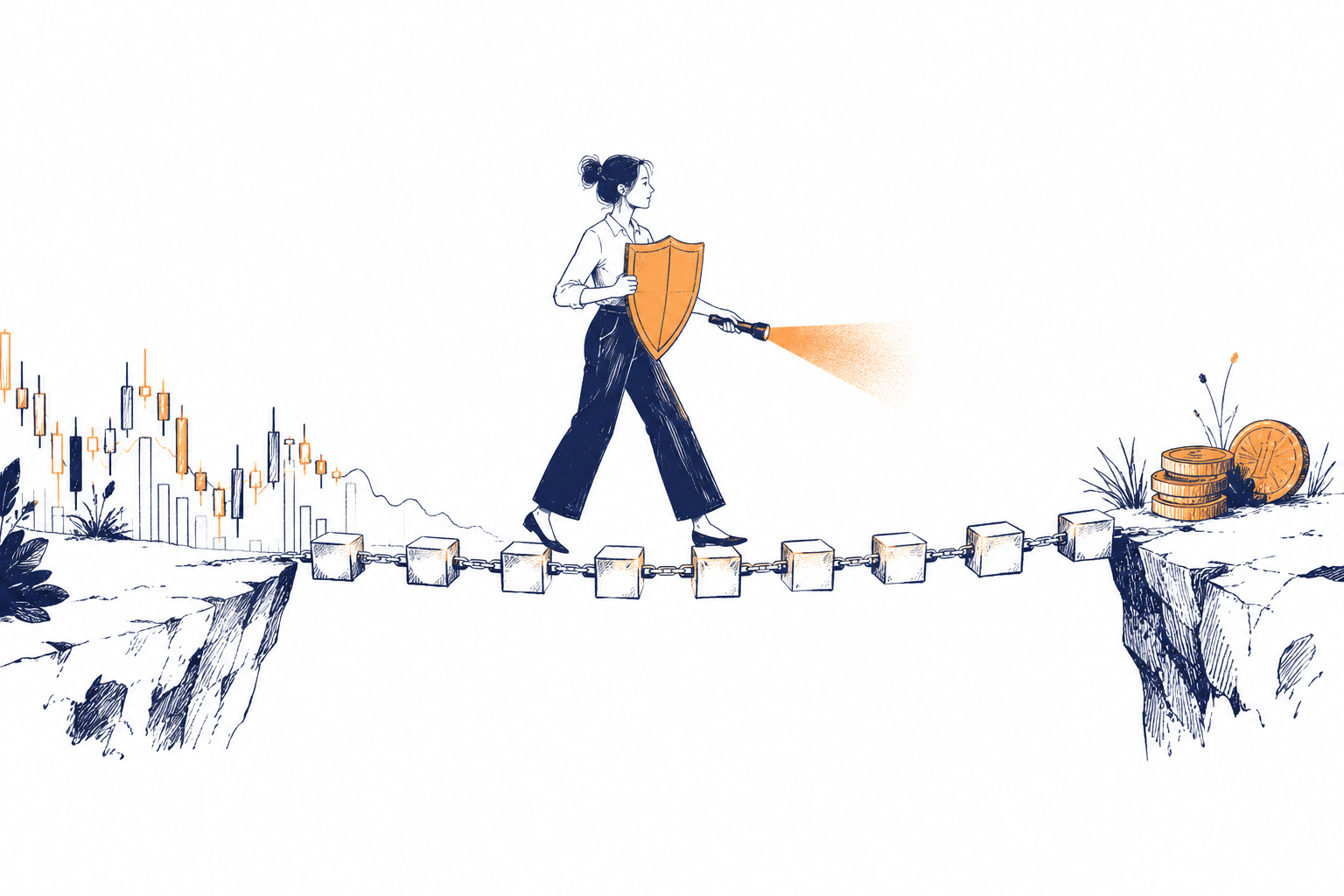

Finding the next Bitcoin is often presented as the ultimate goal of cryptocurrency investing. Yet for most beginners, choosing the “wrong” coin isn’t what causes the biggest losses.
Learning how to invest in cryptocurrency safely therefore starts with a different question. Instead of asking which asset could generate the highest returns, it is often more useful to ask which risks can be controlled before the first purchase is even made.
More often, the damage comes from a series of decisions that have little to do with market performance. Investing money that was needed elsewhere. Buying because everyone else seems to be making profits. Ignoring basic security measures. Selling during periods of panic.
These are mistakes that can affect almost any investor, regardless of which cryptocurrency they choose.
While no investment can eliminate uncertainty, understanding where avoidable mistakes happen makes it easier to build a strategy that can withstand both rising and falling markets.
Most crypto losses have little to do with picking the wrong coin
Price volatility dominates headlines, so it is easy to assume that dramatic market swings are the biggest threat to investors.
Ironically, volatility is often one of the few risks that everyone already expects.
The risks that catch newcomers by surprise tend to be far less visible. Buying after social media excitement peaks, allocating too much money to a single asset, falling victim to scams or storing funds insecurely can all have consequences that last much longer than a temporary market correction.
This changes the way successful cryptocurrency investing should be viewed.
Choosing a promising project certainly matters, but even strong investments can produce disappointing outcomes if poor decisions surround them. Likewise, a diversified portfolio offers little protection if access to the assets is lost through weak account security or compromised wallet credentials.
In other words, successful investing is not simply about finding opportunities. It is equally about reducing the number of avoidable mistakes that can permanently damage long-term results.
That distinction becomes especially important because cryptocurrency gives individuals far more control over their assets than traditional financial systems. Greater control also means greater personal responsibility.
Risk management starts before your first purchase
Many people believe risk management begins once they own cryptocurrency.
In reality, it starts much earlier.
The amount invested often matters more than the cryptocurrency itself. Allocating money that is already needed for rent, bills or emergency expenses creates pressure that can quickly influence future decisions.
A temporary market decline becomes emotionally difficult when the invested capital has another purpose outside the investment portfolio. Instead of viewing volatility as a normal part of financial markets, investors may feel forced to sell simply to recover part of their cash.
This creates a cycle that is difficult to escape. Purchases become driven by optimism, while sales become driven by fear.
One practical way to reduce this pressure is to separate investment capital from money intended for everyday financial obligations. Cryptocurrency remains a high-risk asset class, meaning its price can fluctuate significantly over relatively short periods.
That does not necessarily make it unsuitable for long-term investing. However, it does mean investors should be prepared for periods where prices move sharply in either direction without allowing those movements to dictate every decision.
Position sizing also deserves more attention than it usually receives.
New investors often spend considerable time researching which cryptocurrency to buy but relatively little time deciding how much of their portfolio should be exposed to it.
Concentrating too much capital in a single digital asset increases exposure to unexpected events, whether those involve technological failures, regulatory developments or project-specific challenges.
A useful question before making any investment is surprisingly simple:
If this position lost a significant portion of its value over the next few months, would my overall financial situation remain manageable?
If the answer is no, the problem may not be the cryptocurrency itself. It may be the level of exposure.
Why researching a project matters more than watching its price
One of the easiest traps for new investors is assuming that price tells the whole story.
A cryptocurrency trading at US$ 0.10 can feel like a better opportunity than one worth thousands, simply because it appears “cheaper”. In reality, the price of an individual token says very little about the value of the project behind it.
A low-priced token is not automatically undervalued, just as a high-priced cryptocurrency is not necessarily expensive. What matters is how the network works, whether people actually use it and whether its economic model supports sustainable growth over time.
This is why experienced investors often spend more time understanding a project than watching its daily price movements.
A useful place to begin is by asking simple questions. What problem is this cryptocurrency trying to solve? Is development still active? Does the network have genuine users, or is interest driven primarily by speculation?
Another concept worth understanding is tokenomics — the set of rules that governs how a cryptocurrency is created, distributed and introduced into circulation.
Tokenomics influences far more than many beginners realise. If large numbers of tokens are scheduled to enter the market through future unlocks, for example, the additional supply can affect prices regardless of how optimistic investors feel about the project itself.
Looking at a price chart tells you where an asset has been. Looking at its tokenomics offers clues about the forces that could shape where it goes next.
Research will never remove uncertainty from cryptocurrency investing. Markets remain unpredictable, and even well-designed projects can struggle in changing economic or regulatory environments.
What research does provide is context. Instead of relying entirely on headlines or social media sentiment, investors gain a clearer understanding of what they actually own — and why they chose to buy it in the first place.
That perspective becomes especially valuable when markets stop moving in one direction.
The market is volatile, but your decisions don’t have to be
Every market cycle creates its own narratives.
When prices rise quickly, it can feel as though everyone else is making money. News feeds fill with success stories, social platforms become increasingly optimistic and every missed opportunity seems impossible to recover.
This is where FOMO, or the fear of missing out, becomes one of the most expensive emotions in cryptocurrency investing.
Buying simply because prices have already surged often means following the crowd rather than following a plan. By the time excitement reaches its highest point, early investors may already be taking profits while newcomers are entering positions at far higher prices.
The opposite tends to happen during sharp declines.
Fear replaces optimism. Temporary losses suddenly feel permanent, encouraging investors to sell assets they originally intended to hold for years.
Both situations have something in common: decisions become reactions to market sentiment instead of reflections of a long-term strategy.
Creating rules before investing can help reduce that influence.
Rather than deciding what to do during periods of extreme volatility, investors can define their approach in advance. This may include setting an overall investment budget, deciding what proportion of a portfolio should be allocated to cryptocurrency and establishing a realistic time horizon before making the first purchase.
Some investors also use dollar-cost averaging (DCA), a strategy that involves investing fixed amounts at regular intervals instead of trying to identify the perfect moment to enter the market.
DCA does not eliminate investment risk, nor does it guarantee better returns. Its main advantage is behavioural rather than mathematical. By spreading purchases over time, it reduces the temptation to make decisions based entirely on short-term market movements.
Perhaps the biggest misconception about cryptocurrency investing is that successful investors make better predictions than everyone else.
In many cases, they simply make fewer emotional decisions.
Owning cryptocurrency also means protecting it
Buying cryptocurrency is only one part of the investment process. Keeping it secure is equally important.
Unlike many traditional financial systems, blockchain transactions are generally irreversible. If cryptocurrency is sent to the wrong address or stolen through compromised credentials, recovering those funds can be extremely difficult, and in many cases, impossible.
This makes digital security a fundamental part of responsible investing rather than an optional extra.
Several straightforward practices can significantly reduce unnecessary risks.
Using strong, unique passwords for every exchange or wallet is an obvious first step, but it should not be the only one. Enabling two-factor authentication (2FA) adds another layer of protection by requiring a second form of verification before an account can be accessed.
Where possible, authentication apps are generally considered more secure than SMS verification, which can be vulnerable to attacks such as SIM swapping, where criminals fraudulently gain control of a victim’s phone number.
For investors planning to hold cryptocurrency over longer periods, a hardware wallet can provide additional protection by storing private keys offline, making them much harder for attackers to access remotely.
Yet even the most secure wallet depends on one critical piece of information: the seed phrase.
This sequence of recovery words effectively represents ownership of the wallet itself. Anyone who gains access to it can usually access the assets stored inside.
For that reason, protecting a seed phrase is not simply another security recommendation — it is one of the most important responsibilities that comes with self-custody.
Technology can reduce risk, but it cannot replace careful habits.
The safest crypto strategy isn’t about predicting the future
Every investment involves uncertainty, and cryptocurrency is no exception.
Prices respond to technological developments, regulatory decisions, macroeconomic conditions and shifts in investor sentiment — many of which cannot be predicted with confidence.
The goal of investing safely, therefore, is not to eliminate risk. It is to distinguish between the risks that are unavoidable and those that are entirely within an investor’s control.
Market volatility belongs to the first category.
Poor preparation, emotional decision-making and weak security belong to the second.
That distinction matters because avoidable mistakes often have permanent consequences, while market fluctuations are usually temporary.
The investors who remain in the market through multiple cycles are not always those who discovered the next breakthrough project first. More often, they are the ones who developed habits capable of surviving uncertainty: investing only what they could afford to leave untouched, researching before buying, following a consistent strategy instead of market emotion and treating security as part of the investment itself.
Learning how to invest in cryptocurrency safely is ultimately less about finding certainty than building resilience.
No strategy can guarantee profits, but a disciplined approach can help investors avoid many of the mistakes that prevent them from staying in the market long enough to benefit from experience.