
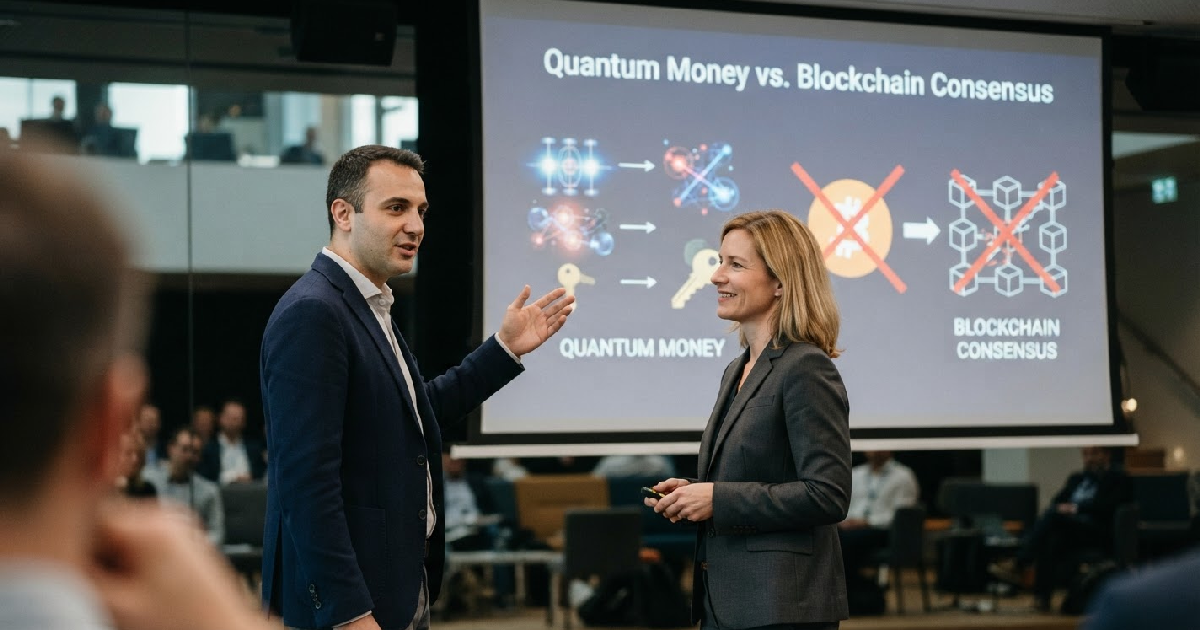

Quantum money, a concept dating back more than half a century, is re-emerging as a potential disruptor to current digital finance models, with prominent experts suggesting it could render blockchain consensus mechanisms obsolete.
Speaking at the latest BeInCrypto Experts Council, Stefano Gogioso and Daniela Herrmann presented the compelling case for quantum money as the “final form of digital cash.” Their argument hinges on a fundamental law of physics, not complex cryptographic algorithms, to guarantee unforgeability.
The enduring quest for trustless currency
This provocative stance challenges the very foundation of systems like Bitcoin, which rely on distributed consensus to validate transactions and prevent double-spending. Gogioso contends that consensus itself acts as the “last middleman,” a role quantum physics could ultimately eliminate. If their vision materializes, it could profoundly reshape how we understand and secure digital value.
The history of money is, at its core, a narrative of trust and its intermediaries. Physical cash, like a gold coin, inherently proves its value and requires no third party for verification, but it struggles with distance. The advent of digital money solved the distance problem, yet it reintroduced intermediaries in the form of banks and payment processors that confirm transactions.
Bitcoin addressed this by replacing institutional trust with mathematical proof and a network-wide consensus mechanism. Thousands of computers collectively agree on a shared transaction history, theoretically removing the need for a central authority. However, this system still necessitates coordination, energy, and agreement among participants.
Wiesner’s quantum money vision
The notion of leveraging physics rather than trust is actually older than both the modern internet and Bitcoin. Columbia University graduate student Stephen Wiesner first proposed his concept of quantum money, initially termed “quantmoney,” around 1970.
Though initially rejected by academic journals, Wiesner’s manuscript, “Conjugate Coding,” finally saw publication in 1983. His radical idea outlined money protected by the immutable laws of physics, making counterfeiting impossible. This pioneering work laid the groundwork for quantum information science, including the foundational BB84 protocol for quantum cryptography.
Physics over algorithms: a new security paradigm
Classical cryptography relies on the computational difficulty of solving complex mathematical problems. A code is considered secure as long as breaking it would take an infeasible amount of time, even for the most powerful supercomputers. Quantum cryptography, however, operates on an entirely different principle.
Its security guarantee stems from the no-cloning theorem, a physical law proven by physicists William Wootters and Wojciech Zurek in 1982. This theorem states that an unknown quantum state cannot be perfectly copied. Any attempt to duplicate such a state inevitably disturbs it, rendering the forgery detectable and ultimately futile.
Device-independent cryptography’s promise
Stefano Gogioso has dedicated years to transforming this theoretical physics into practical applications. He describes self-defending quantum keys that are destroyed if intercepted, preventing unauthorized access. He extended this concept further during the BeInCrypto Experts Council.
Gogioso highlighted the potential for “device-independent cryptography,” where applications can be secured even if the underlying hardware is compromised or supplied by a hostile entity. The system’s security doesn’t depend on trusting the manufacturer; rather, it performs self-tests, refusing to operate if tampered with. This characteristic is especially significant given how easily backdoors can be hidden within complex hardware components today.
This principle directly translates to the realm of money. If a quantum state cannot be copied, it cannot be counterfeited. An item that cannot be forged can inherently serve as a form of money, providing a fundamental layer of security that classical systems cannot match.
Gogioso emphasizes that the inability to cheat or copy directly leads to quantum money and new financial instruments with significantly fewer trust assumptions.
Beyond blockchain: removing the final intermediary
Bitcoin successfully decentralized monetary control by replacing banks with a distributed network. However, it still relies on a consensus mechanism and a shared ledger to agree on which transactions are legitimate. Gogioso identifies this agreement process as the ultimate intermediary. While Web3 and zero-knowledge proofs have enhanced privacy and reduced some trust requirements, consensus remains vital for preventing forgery in these systems.
This reliance on consensus comes with substantial costs, including energy consumption and the need for broad participant agreement. Bitcoin’s energy usage, for instance, is estimated to exceed that of entire nations like Argentina. Quantum money, by contrast, offers a physical guarantee of unforgeability, eliminating the need for these resource-intensive coordination efforts.
Gogioso articulated that quantum money represents the “next and final evolution” in digital currency. It offers a digital asset transmissible over distances, but without the need to trust intermediaries, global ledgers, or specific entities validating transactions. The inherent physics provides direct unforgeability. From this perspective, consensus truly becomes the “last middleman.”
The potential implications are profound. If this assertion holds true, quantum money could stand in relation to Bitcoin much like Bitcoin stood to traditional banking systems. It presents a symmetry where the same quantum physics that might eventually threaten Bitcoin’s cryptographic signatures could also entirely remove the necessity for consensus itself.
The one defense that survives smarter attackers
The current timing for this discussion is particularly relevant given the rapid advancements in artificial intelligence. Many of today’s security protocols assume that attackers aren’t intelligent enough, or that breaking certain problems is computationally too demanding within a reasonable timeframe. Gogioso argues that such assumptions become increasingly fragile as AI capabilities grow.
Physics, however, offers a different kind of assurance. Quantum security is rooted in the fundamental laws of the universe, providing an unbreakable defense. No matter how sophisticated an AI becomes, it cannot alter these foundational principles. At worst, an attacker might prevent a quantum transaction from occurring, but they cannot successfully forge it.
This intrinsic security, independent of an attacker’s intelligence or computational power, represents the deeper appeal of quantum approaches. It shifts the basis of security from human-defined limits to the very fabric of reality.
Quantum cash: not yet ubiquitous, but within reach
Both Gogioso and Daniela Herrmann were careful to manage expectations, acknowledging that quantum money isn’t yet a practical reality. Herrmann, whose company develops commercial quantum tools, clarified that while quantum money is a future vision, its widespread availability depends on further technological advancements.
The primary hurdle remains quantum memory. Maintaining fragile quantum states for extended periods is a significant challenge, with current systems only capable of holding them for seconds. This limitation currently prevents the full realization of quantum money, though existing hardware can support shorter-lived quantum tasks.
Despite these challenges, significant progress is being made. Laboratory experiments have already started demonstrating quantum tokens and related schemes, moving the concept beyond theoretical papers. Gogioso expressed optimism for the near future, stating that within five to seven years, we could be living in a world where quantum resources enable previously impossible feats.
He underlined that the software required for these capabilities can be developed today, rather than waiting years for hardware to catch up. More than five decades after Stephen Wiesner first envisioned money protected by physics, the idea is actively transitioning from concept to tangible research. If Gogioso and Herrmann are correct, the era of consensus as the indispensable middleman in digital finance may soon draw to a close.