
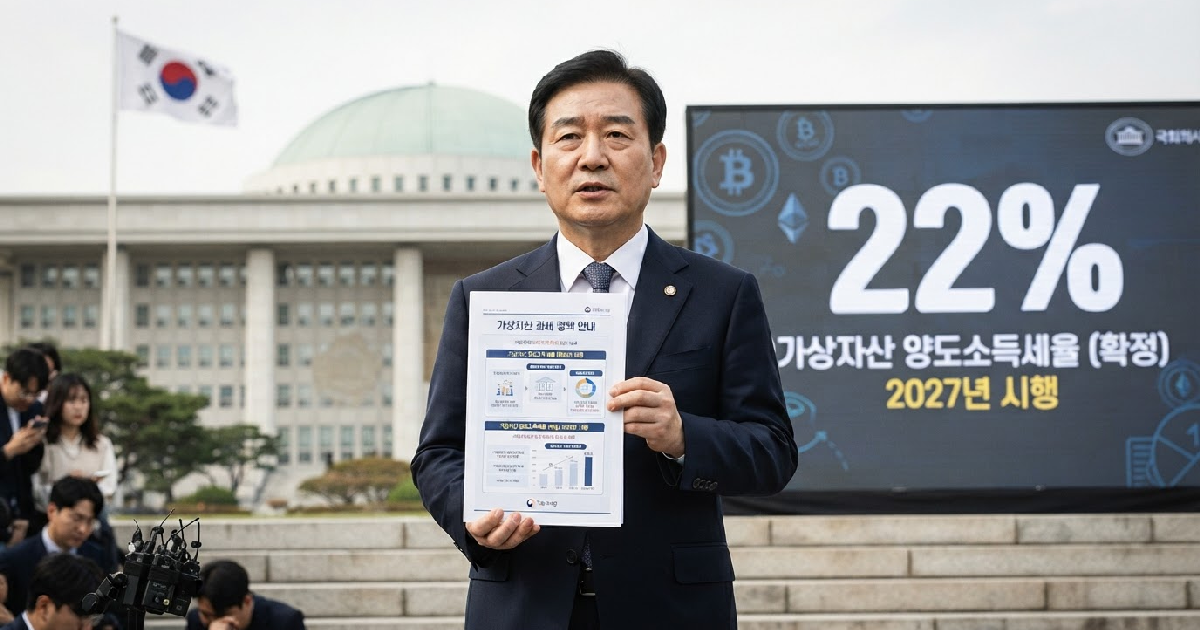

South Korea is moving ahead with its plan to impose a 22% tax on annual cryptocurrency gains exceeding 2.5 million won, equivalent to roughly $1,740 USD, beginning January 1, 2027.
This decision, confirmed by Deputy Prime Minister Koo Yun-cheol on July 29, 2026, signals the government’s firm intent to implement the long-delayed measure despite a significant political battle unfolding in the National Assembly and widespread public opposition.
South Korea’s crypto tax framework takes shape
The announcement ends months of speculation and repeated postponements, establishing a firm timeline for investors who will file their first crypto tax returns in May 2028. This move positions South Korea alongside other major economies that have already begun taxing digital asset profits.
Under the new rules, any income derived from transferring or lending cryptocurrency will be categorized as “other income” for tax purposes. The system allows for an annual deduction of 2.5 million Korean won, meaning only gains above this threshold will incur the tax.
The tax rate itself will be a combined 22%, comprising a 20% national tax and an additional 2% local income tax. The National Tax Service (NTS) is currently finalizing implementation guidance and has been holding working-level meetings with the country’s five major crypto exchanges, including Dunamu (Upbit), Bithumb, Coinone, Korbit, and Gopax, to ensure smooth compliance ahead of the 2027 deadline.
One of the most contentious aspects of the new framework is the government’s current refusal to allow crypto loss carryforwards. This means investors cannot offset current year gains with losses from previous years, a feature common in traditional capital markets. Critics say this could disadvantage domestic investors and push trading volume towards offshore platforms.
Political and public outcry against the levy
The government’s resolve to push through the tax comes after three previous delays, with the measure originally slated for January 2022. Each postponement reflected strong political pushback and public discontent. This time, the opposition People Power Party (PPP) remains steadfast in its efforts to repeal the tax entirely.
Lawmaker Song Eon-seok of the People Power Party introduced an amendment to the Income Tax Act in March 2026, aiming to abolish the crypto tax. That bill was referred to a parliamentary subcommittee on July 29, 2026, where its fate remains uncertain.
Meanwhile, a public petition calling for the complete abolition of the tax has gathered 58,571 signatures, well past the 50,000 required for mandatory legislative review by the National Assembly.
Opponents argue that taxing ordinary crypto investors so heavily, especially without allowing for loss carryforwards, is unfair when most retail stock gains remain exempt from similar levies. They also raise concerns about potential double taxation, as crypto assets are already subject to Value Added Tax (VAT).
Moreover, the complexity of calculating acquisition costs, particularly for non-resident foreign investors, poses a significant logistical challenge. These factors, critics warn, could lead to a substantial shift in trading activity away from regulated domestic exchanges.
Government stands firm on implementation
Despite the opposition, the South Korean government and the ruling Democratic Party are determined to move forward. Deputy Prime Minister Koo Yun-cheol explicitly told lawmakers at a National Assembly Finance and Economy Planning Committee meeting on July 29, 2026, that “We are pushing forward with the plan to tax cryptocurrency starting next year as scheduled.”
Moon Kyung-ho, director of the Finance Ministry’s income tax division, echoed this sentiment in May 2026.
Senior specialist Choi Byung-kwon of the National Assembly’s Fiscal and Economic Planning Committee has cautioned against repealing the policy. He argued that such a reversal could damage the government’s tax credibility and introduce unwanted volatility into the crypto market. Choi also highlighted that many major global economies already tax digital asset income, suggesting South Korea is aligning with international standards.
Broader digital asset legislation
The implementation of this tax is also part of a larger legislative effort to regulate the burgeoning digital asset sector. The Financial Services Commission (FSC), in collaboration with the ruling Democratic Party, is preparing a consolidated Digital Asset Basic Act. This act aims to bring together ten pending digital asset bills under a single framework.
The proposed legislation intends to establish clear rules for stablecoin issuance and circulation, define digital asset businesses, regulate their conduct, set entry standards for exchanges, and mandate disclosure requirements and internal controls. FSC Chairman Lee Eog-weon had previously stated that comprehensive digital asset legislation should be finalized during 2026.
This comprehensive approach underscores the government’s commitment to integrating digital assets into the broader financial system, albeit with a focus on regulatory oversight and revenue generation.
Implications for investors and the market
For South Korean crypto investors, the looming 2027 tax deadline means they must begin meticulously tracking their gains and losses. The absence of loss carryforwards means every profitable trade above the 2.5 million won threshold will be subject to the 22% levy, regardless of previous capital losses. This could significantly impact trading strategies, particularly for active traders.
The debate around whether crypto profits should be treated as “other income” rather than capital gains also remains a point of contention. Deputy Prime Minister Koo Yun-cheol noted that reclassifying crypto as capital gains would require a more extensive review of the country’s entire capital-market tax regime.
This distinction has crucial implications for how investors view their digital asset holdings in comparison to traditional investments like stocks.
The government’s firm stance, despite the parliamentary and public resistance, suggests a growing global trend towards greater regulation and taxation of the cryptocurrency space. While the specifics vary by jurisdiction, the underlying principle of taxing digital asset profits is gaining wider acceptance among national treasuries worldwide.
How South Korea’s approach ultimately impacts its domestic crypto industry, particularly in light of the developing regulatory infrastructure, will be closely watched by other nations contemplating similar policies.
Unless lawmakers successfully repeal or further delay these provisions, South Korea’s crypto tax regime will officially commence at the start of next year. Investors and market participants will then have a clearer picture of the long-term tax landscape for digital assets in one of Asia’s most dynamic crypto markets.