
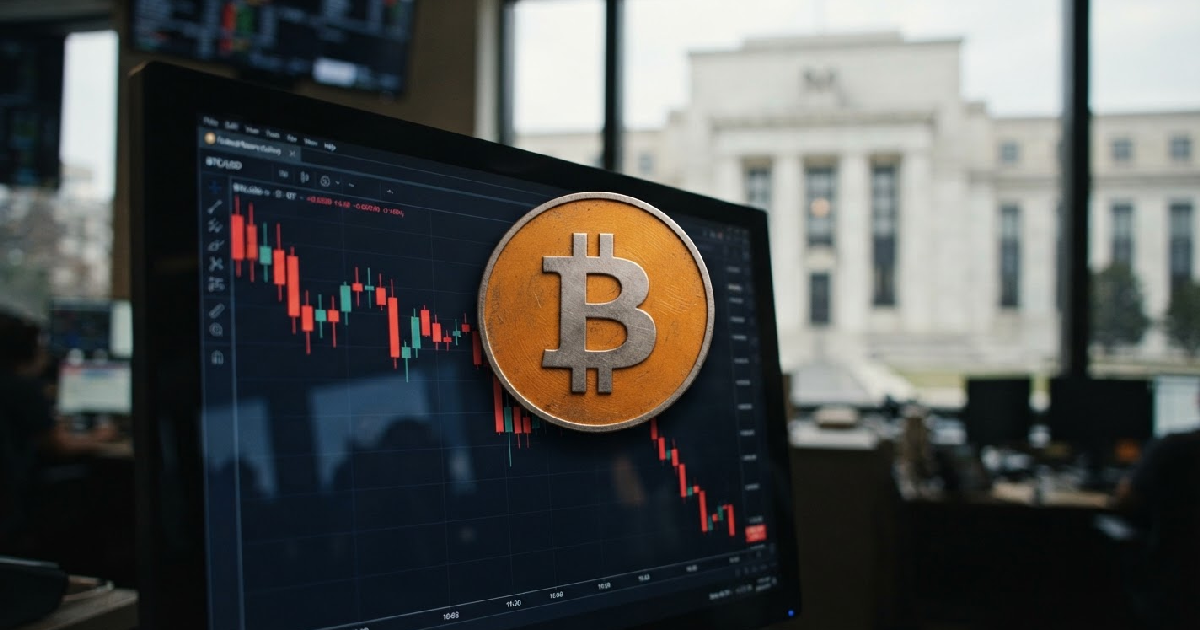

Bitcoin experienced a significant downturn during Asian trading hours on July 28, 2026, falling sharply as market participants began recalibrating their expectations for a more aggressive, hawkish stance from the United States Federal Reserve.
This unexpected shift in sentiment, driven by robust labor data, firmer business activity, and persistent inflation, has put immediate downward pressure on risk assets across the board, including the world’s largest cryptocurrency.
Federal Reserve’s Unexpected Hawkish Pivot
The move marks a notable reversal from just a day prior, when a dovish outlook for the Fed had dominated market discourse. But the confluence of strong economic indicators has suddenly refocused investor attention on the prospect of tighter monetary policy, creating fresh headwinds for digital asset valuations.
The sudden intensification of hawkish Federal Reserve expectations comes as a surprise to many, especially after recent weeks had pointed towards a loosening of monetary policy. Strong labor market reports, resilient business activity, and stubbornly high inflation figures have prompted a re-evaluation of the Fed’s likely trajectory.
These data points appear to contradict earlier signals of a cooling economy. Investors now anticipate the central bank may need to maintain higher interest rates for longer, or even consider another hike, to bring inflation back to its 2% target. This sentiment directly contrasts with the recent hopes for imminent rate cuts.
Reversing Course from Dovish Hopes
Just a day before Bitcoin’s sharp fall, on July 27, 2026, market expectations painted a vastly different picture for the Federal Reserve. The CME FedWatch tool had shown a 92% probability for a 25 basis point rate cut by September, a substantial jump from 78% only a week earlier.
Furthermore, the likelihood of cumulative 50 basis point cuts by year-end had reached 68%. These dovish expectations were predicated on consistently declining inflation data and signs of a cooling labor market, including July nonfarm payrolls slowing to 150,000 and the unemployment rate ticking up to 4.1%.
Bitcoin’s Heightened Sensitivity to Macroeconomic Pressures
Bitcoin, often considered a bellwether for the broader cryptocurrency market, continues to demonstrate its increasing sensitivity to global macroeconomic conditions. As a “risk-on” asset, its price performance is intrinsically linked to factors like interest rates, liquidity, and investor appetite for speculative ventures.
A hawkish Federal Reserve environment generally means higher interest rates and less liquidity flowing through the financial system. This makes traditional, less volatile assets more attractive and increases the opportunity cost of holding non-yielding cryptocurrencies, prompting investors to de-risk their portfolios.
Historical Precedents and Market Reactions
Bitcoin’s journey has been marked by pronounced reactions to the Federal Reserve’s monetary policy cycles. During the quantitative easing (QE) era of 2020-2021, characterized by near-zero interest rates and abundant liquidity, Bitcoin soared from approximately $7,000 to nearly $69,000.
Conversely, the aggressive rate hike cycle of 2022-2023, where the Fed raised rates 11 times, saw Bitcoin plummet from around $47,000 to roughly $15,500. This historical pattern underscores the direct correlation between the Fed’s stance and Bitcoin’s valuation, with tightening cycles typically leading to downward pressure.
Broader Impact on Digital Assets and Institutional Holdings
The ripple effects of shifting Federal Reserve expectations extend beyond Bitcoin itself, influencing the wider digital asset ecosystem and institutional investment strategies. When risk appetite diminishes, outflows from crypto investment vehicles, such as spot Bitcoin exchange-traded funds (ETFs), become more common.
Looking back at June 2026, for instance, U.S. spot Bitcoin ETFs experienced $82.2 million in outflows, reversing a previous day’s inflow. BlackRock’s IBIT saw a $31 million loss, while ARKB dropped $44 million in outflows. Ethereum ETFs also weren’t spared, losing $29 million. Such movements highlight how quickly institutional money can react to macroeconomic signals.
Tesla’s Bitcoin Holdings See Impairment
Even major corporate holders of Bitcoin aren’t immune to these market fluctuations. Tesla’s Q2 earnings report, released recently, revealed its Bitcoin holdings remained unchanged at 11,509 BTC. However, a 14% quarterly decline in Bitcoin’s price forced the electric vehicle giant to recognize a $112 million impairment.
This real-world example demonstrates the direct financial consequences for companies that have integrated cryptocurrencies into their balance sheets, underlining the volatility inherent in such assets, particularly when influenced by external economic forces.
What Comes Next: Eyes on the FOMC and CPI
All eyes are now turning to the Federal Open Market Committee (FOMC) meeting scheduled for July 28-29, 2026, with the interest rate decision expected on Wednesday, July 29, at 2:00 PM Eastern Time (6:00 PM GMT). Any hawkish rhetoric or concrete action from the Federal Reserve will likely further influence market sentiment and risk asset pricing.
Beyond the immediate FOMC decision, investors are also keenly awaiting the release of July Consumer Price Index (CPI) data by the U.S. Bureau of Labor Statistics on August 13. Market expectations currently hover around 3.0% year-over-year growth for headline CPI and 3.2% for core CPI.
These inflation figures will be crucial in shaping the Fed’s future policy decisions and, consequently, the trajectory of Bitcoin and other risk assets.