
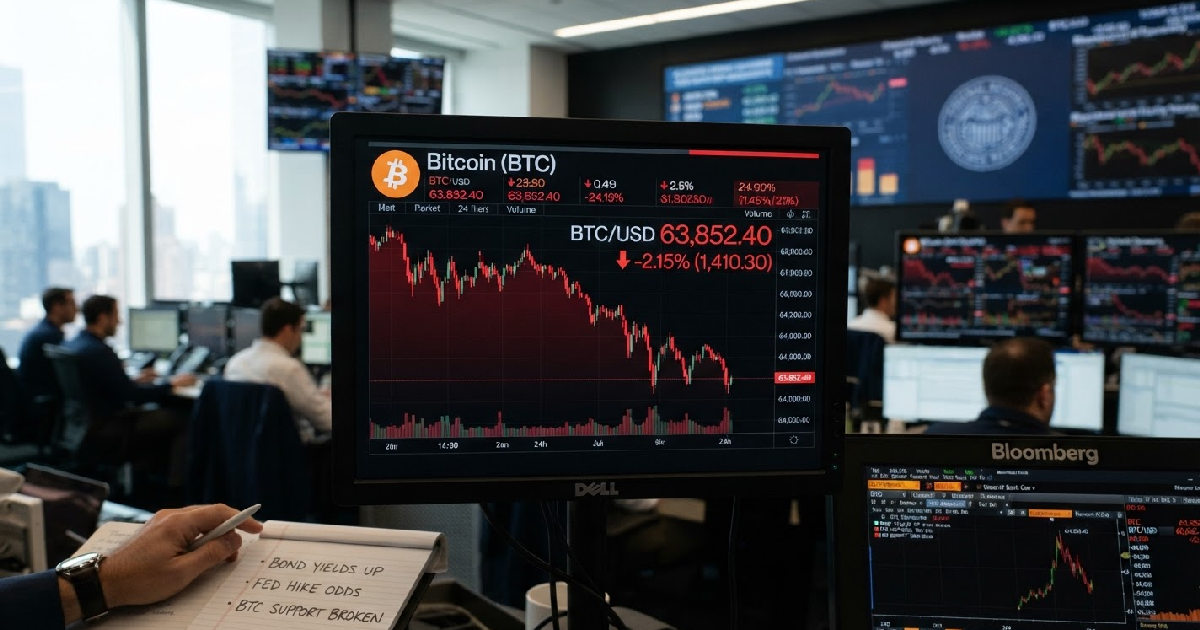

Bitcoin retreats below $64,000 on Friday, July 24, 2026, dropping more than 1.6%. 6% to fall below the critical $64,000 level on Friday, July 24, 2026. This price correction intensified after Wall Street trading began, largely driven by surging US bond yields and escalating expectations for a Federal Reserve interest rate hike.
The cryptocurrency market, and Bitcoin in particular, has grown increasingly sensitive to broader macroeconomic headwinds and geopolitical tensions. This environment continues to reduce investor appetite for risk assets, pushing down valuations across the digital asset space.
Bitcoin faces fresh pressure at $64,000 mark
The latest downturn saw Bitcoin approach $64,000 as bulls struggled to maintain recent gains. Market analytics account Wealthmanager noted that a sustained break below $64,000 would “invalidate” the low-timeframe market structure, signaling further potential downside.
Earlier in the week, on July 21, 2026, Bitcoin had traded near a two-week high of around $65,500. Its current real-time price stood at $65,392.20 USD as of July 24, 2026, showcasing the swiftness of Friday’s correction.
Echoes of previous bear market behaviour
Crypto trader Killa observed that BTC was repeating a familiar short-term trading pattern. Adding to this, analyst Rekt Capital theorized that BTCUSD mirrored behavior seen during the 2022 bear market.
This pattern involved a rejection from the 50-month exponential moving average (EMA) at $65,950. Bitcoin had earlier fallen from an October 2025 high near $126,000 to a 21-month low of $58,000 in late June 2026, then partially recovered.
Soaring US bond yields tighten financial conditions
A primary catalyst for Bitcoin’s slide has been the rapid ascent of US Treasury yields. The 2-year Treasury yield, a key indicator of short-term interest rate expectations, reached approximately 4.36% on Thursday, July 23, 2026, its highest point since early 2025.
Mosaic Asset Company, a trading firm, explicitly stated that these rising yields were a significant driver of the crypto sell-off. The 2-year yield finished at 4.33% on Friday, climbing approximately 15 basis points over the week, according to Chandler Asset Management.
10-year and 30-year yields also climb
The 10-year Treasury note yield closed at 4.69%, as reported by Advisor Perspectives and Trading Economics. This yield edged up by 0.29 points over the past month and stands 0.30 points higher than a year ago, reflecting a broader tightening trend.
Chandler Asset Management noted the 10-year yield rose approximately 12 basis points over the week to about 4.67%. The 30-year Bond Yield held steady at 5.16% on July 24, 2026.
This remained above the 5% threshold, with Chandler Asset Management observing it at approximately 5.15%.
Federal Reserve faces harder case to hold rates
These bond market movements are directly influencing expectations for the Federal Reserve’s monetary policy. The Fed’s policy-setting body, the Federal Open Market Committee (FOMC), is scheduled to meet on July 28-29, 2026.
Its interest rate decision will be announced on Wednesday, July 29, at 2 p.m. ET, followed by a press conference at 2:30 p.m. ET. The Fed’s current federal funds rate target stands at 3.5% to 3.75%, with an inflation target of 2%.
Rate hike odds increase despite stable inflation
Current inflation sits at 3.7%, according to Governor Lisa Cook. Even with the Fed’s preferred Personal Consumption Expenditures index at 4.1% (with a core reading of 3.4%), market odds for a rate hike have surprisingly grown.
Nigel Green, CEO of deVere Group, commented on July 23 that “The Fed will find holding steady a harder case to make than it looked even a few weeks ago.”
CME Group’s FedWatch Tool now shows a 38% likelihood of a rate hike at the upcoming meeting. This marks a significant jump from just 12% a week prior.
Prediction markets like Kalshi also reflect this shift, indicating a 24% chance of a 25 basis point hike. Still, the probability of a hold remains higher at 74%.
Gregory Daco, Chief Economist for EY-Parthenon, stated in a July 22 email that a July hike remains “highly unlikely.” He added that the September FOMC meeting could test the durability of recent inflation improvements.
Daco’s base case is for the Fed to stay on hold, but he calls it a “60–40 call.” This highlights the persistent uncertainty surrounding monetary policy.
Trader outlook remains cautious ahead of FOMC
The immediate outlook for Bitcoin remains intertwined with the Federal Reserve’s upcoming decision and broader macroeconomic indicators. Recent events have tempered earlier market sentiment, which had suggested a 78.5% probability of Bitcoin hovering around $67.5k for July 2026.
Predictions for July 2026 had Bitcoin trading between $56,000 and $62,000 until the Fed meeting, underscoring the high anticipation. If Bitcoin breaks above $63,800, the downtrend might be over.
However, a drop below $56,200 could open the door to the $50,000 to $53,000 range. This would signal significant further market weakness.