
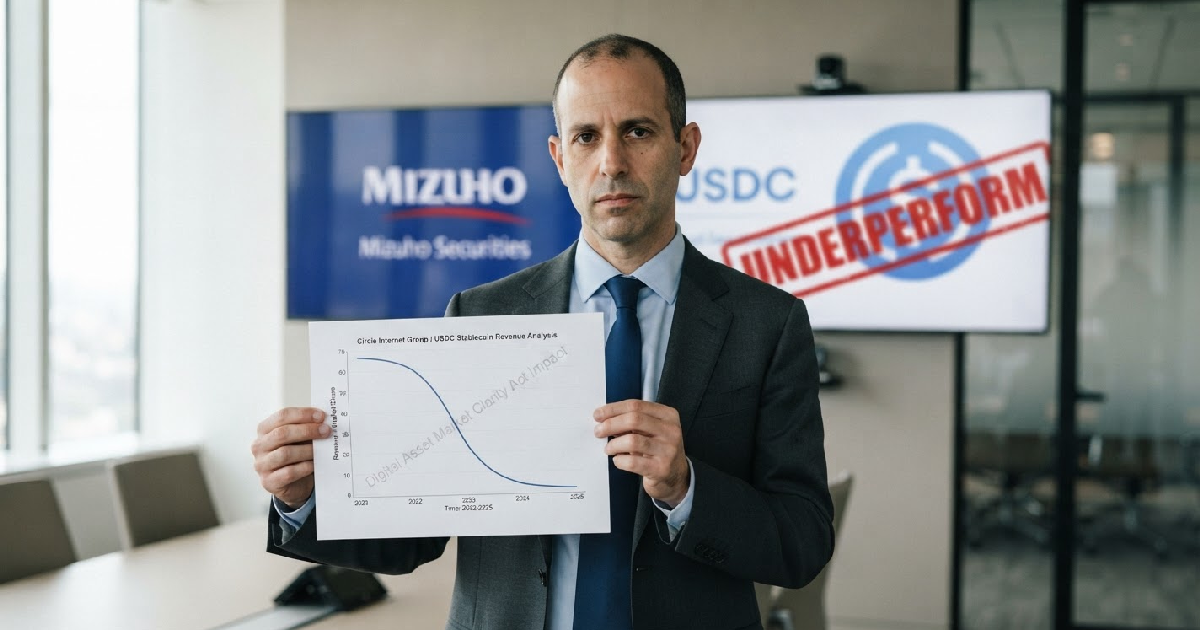

Mizuho analyst Dan Dolev has issued an “Underperform” rating for Circle Internet Group (CRCL), slashing its price target to $50 from $85, warning that the Clarity Act Circle impact may erode USDC revenues long term.
This downgrade, reported on July 21 and 22, 2026, stems from Dolev’s concern that the impending Digital Asset Market Clarity Act will significantly intensify competition for Circle’s dominant USDC stablecoin, ultimately eroding the company’s revenue base.
Mizuho forecasts challenges for Circle’s USDC revenue
The emergence of OpenUSD, a new stablecoin backed by a powerful consortium including Coinbase, poses a direct threat to Circle’s market position.
While the Clarity Act is widely anticipated to usher in a new era of regulatory certainty for the cryptocurrency industry, Mizuho’s analysis suggests it could have an unexpected, adverse effect on established stablecoin issuers like Circle. For CRCL investors, the news saw shares dip 6% to $67, despite an earlier 7% intraday rally fueled by broader optimism around the Act’s passage.
Dan Dolev and his team at Mizuho contend that regulatory clarity, far from insulating Circle, will invite a surge of institutional-grade competition into the stablecoin sector. This influx, they believe, will hasten the commoditization of crypto tokens, specifically impacting USDC and its revenue streams.
The core of the issue, according to Mizuho, lies in the stablecoin market’s evolving dynamics. More players mean tighter margins and a fight for market share, a scenario less favorable for incumbents who’ve enjoyed a relatively less crowded field.
Downgrade reflects competitive concerns
Mizuho’s decision to reiterate an “Underperform” rating and reduce Circle’s price target from $85 to $50 underscores their conviction. This adjustment comes after careful consideration of the regulatory shift and new competitive landscapes.
Circle Internet Group (CRCL) shares, which trade on the NYSE, initially saw an uptick on July 21, 2026, as hopes for the Clarity Act’s passage buoyed market sentiment. However, the subsequent Mizuho report prompted a 6% decline, settling the stock at $67 on the day.
The threat from OpenUSD’s business model
A significant factor in Mizuho’s bearish outlook is the recently launched OpenUSD (OUSD), a dollar-pegged stablecoin that debuted on June 30, 2026. OpenUSD operates under Open Standard, an independent consortium governance model supported by over 140 influential firms.
This powerful consortium includes major players like Visa, Mastercard, Stripe, BlackRock, and Coinbase. Crucially, OpenUSD employs a “pass-through” model for its reserve yield, directing nearly all of it to distributors and retaining only a minimal management fee.
This contrasts sharply with Circle’s model, where it retains approximately 38% of USDC’s reserve income after sharing revenue with partners such as Coinbase and Binance. Mizuho warns that OpenUSD’s structure will suppress Circle’s margins and intensify pricing pressure.
Clarity Act’s double-edged sword for stablecoins
The Digital Asset Market Clarity Act (H.R. 3633) represents a monumental effort to establish a coherent regulatory framework for cryptocurrencies in the U.S. Introduced in May 2025 by House Financial Services Committee Chairman French Hill and House Agriculture Committee Chairman G.T. Thompson, it aims to clarify long-standing ambiguities.
However, what benefits the broader market by providing structure might concurrently introduce unforeseen challenges for specific players. Regulatory certainty can cut both ways, fostering growth but also inviting fiercer competition.
Legislative progress and key provisions
The Clarity Act has made significant strides through Congress. The House passed H.R. 3633 on July 17, 2025, with strong bipartisan support, receiving 294 votes to 134. More recently, the Senate Banking Committee approved its segment of the Act on May 14, 2026, by a margin of 15 to 9.
The White House has reportedly agreed to an ethics package, clearing a major hurdle for a Senate floor vote, which could happen as soon as next week. Key provisions include granting the Commodities Futures Trading Commission (CFTC) oversight of crypto-spot markets while maintaining the SEC’s jurisdiction over investment contract assets.
The bill also establishes a federal market structure, includes consumer protection measures, and defines “mature blockchain” to distinguish between securities and commodities. It notably prohibits yield on idle stablecoins but allows for activity-based rewards, with regulators given one year to define these permitted activities.
New regulatory landscape encourages competition
For years, regulatory uncertainty acted as a barrier to entry for many traditional financial institutions and large corporations. The Clarity Act, by providing a clearer rulebook, effectively dismantles this barrier.
Mizuho argues this newfound clarity will inevitably attract a wave of well-capitalized new entrants into the stablecoin market. These institutional players, often with vast networks and deep pockets, are poised to challenge the dominance of established issuers like Circle.
Coinbase’s evolving role and negotiating leverage
Coinbase, a key partner and the largest distributor for Circle’s USDC, has openly endorsed the OpenUSD project. This endorsement is a critical development that could reshape the dynamics of its relationship with Circle.
Mizuho analysts specifically highlight that Coinbase’s support for OpenUSD will grant it significant additional leverage in its upcoming revenue-sharing negotiations with Circle. These agreements, which dictate how yield from USDC reserves is split, are due for renegotiation as soon as next month, likely August.
Circle’s market position amidst changing tides
Circle, the sole issuer of USDC, has built a robust and compliant operational framework. The company, which went public on the NYSE in June 2025 under the ticker CRCL, holds money transmitter licenses across 49 U.S. states, a NYDFS BitLicense, and a French ACPR Electronic Money Institution license under MiCA regulations.
Its commitment to compliance was further evidenced by its adherence to the GENIUS Act, signed into law in July 2025, which defines payment stablecoins and mandates 1:1 reserves of cash or short-dated Treasuries, monthly attestations, and annual audits for issuers above $50 billion. Circle already met these conditions.
Furthermore, the company recently secured approval from the Office of the Comptroller of the Currency (OCC) to establish a national digital currency bank.
USDC circulation has seen substantial growth, increasing approximately 80% over the past two years, from $33 billion in early 2024 to about $60 billion by Q1 2026.
As of July 20, 2026, there was $73.1 billion USDC in circulation, fully backed by $73.4 billion USD in reserves, managed by BlackRock and attested by Deloitte & Touche monthly.
Despite these strong fundamentals and impressive growth, the competitive pressures highlighted by Mizuho, driven by regulatory clarity and new entrants like OpenUSD, represent a significant challenge to Circle’s long-term profitability and market dominance.