
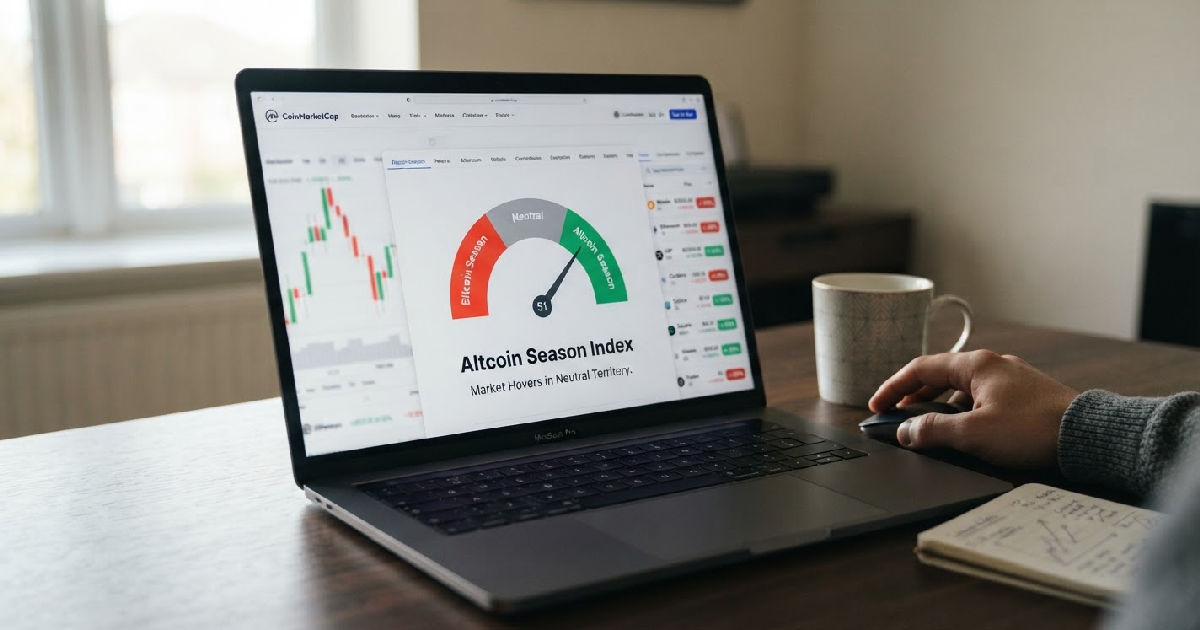

CoinMarketCap’s Altcoin Season Index registered a value of 51 on July 20, 2026, positioning the cryptocurrency market squarely in a neutral zone. This reading suggests that the market isn’t currently experiencing a decisive “altcoin season” where alternative cryptocurrencies broadly outperform Bitcoin, nor is it a period of clear Bitcoin dominance.
The updated real-time metric reflects a period where the performance of altcoins has been mixed against Bitcoin over the preceding 90 days. For traders and investors, this equilibrium point often signals a period of strategic re-evaluation and potential volatility before the market commits to its next significant trend.
What the Altcoin Season Index Means
The Altcoin Season Index is a widely recognized tool from CoinMarketCap designed to measure the relative performance of altcoins against Bitcoin. It specifically tracks the price performance of the top 100 cryptocurrencies by market capitalization, meticulously excluding stablecoins and wrapped tokens like Wrapped Bitcoin (WBTC) or Lido Staked ETH (stETH).
Its methodology is straightforward yet effective. An “altcoin season” is officially declared if 75% or more of these selected altcoins surpass Bitcoin’s performance over a rolling 90-day window. Conversely, if fewer than 25% of these altcoins outpace Bitcoin, the market enters a “Bitcoin season.”
A score between 25 and 75, including the current reading of 51, categorizes the market as neutral or transitional. This indicates that while roughly half of the top altcoins have shown better returns than Bitcoin, the other half have not, creating a balanced and often indecisive market environment.
This metric serves as a useful snapshot of relative strength across different cryptocurrency asset classes, complementing other indicators like Bitcoin dominance and total market capitalization for a more comprehensive market view.
Implications of the Current Neutral Reading
The Altcoin Season Index hovering at 51, notably close to the 50-point midpoint, underlines a market that hasn’t yet shown a clear directional bias. This lack of a decisive tipping point in either direction can be a challenging environment for traders seeking strong trends.
Historically, such neutral readings have often preceded periods of increased market volatility. This is typically when professional traders and institutional investors begin positioning their portfolios in anticipation of the next major market move, be it a resurgence of Bitcoin or a broader altcoin rally.
For short-term traders, the 51 reading suggests prudence and a “wait-and-see” approach might be optimal, as significant capital rotation hasn’t fully commenced. The market isn’t offering clear signals for aggressive directional bets on either side.
Long-term investors, however, might view this neutral phase as an opportune period for accumulation. They often focus on altcoins with robust fundamentals and demonstrable network activity, looking to build positions before a potential uptrend gains momentum.
Historical Context of Cryptocurrency Cycles
Understanding the current neutral state requires looking back at previous market cycles. Altcoin seasons are not new phenomena; they typically emerge after Bitcoin has experienced significant price rallies and subsequently enters a phase of stability or consolidation.
A notable altcoin season occurred in late 2017 to early 2018, primarily fueled by the Initial Coin Offering (ICO) boom. During this period, capital flowed from Bitcoin into Ethereum and then into numerous new project tokens, causing Bitcoin dominance to plummet from over 80% to around 31%.
More recently, the 2021 DeFi and NFT summer also saw a pronounced altcoin season. Decentralized Finance protocols and Non-Fungible Tokens drove significant interest and capital inflows, with Bitcoin dominance falling from nearly 70% to just under 40% as large-cap altcoins delivered returns of 174% while Bitcoin gained only 2% in the first half of that year.
The current market structure in 2026, though, presents a different landscape compared to these earlier cycles. The influence of institutional capital, particularly through mechanisms like the Spot Bitcoin Exchange-Traded Funds (ETFs) launched in the U.S. in January 2024, plays a more significant role. Funds entering the market via these ETFs tend to remain concentrated in Bitcoin, potentially altering the dynamics of capital rotation into altcoins.
Navigating Future Market Shifts and Indicators
While the Altcoin Season Index offers valuable insight, it’s not the sole determinant of market direction. Analysts widely agree that a sustained altcoin season would likely require Bitcoin dominance to fall below the 50-55% threshold, a level it typically oscillates between 40% and 60% as of 2026.
Another critical factor is the Bitcoin halving, with the most recent one occurring in April 2024. Historically, major altcoin rallies often emerge 12 to 18 months post-halving. This timing aligns with predictions that 2026-2027 could still be favorable for altcoins, provided other conditions align.
However, the evolving market structure means future altcoin seasons might look different. Experts like Ki Young Ju, CEO of CryptoQuant, suggest a “new Altcoin Season” might prioritize capital flow into established stablecoins or widely accepted altcoins, rather than a broad surge across all smaller, more speculative tokens. This implies a more discerning market, potentially driven by institutional preferences.
Beyond the index, market participants will be closely monitoring other key indicators. These include movements in Bitcoin dominance, the ETH/BTC ratio, and overall altcoin trading volumes. Shifts in public sentiment, often gauged through social media trends and the Crypto Fear and Greed Index, will also provide clues as to when the market might finally commit to a clear trend.
The Altcoin Season Index at 51, therefore, isn’t just a number; it’s a signal of ongoing market indecision and a precursor to potential shifts. It emphasizes that while the market currently hovers in equilibrium, various underlying forces are at play, shaping what comes next for the broader cryptocurrency ecosystem.
Traders and investors should continue to track this index alongside broader market conditions, global regulatory developments, and macroeconomic factors. These elements collectively will dictate whether capital ultimately flows back into Bitcoin, igniting another Bitcoin season, or disperses more widely, ushering in a robust altcoin rally.
The prudent approach remains one of cautious observation, allowing the market to reveal its next dominant narrative before making significant directional commitments.