
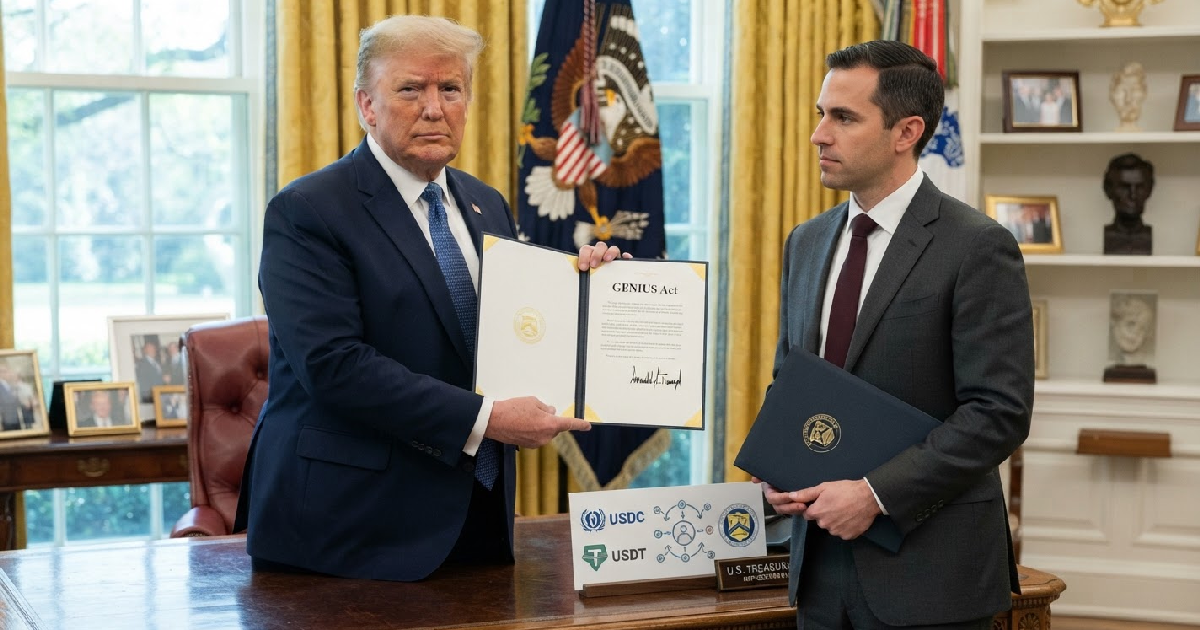

The GENIUS Act, signed into law by President Donald Trump on July 18, 2025, established a comprehensive federal regulatory framework for stablecoins. S. Stablecoins Act (GENIUS Act), signed into law by President Donald Trump on July 18, 2025, marks its first anniversary today. This federal law, identified as Public Law 119–27, created a comprehensive regulatory framework for stablecoins, aiming to replace fragmented state rules with a unified standard. It mandates one-for-one liquid reserves, redemption rights, and monthly disclosures.
A year in, the Act has injected federal legitimacy into the stablecoin sector, fostering significant market growth and institutional acceptance. This shift has occurred despite core implementation rules still being in proposal form. Today, the stablecoin market holds about $310 billion, a figure that underscores the law’s profound impact.
GENIUS Act drives stablecoin market expansion
The stablecoin market has seen substantial growth since the GENIUS Act’s enactment. As of July 18, 2026, the total market capitalization stands at approximately $310 billion. Federal Reserve researchers, for instance, estimated the capitalization at $317 billion on April 6, 2026.
This represents a more than 50% increase in market value since early 2025, before the law took effect. Tether’s USDT accounts for about $184 billion of this total, while Circle’s USDC holds roughly $73 billion. Additionally, Ethereum stablecoin transaction volume has climbed 50% since the Act’s enactment.
Kyle Sonlin, President and Co-founder of Global Settlement Network, notes a significant change in industry dialogues. He says conversations with governments and institutions now “start from acceptance of stablecoins as financial infrastructure.” His team now spends “far less time explaining why stablecoins matter.”
Enterprise adoption accelerates through regulatory clarity
The Act’s clarity has directly impacted enterprise sales funnels. Eric Barbier, CEO of Triple-A, observes that businesses are increasingly moving from evaluation to implementation for stablecoin payments through his platform. He points to a “marked reduction” in sales cycles for these enterprise customers.
Barbier highlights how the Act has “ushered in a significant, positive shift in stablecoin adoption, especially amongst businesses.” He adds that the legislation “has not just brought regulatory clarity, but also brought stablecoins into the mainstream.” This commercial shift is evident in broader institutional movements.
Visa’s expansion offers a notable institutional reference point. Its stablecoin settlement pilot now supports nine blockchains and reached a $7 billion annualized settlement run rate by April, marking a 50% increase from the previous quarter. On July 16, Visa also introduced an enterprise platform providing financial institutions and fintech firms with access to stablecoin storage, redemption, minting, and burning through a single Visa-managed environment.
Persistent banking friction delays full integration
Despite the improved sales environment, integrating stablecoins into existing financial systems still faces hurdles. Diogo Cassinelli, sales and partnerships manager at Trace Finance, points out that while issuance clarity is welcome, each banking partner requires an independent compliance judgment. This applies to how stablecoins enter, leave, and settle accounts across various jurisdictions.
Cassinelli states that these individual reviews can add “months to timelines that should take weeks.” The cost of these reviews repeats each time an operator enters a new country or adds another bank. This means stablecoin providers can close a customer faster under the GENIUS Act, but then face prolonged efforts connecting that customer to traditional banking infrastructure.
The lack of a shared legal and supervisory standard for banking compliance teams remains a key bottleneck. Enterprise buyers now accept the federal direction and understand the use case, but operational deployment depends heavily on banks, custody arrangements, and compliance teams navigating unfinished rules.
Edwin Mata, CEO and co-founder of Brickken, sees regulated dollars as the cash leg for tokenized securities, private credit, investment funds, and other on-chain financial products, underscoring the need for robust plumbing.
Early entrants solidify market positions
The ongoing regulatory evolution has given early movers a strategic advantage. Alex Witt, general partner at Verda Ventures, credits the GENIUS Act with legitimizing the sector and drawing institutional firms into the federal perimeter. He notes that early charter decisions and product launches could provide selected firms an initial edge before regulators complete all operating rules.
The Office of the Comptroller of the Currency (OCC) conditionally approved national trust bank applications or conversions for Ripple, Fidelity Digital Assets, BitGo, Paxos, and First National Digital Currency Bank in December 2025. Similarly, Tether launched its USA₮ stablecoin in January 2026. Anchorage Digital Bank acts as the issuer for USA₮, with Cantor Fitzgerald serving as the reserve custodian and preferred primary dealer.
These actions demonstrate companies building towards the GENIUS Act’s framework ahead of its full effective date. Such initiatives concentrate early access among firms with capital, legal teams, and established banking and federal relationships. Startups, often with fewer resources, confront the same evolving framework but with a greater burden to navigate compliance reviews.
The OCC opened its broad implementation proposal in February, and federal agencies published an interagency customer-identification proposal in June. Public comments for this proposal remain open through August 21. This timeline extends beyond the July 18 anniversary deadline Congress set for regulations. The Senate Banking Committee also advanced the CLARITY Act 15-9 on May 14, though it remains short of a floor vote.
The January 2027 test for stablecoin integration
The GENIUS Act takes effect by January 18, 2027, or 120 days after primary federal stablecoin regulators issue final implementing regulations, whichever comes first. This impending deadline sets a critical test for the stablecoin market. The first year successfully lowered the “cost of persuasion,” making stablecoins easier to sell and gain acceptance.
The next six months will determine if federal rules can also lower the “cost of connection,” streamlining integration into broader financial infrastructure. A “bull case” scenario predicts that final GENIUS rules, coupled with further CLARITY progress, will provide banks with common compliance references. This would shorten integration timelines and turn regulated stablecoins into routine settlement assets for payments and tokenized markets.
Conversely, a “bear case” suggests that early access for incumbents will retain its value. Conditional charter approvals and existing partnerships could allow a small group to define stablecoin distribution before smaller firms can compete effectively.
Even a “policy-delay case,” where regulatory uncertainty persists, would favor firms able to absorb higher legal costs and longer wait times. This would ensure adoption continues, but operational fragmentation remains, affecting the broader tokenized asset markets.
The Act has undeniably legitimized stablecoins and accelerated their enterprise adoption. The forthcoming period will show whether this foundational legislation can fully overcome operational friction and truly democratize access to this evolving financial infrastructure, solidifying its place in the global financial system.