
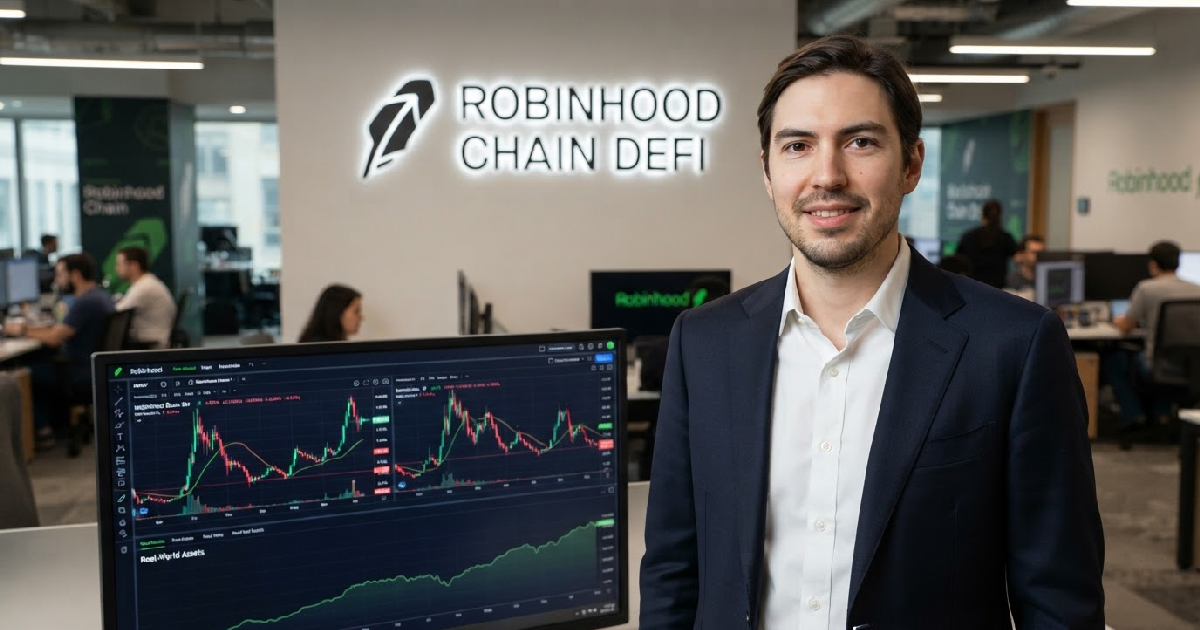

Robinhood Chain DeFi is Robinhood Markets, Inc.’s new Layer 2 blockchain, marking its entry into decentralized finance. has embarked on an ambitious journey into decentralized finance (DeFi) with the launch of its own Layer 2 blockchain, Robinhood Chain.
Unveiled to the public on July 1, 2026, the company aims to bring its more than 10 million active users into onchain finance, leveraging its extensive retail client base to make complex DeFi accessible through integrated products like stock tokens and lending protocols.
Robinhood’s bold bet on onchain finance
But early activity on the chain shows speculative memecoin trading currently overshadows its intended focus on real-world assets.
This initiative represents a strategic pivot for Robinhood, which seeks to democratize finance by onboarding traditional assets onto the blockchain. However, initial data suggests user behavior is leaning heavily towards speculative assets, presenting a critical challenge as Robinhood attempts to align its platform’s utility with the broader DeFi landscape.
The public mainnet launch of Robinhood Chain, built on the Arbitrum Platform as an Ethereum Layer 2 network, underscores Robinhood’s commitment to integrating its vast user base into decentralized finance. Introduced at “The World is Flat” keynote event in London, this new blockchain was designed to be AI-native and primarily tailored for real-world assets, directly connecting Robinhood’s existing onchain user base.
Alongside the new chain, Robinhood rolled out new stock tokens, which are tradable across various crypto platforms and accessible in over 120 countries, excluding the U.S. These tokens enable 24/7 trading on Robinhood Chain and can be utilized in lending pools or as collateral within DeFi protocols.
Furthermore, the company introduced Robinhood Earn, its first decentralized lending product integrated directly into the main Robinhood app in the U.S., allowing eligible users to lend dollar-backed USDG from a self-custody wallet for an estimated 7% APY.
Expanding access to DeFi offerings
Robinhood’s DeFi expansion extends to more complex financial instruments. Eligible users in certain jurisdictions can now access perpetual futures via the decentralized exchange Lighter within the Robinhood Wallet. For clients in Europe, this includes new perpetual futures tied to commodities, ETFs, and foreign exchange, offering up to 10x leverage. This move places Robinhood in direct comparison with dedicated onchain derivatives platforms.
Looking ahead, Robinhood is also preparing to introduce agentic accounts for digital assets in the U.S. These accounts will allow qualified traders to link their preferred AI models to Robinhood’s data and tools, facilitating market analysis and strategy execution while human oversight maintains control over capital allocation.
Seong Seog Lee, Head of Product at Robinhood Crypto, clarified their strategic intent, stating: “Our opportunity isn’t to take volume from existing crypto traders. Most people have never touched a perpetuals contract, not necessarily because they don’t want exposure, but because the on-ramps have never been there. We’re changing that.”
Memecoins overshadowing real-world asset vision
Despite Robinhood’s declared emphasis on real-world asset tokenization, early activity on Robinhood Chain reveals a strong inclination towards speculative trading. On July 12, just weeks after its mainnet launch, the chain briefly ascended to the No. 2 position in decentralized exchange (DEX) trading volume, recording approximately $878 million in 24-hour activity.
This surge temporarily saw it leapfrog Coinbase’s Base and Ethereum in that metric, according to DefiLlama.
However, much of this trading volume was driven by memecoin speculation rather than the tokenized stocks and ETFs the platform was designed to facilitate.
The chain processed only $5.9 million in perpetual futures on July 13, a figure significantly smaller than the $8.9 billion in perpetual futures recorded by Hyperliquid, a benchmark for onchain derivatives, on the same day. This highlights the nascent stage of Robinhood Chain’s intended advanced trading features.
Bridged capital and memecoin dominance
A notable disparity exists between the total value locked (TVL) and the actual capital deployed within Robinhood Chain’s DeFi products. The network saw $734 million bridged onto it, yet only $211 million of this is currently deployed in lending or yield products.
This suggests a considerable portion of assets remains inactive in user wallets, not yet contributing to the deeper DeFi applications Robinhood aims to foster.
The dominance of memecoins on the chain further illustrates this trend. Tokenized real-world assets (RWAs) on Robinhood Chain currently account for just $12.66 million in active market capitalization.
This amount is dwarfed by a single token, CASHCAT, a cat-themed memecoin, which peaked at a $156 million market cap after rallying more than 2,100% in its first week. That brief peak made CASHCAT’s market cap 12 times larger than the chain’s entire tokenized real-world asset market, underscoring the speculative nature of early activity.
Charting the path to lasting DeFi adoption
The initial trajectory of Robinhood Chain echoes a common challenge for new blockchains seeking mainstream adoption: sustaining utility beyond speculative trading. The company’s CEO, Vlad Tenev, had previously stated on July 2 that memecoins were a “dead end” in a CNBC interview.
Just six days later, he posted that Robinhood Chain “works great for memes too,” presumably after witnessing CASHCAT’s rapid rise. While the company did not directly address this apparent contradiction, Seong Seog Lee noted, “The early activity on Robinhood Chain is exciting: developers are building, users are engaging, and the chain is performing as designed.”
This scenario parallels the experience of other new networks. The Blast network, for instance, saw its TVL decline from $2.2 billion to $29 million over a two-year period following the conclusion of its yield incentive program.
For Robinhood, the crucial question in the coming months will be whether its initial surge of speculative activity can evolve into sustained, meaningful usage.
The company remains focused on onboarding its extensive user base into decentralized finance by leveraging its blockchain, with Lee affirming, “That’s what open, accessible infrastructure looks like in practice, and it’s core to what Robinhood has always stood for: democratizing finance for all.”
Converting interest into genuine utility
Robinhood Chain’s initial ability to attract significant trading volume, even if primarily speculative, highlights the considerable influence of its brand and user base. But the platform’s long-term success will hinge on its capacity to convert this transient interest into durable engagement with its core vision of tokenized real-world assets and yield products.
The large amount of bridged capital that remains idle suggests that while users are willing to bring assets onto the chain, they aren’t yet actively deploying them in the intended DeFi applications. This indicates a continuing need for user education and enhanced user experience.
The crypto industry continues its rapid evolution, with many platforms striving to seamlessly integrate traditional financial products with decentralized infrastructure. As AI-driven DEX platforms gain traction on networks like Ethereum, improved user experience and advanced analytics will likely play a pivotal role in driving mainstream DeFi adoption.
Robinhood’s path to fully integrating 10 million casual investors into DeFi is still in its early stages, and its ultimate success will depend on moving beyond memecoin hype to deliver on its promise of accessible, utility-driven onchain finance, including 24/7 stock token trading and onchain lending.
“We’re looking forward to users discovering everything Robinhood Chain makes possible with bringing real-world assets onchain, including 24/7 stock token trading, onchain lending, and more,” Lee added, outlining the firm’s forward-looking objectives for the platform.