
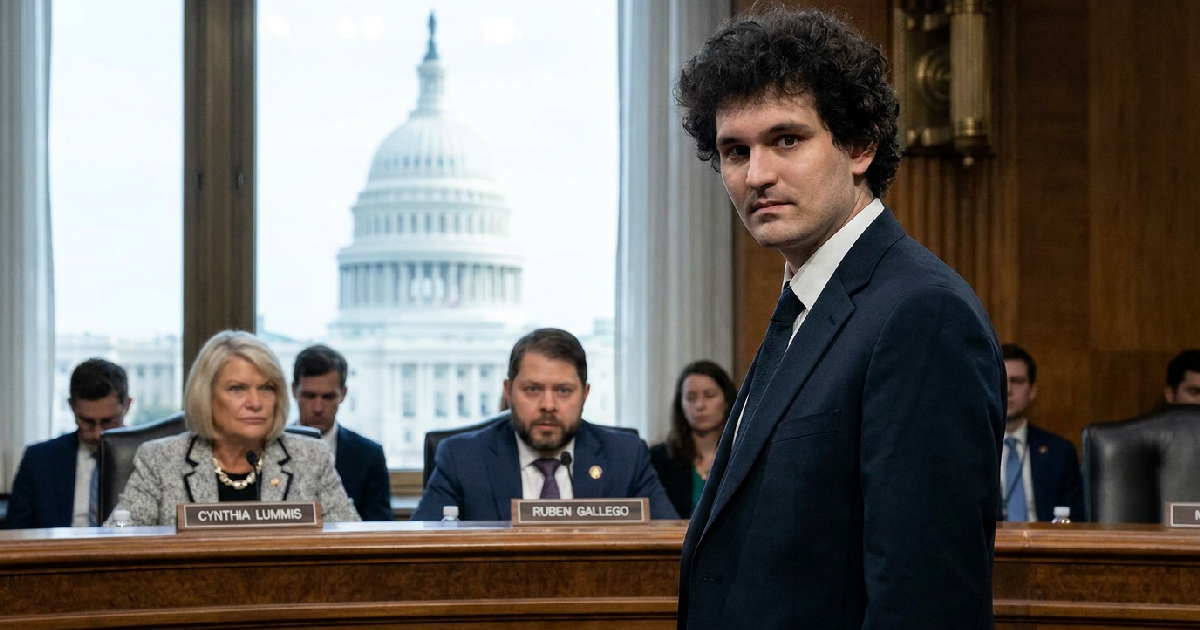

The U.S. Senate unanimously passed a resolution opposing any federal clemency for Sam Bankman-Fried on Wednesday, June 17, 2026. S. Senate has unanimously passed a resolution opposing any form of federal clemency for FTX founder Sam Bankman-Fried, explicitly rejecting a presidential pardon or sentence commutation. This bipartisan measure, Senate Resolution 772 (S.Res.772), was passed on Wednesday, June 17, 2026. It reflects a unified legislative stance against leniency for Bankman-Fried, convicted of orchestrating one of the largest financial frauds in U.S. history.
Senators Cynthia Lummis (R-WY) and Ruben Gallego (D-AZ) jointly introduced the resolution, highlighting congressional resolve. Bankman-Fried’s conviction in November 2023 on seven counts, including wire fraud, led to a 25-year prison sentence and an $11 billion forfeiture order on March 28, 2024.
Lawmakers lead unified stance on Sam Bankman-Fried clemency
The Senate’s unanimous vote on S.Res.772 represents a rare bipartisan consensus on accountability within the digital asset sector. This measure passed by unanimous consent, a procedural move that means no senator voiced an objection, underscoring collective legislative resolve.
Senators Cynthia Lummis, a Wyoming Republican, and Ruben Gallego, an Arizona Democrat, both lead the Senate Banking Subcommittee on Digital Assets, with Senator Lummis serving as its top Republican and Senator Gallego as its top Democrat.
Senator Lummis, a well-known advocate for the crypto industry, has notably driven efforts to ensure Bankman-Fried remains behind bars. She declared, “He had his day in court,” when the pair introduced the measure. Senator Gallego reinforced this position, firmly asserting, “Let him stay in jail.”
Bankman-Fried’s conviction and clemency attempt
Sam Bankman-Fried’s legal trajectory has shifted from crypto entrepreneur to convicted felon. A jury found him guilty in November 2023 on seven counts, including wire fraud and money laundering. He received a 25-year prison sentence on March 28, 2024, along with an $11 billion forfeiture order.
He won’t be eligible for release until around 2044, reflecting the severity of his financial crimes. The Senate’s action follows his recent request for clemency, even after a Manhattan federal appeals court upheld his conviction and sentence on June 12, 2026. That court labeled him the “main driver of one of the largest frauds on record.”
This legislative move gains significance considering previous presidential clemency decisions for other notable crypto figures. Former President Donald Trump had pardoned Binance founder Changpeng Zhao and Silk Road creator Ross Ulbricht. However, Trump publicly stated in January he had no plans to pardon Bankman-Fried.
Echoes of FTX’s dramatic collapse
The FTX collapse in November 2022 remains a cautionary tale for the burgeoning crypto industry and its regulators. Bankman-Fried simultaneously ran FTX, a cryptocurrency exchange holding customer funds, and Alameda Research, his proprietary trading firm. This dual role created a critical conflict of interest that enabled the fraud.
He illegally diverted billions of dollars in FTX customer deposits to Alameda. These funds bankrolled risky trades, venture investments, political donations, and Bahamian real estate. FTX’s internal software also exempted Alameda from standard trading rules, allowing it to bypass collateral requirements imposed on other traders.
The fraud became public knowledge in November 2022 after CoinDesk obtained Alameda’s balance sheet. This report revealed that Alameda’s assets primarily consisted of FTT, a token created by FTX itself. Binance’s subsequent announcement to sell its FTT holdings triggered a rapid price crash, leading to a liquidity crisis.
Customers rushed to withdraw their deposits from FTX, but the exchange couldn’t meet the demand, as the funds were gone. FTX filed for Chapter 11 bankruptcy on November 11, 2022, just over a week after the CoinDesk report. Prosecutors maintain that the fraud resulted in over $8 billion in stolen customer funds.
Implications for crypto policy and executive power
While non-binding, this Senate resolution sends a powerful signal to the executive branch regarding high-profile crypto fraud cases. It establishes a significant hurdle for any future administration considering clemency for Sam Bankman-Fried, emphasizing bipartisan desire for strict accountability in digital assets.
The unanimous congressional will offers clarity for market participants. It reinforces the notion that individuals engaging in severe financial misconduct within the crypto space will face substantial consequences. This stance could contribute to rebuilding trust in an industry still recovering from major collapses.
This precedent also suggests that congressional opinion can heavily influence executive clemency decisions, especially in cases where public trust has been severely eroded. It highlights the legislative branch’s role in expressing institutional will, independent of constitutional executive powers.
Ultimately, this strong legislative posture may encourage more robust regulatory frameworks aimed at preventing similar financial disasters. It’s a clear reminder that profound political consequences follow even the most audacious financial crimes, irrespective of other considerations.