
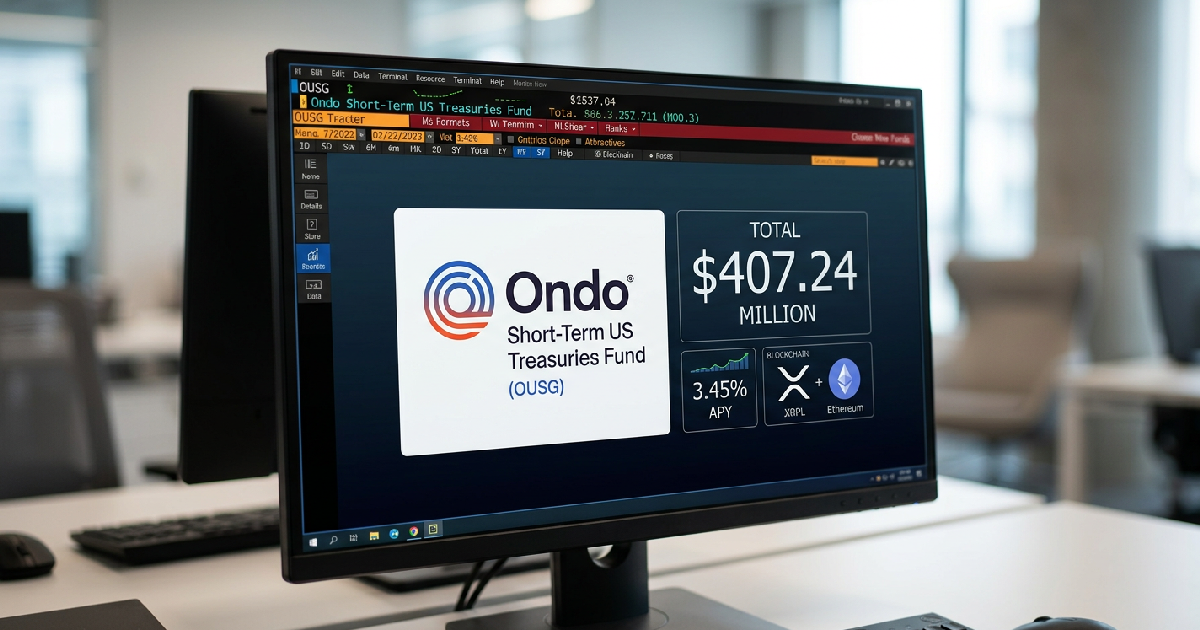

The Ondo Short-Term US Treasuries Fund (OUSG) reached a total value of $407.24 million as of July 10, according to data from the official Ondo OUSG page. This milestone signals a shift in the digital asset market as Wall Street firms transition from theoretical pilots to live, tokenized collateral layers. The fund currently offers a quoted 3.45% APY and operates across multiple blockchain networks to facilitate institutional settlement.
While tokenized sovereign debt was once viewed as a niche concept, current data shows a maturing ecosystem of regulated fund structures. The OUSG fund manages a chain split consisting of approximately $222.07 million on XRPL and $185.17 million on Ethereum. This multi-chain presence indicates that issuers are leveraging established crypto rails to handle ownership records and transfer mechanics while keeping underlying assets within traditional legal frameworks.
Practical application of these products is visible in how they are now being utilized as portfolio building blocks. OUSG does not merely hold raw Treasury bills; it allocates capital across several other digitally native Treasury products. These include about $150 million in the State Street Galaxy Onchain Liquidity Sweep Fund and $101.01 million in BlackRock’s BUIDL, showing a growing interconnectedness between major financial institutions.
Ondo Short-Term US Treasuries Fund provides a blueprint for digital collateral
The nine-figure scale of OUSG suggests that the category has moved past the experimental stage to become a working investment vehicle. Explicit subscription rules govern the fund, including a $5,000 minimum for instant investments and redemptions. Access is currently restricted to accredited investors and qualified purchasers, maintaining a clear compliance boundary that mirrors traditional private fund structures.
Beyond its major stakes in State Street and BlackRock, OUSG holds $77.08 million in Franklin Templeton’s BENJI and approximately $69.10 million in the Fidelity Treasury Digital Fund. This internal diversification helps explain the market’s maturation. When regulated funds begin owning shares of other tokenized funds, it creates an investable market structure rather than a collection of isolated products.
This development addresses a specific gap in the digital asset space. While stablecoins provided a medium for fast dollar-denominated settlement, they generally lacked the yield-bearing qualities institutions require for idle capital. By turning government paper into onchain collateral, issuers are providing a low-risk, yield-generating asset that can move at the speed of software.
com/bitcoin-exchange-supply-eight-year-lows-analysis/”>Bitcoin exchange supply maintains multi-year lows, reflecting a broader trend of assets moving toward more sophisticated or long-term storage solutions.
Tokenization of government debt changes the operating layer
It is important to distinguish the digital token from the legal claim it represents. In the current market, tokenization most often changes the operating layer—how ownership is recorded and how settlement is processed—rather than the nature of the security itself. The White House Digital Assets Report, issued under Executive Order 14178, clarified that regulatory treatment “follows the nature of the underlying asset,” meaning these tokens remain subject to existing securities laws.
Institutions require this legal clarity to operate at scale. They need to know the identity of their counterparties and what legal rights survive if a platform fails. Consequently, the market is building a regulated digital layer on top of traditional fund law. This conservative approach is precisely why the category is growing. It imports the legal protections firms trust onto more flexible, programmable rails.
However, high total value locked (TVL) does not always equate to deep market liquidity. A fund can be operationally efficient while remaining narrow if redemptions are gated or the holder base is concentrated. Large asset values provide a snapshot of the balance sheet but do not guarantee smooth exits during periods of market stress. This is particularly relevant as crypto liquidations rise alongside Treasury yields, creating new correlations between traditional and digital markets.
Institutional adoption drives the shift toward digital money markets
The rise of OUSG and its peers highlights how Wall Street is effectively capturing the efficiency of digital rails to serve its existing client base. This is not a rewrite of how sovereign bonds are issued, but a technical upgrade to how they are distributed and used as collateral. By using government money funds and Treasury-heavy structures, firms can offer programmable transfer rails without bypassing traditional finance.
The success of these vehicles depends on making trusted old reserve assets work inside new systems. Government paper remains the center of traditional collateral markets because it is easy to price and widely accepted. The current testing phase is determining whether that same paper can be verified and moved more easily through software.
For now, the OUSG figures represent a move toward a more transparent and analyzable market. The existence of disclosed balances, visible yields, and known investor thresholds makes the category harder to romanticize and easier to evaluate. As these products continue to integrate with one another, they form the foundation of a digital funding market that institutions can actually trust.