
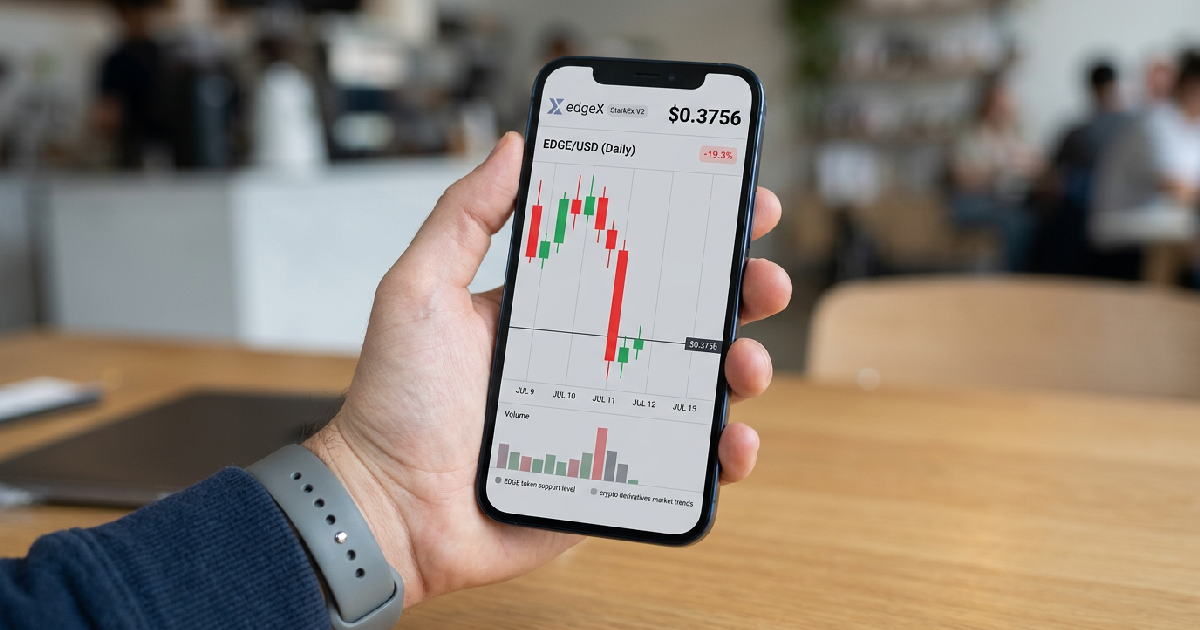

The edgeX token (EDGE) fell 19.3% to trade at $0.3756 on July 11, 2026. 3% to trade at $0.3756 on July 11, 2026, as the project struggles to establish a firm price floor amid ongoing post-TGE discovery. Market capitalization for the derivatives-focused protocol slid to $131.47 million, while trading volume plummeted 51.79% to $31.74 million.
This contraction indicates that many market participants are choosing to wait for confirmation rather than chasing lower entry points.
Derivatives traders reduce leverage as speculative conviction fades
The current price action continues a volatile path for the EDGE token, which officially launched on March 31, 2026, following a postponement from the previous December. Despite a fundamental shift to the StarkEx V2 architecture—designed to improve self-custody and transaction performance—the market remains cautious.
Investors are currently weighing the platform’s technological progress against a difficult market history, including a significant flash crash in June that continues to impact sentiment.
Recent data from the perpetual markets highlights a cooling trend among speculative traders. Open Interest (OI) dropped 25.79% to $20.96 million on July 11, signaling that participants are closing out leveraged positions rather than betting on an immediate reversal.
This exit of capital suggests a lack of aggressive positioning in either direction, which could reduce future liquidation pressure if buyers eventually return. But for now, the crypto market liquidation analysis from earlier in the year remains a relevant warning for those monitoring thin liquidity.
Funding rates have also trended toward neutral levels, reaching approximately 0.0024%. This shift suggests that the premium previously paid by long-holders has evaporated, reflecting a more balanced, albeit stagnant, market environment. When funding reaches neutral territory alongside falling trading volume, it often precedes a period of consolidation. Traders appear hesitant to commit fresh capital while the project navigates its post-launch price discovery phase.
The withdrawal of spot and derivatives activity reinforces the view that conviction is currently low. Much like the Ondo Finance price slide seen in similar market conditions, EDGE is struggling to attract buyers despite its infrastructure milestones. The market’s refusal to aggressively bid at current levels suggests that the search for a sustainable bottom is not yet over.
Technical battle lines form around the $0.2950 support zone
From a technical standpoint, the EDGE token is testing the resilience of its current range after failing to hold a recent rebound above $0.50. Analysts identify $0.2950 as the nearest critical support level. A failure to defend this zone could expose the price to a further decline toward $0.2330.
Conversely, reclaiming the $0.50 level would be required to shift focus back toward the $0.7137 resistance and rebuild momentum.
Daily chart indicators offer mixed signals for prospective bulls. The Parabolic SAR remains below the current price, indicating that the broader recovery structure has not fully collapsed despite the recent 19.3% drop. However, the Moving Average Convergence Divergence (MACD) shows signs of weakening strength.
While the MACD line stays above the signal line, the histogram is shrinking and both lines are beginning to flatten, suggesting that buying pressure is stalling.
The inability to sustain levels above $0.50 remains a primary concern for the bulls. Until fresh demand materializes, the technical outlook remains under pressure. This caution mirrors the broader trend of bitcoin price analysis where key resistance levels have recently rejected major assets, leaving altcoins like EDGE searching for independent catalysts.
Infrastructure upgrades face the legacy of the June flash crash
While edgeX highlights its move to StarkEx V2 as a core growth driver, the token’s valuation is still shadowed by the events of June 2, 2026. On that day, EDGE experienced a flash crash of over 77%, plunging from roughly $1.14 to as low as $0.31.
The event triggered more than $6.2 million in liquidations and led to public accusations of manipulation by on-chain researchers like ZachXBT. edgeX denied these claims, citing thin liquidity and “deliberate attempts by certain external parties” to influence the price.
In response, the team launched a 200,000 USDC bounty and began a goodwill payment program. However, with half of approved claims due to be paid in EDGE tokens only in April 2027, some investors remain wary of potential future supply overhangs.
The project, led by CEO Davy and co-founder KF.edge, is now tasked with proving that its high-performance orderbook—capable of handling 200,000 orders per second—can attract the institutional liquidity needed to prevent similar volatility in the future.
The StarkEx V2 integration is intended to position edgeX as a truly independent derivatives infrastructure. By leveraging zero-knowledge proofs for Ethereum-based financial settlement, the protocol aims to offer speed and efficiency comparable to a centralized exchange. If successful, these technical improvements may eventually offset the reputational damage from June and provide a stable foundation for the EDGE tokenomics.
Evaluating the future of EDGE circulating supply and utility
The long-term trajectory of EDGE will largely depend on its ability to transition from a speculative asset to a utility token. With a total supply of 1 billion tokens and roughly 350 million currently in circulation, the “low float” nature of the project remains a factor in its price sensitivity.
While 49% of the supply is allocated to the community for future rewards and airdrops, lock-up periods for core contributors and investors extend into 2027, limiting immediate supply increases.
For the $0.2950 support floor to hold, the protocol must demonstrate that its Multi-VM architecture and Deterministic Parallel Transaction Execution (PTE) engine are generating actual trading fees and user growth. The backing of entities like Circle Ventures and Amber Group provides significant institutional credibility, but retail sentiment is still recovering from the post-TGE volatility.
As edgeX continues its price discovery, the market will be looking for more than just technical updates to restore long-term confidence.