
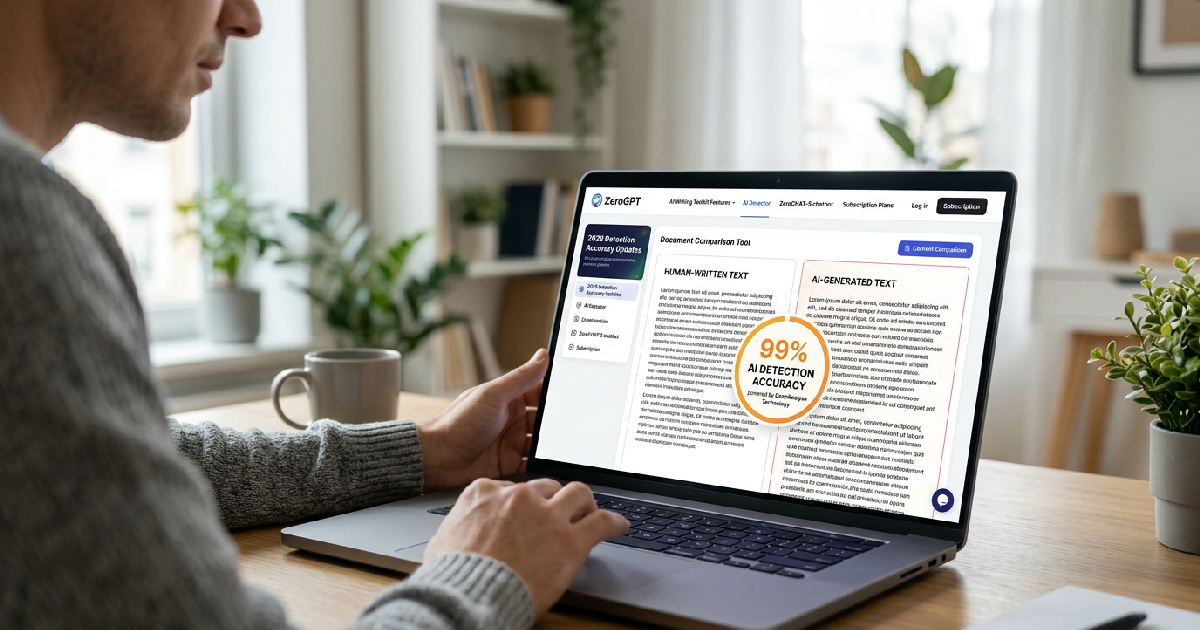

Iceland-based ZeroGPT has expanded its platform into a comprehensive writing toolkit, featuring an AI content detector that utilizes proprietary DeepAnalyse Technology. The system is designed to distinguish between human-written and AI-generated text by scanning linguistic patterns and vocabulary predictability at both macro and micro levels.
According to official statements from the company, which was founded in 2023, the algorithm was developed after analyzing over 20 million articles and texts, achieving a claimed accuracy rate of 99% or higher.
Advanced linguistic scanning and DeepAnalyse technology
The platform targets a wide range of synthetic content, including text from the GPT series, Claude, Gemini, and GPT-5. While the developers claim a “98.80%” accuracy rate and aim for an error rate of less than 1%, independent benchmarks from 2026 suggest significant performance gaps.
Practical testing by NoteGPT recently indicated real-world accuracy of approximately 80% for mixed content, with a 25% false-positive rate on human-authored text.
DeepAnalyse Technology serves as the core of the ZeroGPT detection suite, moving beyond basic keyword matching to analyze the structural coherence of a document.
The system uses a multi-stage deep learning model to classify text based on several factors, including perplexity scoring to measure the predictability of word choices and burstiness analysis to measure variation in sentence length. This methodology is designed to recognize subtle hints of synthetic writing that basic rule-based checkers often overlook.
The model is trained on a massive combined dataset of human-written texts from educational sources and the internet, alongside synthetic data from various Large Language Models (LLMs). This training allows the tool to categorize text into specific classifications, such as “Human-written,” “Mixed signals,” or “Likely generated by AI/GPT.”
The developers maintain that no user-submitted text is saved or used to train the detection tool, a policy intended to protect user privacy as the ethereum network outlook and broader tech sectors shift toward data-sensitive AI integrations.
Expanded features for content creators and editors
Beyond its primary detection function, ZeroGPT has integrated a secondary suite of writing utilities. These include an AI paraphraser, an AI summarizer, and a grammar and spell checker powered by AI. The platform also offers a citation generator, a word counter tool, and an AI translator to support multilingual text management.
These utilities are aimed at helping content creators and students refine their work within a single interface, providing instant results for both detection and editing tasks.
Accessibility has also been a focal point of recent updates. ZeroGPT now offers integration with WhatsApp and Telegram, specifically for users on its highest subscription tier. This allows for mobile access to detection services and advanced AI chatbots like ZeroCHAT-5.
For institutional users, the company provides API access to bake these features directly into internal workflows, similar to how transparency is reshaping crypto casinos by providing verifiable data points for users.
Subscription tiers and specific feature limitations
The platform operates on a freemium model, offering a basic detector for up to 350,000 characters in the free version, though this tier includes advertisements. For professional requirements, ZeroGPT offers three paid plans—Pro, Plus, and Max—each with varying limits on character scans and batch processing capabilities.
- Pro Plan ($7.99/mo): Offers 100,000 characters per detection and 50 batch file checks. It includes 1,500 words in the AI summarizer, 300 words in the AI paraphraser, and a one-time-only 750-word plagiarism check.
- Plus Plan ($14.99/mo): Features 100,000 characters per detection and 60 batch file checks. It grants access to 35,000 words in the plagiarism checker per month, 2,000 prompts in ZeroCHAT-4, and humanized generated text.
- Max Plan ($18.99/mo): Provides 150,000 characters per detection and 75 batch file checks. This tier includes 60,000 words for plagiarism checks, 10,000 words for the AI summarizer, and 3,500 prompts in ZeroCHAT-5. It also grants access to WhatsApp and Telegram integrations and humanized AI-generated text.
Real-world benchmarks and false positive concerns
Despite the company’s claims of “over 98%” accuracy, independent testing in early 2026 highlights notable limitations. A study of 500 text samples found a 14.6% false-positive rate for human-written text, which climbed to 21% for non-native English speakers. Other reports from Phrasly.AI indicated false-positive rates as high as 33% in tests involving 150 essays.
These findings suggest that the algorithm may struggle with the structured writing styles common in academic or formal contexts.
Furthermore, ZeroGPT’s effectiveness appears to vary by language. In one test, the system returned a 61.2% accuracy rate for fully AI-generated Spanish text, significantly lower than its English performance.
Because the tool can sometimes be fooled by lightly edited or rearranged AI content, experts suggest using it as a diagnostic aid rather than a definitive proof of authorship. As search engines continue to monitor technical resistance levels in content quality, accurate detection remains a critical hurdle for the digital publishing industry.