
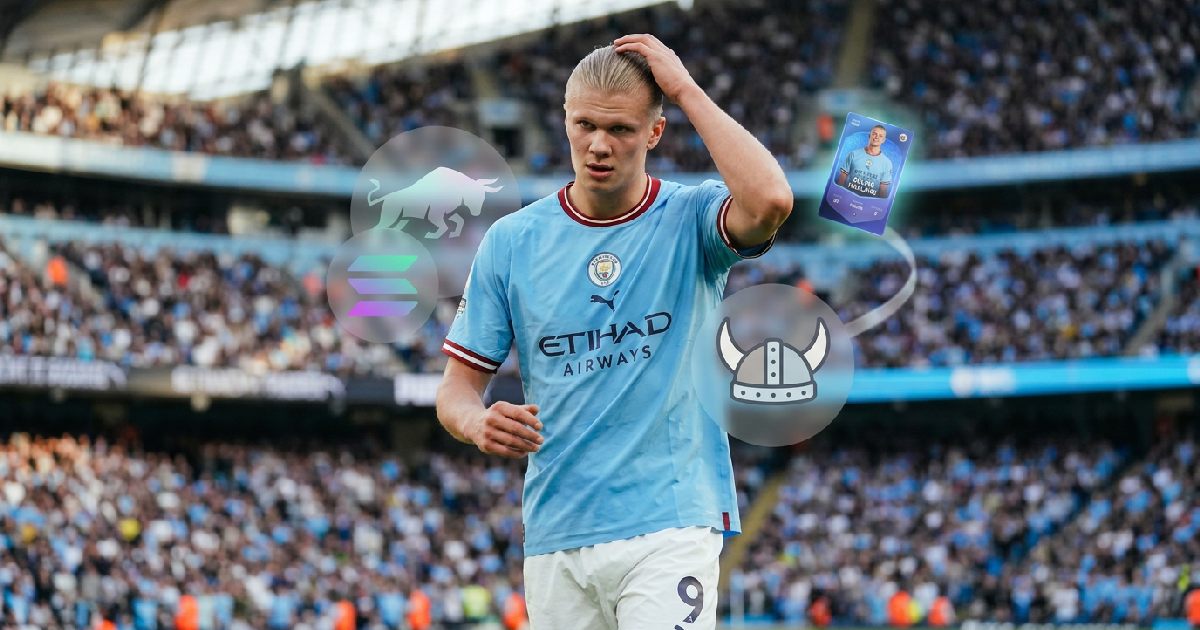

The goal-scoring prowess of Erling Haaland is currently driving a wave of speculative Solana meme coins as Norway prepares for a high-stakes World Cup quarterfinal against England. Market activity surged this week after a Viking-themed Google Easter egg, which displays a Nordic helmet graphic when users search for his name, drew massive global traffic toward the striker.
Developers have moved rapidly to capitalize on the viral moment, launching short-lived tokens such as $RO and $VIKINGROW. While these assets carry no official team affiliation or endorsement from Erling Haaland himself, their deployment tracked closely with the rising search volume.
Viral Google feature fuels meme coin frenzy
The Google Easter egg, an animated Nordic helmet appearing for Haaland-related searches, ignited this latest frenzy just as Norway geared up to face England in Friday’s quarterfinal. This seemingly innocuous digital quirk funneled immense global search traffic toward the striker within hours.
And anonymous developers operating on the Solana blockchain didn’t waste any time. They swiftly launched tokens like $RO and $VIKINGROW, explicitly aiming to capture retail interest spurred by the Google phenomenon. These tokens, critically, lack any real utility or official affiliation with Haaland or his team.
But their launch timing couldn’t have been better, perfectly aligning with Haaland’s skyrocketing search volume. Historically, we’ve seen similar spikes in meme coin activity following viral football moments earlier in the 2026 World Cup tournament, a pattern now well-established in the crypto space.
Speculative Solana tokens ride a wave of viral search traffic
Retail traders have poured into these instruments despite their thin liquidity and a complete lack of verified utility. According to Coinbase data, the Haaland-branded token on Solana has traded near $0.00037, though it remains a fraction of the size of established digital assets. This type of asset is increasingly viewed by analysts as a short-term cultural bet rather than a traditional investment, mirroring the event-driven speculation common in the current altcoin market trends.
The volatility inherent in these tokens is already on display. Reports indicate the primary Erling Haaland meme coin slid nearly 16% over the past day, reflecting the high risks of chasing unverified celebrity-themed launches. For many, the appeal lies in the low entry cost and the speed of the Solana blockchain, but the absence of a long-term roadmap often leaves latecomers holding worthless assets once the hype subsides.
The Erling Haaland token itself has a market capitalization of around $370,000, which is negligible compared to more mainstream cryptocurrencies. Another token, “Haaland The Meme King,” holds an even smaller market cap of $1.763K. This indicates the fragmented and highly speculative nature of this particular niche within the broader crypto market.
The core of this market activity rests on the Solana blockchain, known for its high transaction speeds and low fees. This makes it an attractive platform for anonymous developers to quickly deploy new tokens and for retail traders to make rapid, speculative trades. Despite the excitement, it’s worth remembering that this is largely unverified speculation. Russia’s lawmakers, for instance, are looking to expand whitelist assets, including SOL, underscoring the growing, yet still uncertain, regulatory interest in such blockchains.
Digital collectibles gain ground on real-world performance
Away from the ephemeral world of meme coins, verified digital collectibles are seeing more structured growth. On the blockchain fantasy platform Sorare, Erling Haaland’s official non-fungible token (NFT) cards have seen a notable climb in value. Unlike meme coins, these NFTs are officially licensed through major leagues, and their market value is tied directly to real-world performance data.
Haaland’s impressive tally of seven World Cup goals has significantly lifted demand among fantasy managers who prioritize verified scarcity over pure social media hype. The premium on these assets is well-documented; a unique 1-of-1 Sorare NFT featuring the striker previously sold for 265.1 ETH. At the time of that sale, this translated to over $600,000, underscoring the significant value placed on these digitally scarce player cards.
This divergence suggests that while meme coins capture immediate retail curiosity, serious collectors are anchoring their capital in platforms that offer strengthening network outlooks through transparent utility and real-world correlation. Sorare’s licensing deals with major football leagues provide a crucial layer of authenticity and long-term potential that highly speculative meme coins lack.
Haaland’s World Cup impact on crypto markets
Erling Haaland’s performance throughout the 2026 World Cup has been a direct catalyst for this crypto market activity. He has scored in every World Cup match he’s played this tournament, a remarkable feat. This includes multiple goals in the group stage, with braces in earlier matches.
A particularly influential moment came on July 5, 2026, when Haaland scored two late goals, in the 79th and 90th minutes, against Brazil. This pivotal performance secured a 2-1 victory for Norway, sending them to their first-ever World Cup quarterfinal and subsequently sending the associated crypto assets soaring. The $HAALAND meme coin saw a 289% rally within 24 hours on July 7, 2026, just two days after this crucial match.
Market risks and the upcoming quarterfinal showdown
The celebrity meme coin sector remains a regulatory minefield. Current legal challenges, such as the ongoing Iggy Azalea lawsuit regarding misleading token promotion, highlight the dangers of assets that use a public figure’s likeness without authorization. If the World Cup performance ends or a team is eliminated, these tokens often experience a “final whistle” effect where liquidity evaporates almost instantly.
The upcoming quarterfinal match between Norway and England, scheduled for July 11, 2026, will likely serve as a decisive catalyst for these digital economies. As crypto liquidations rise alongside macro signals, the fragility of event-based tokens becomes more apparent. Whether the Solana-based $HAALAND token can sustain interest beyond the tournament depends entirely on continued viral momentum, a foundation that has proven notoriously unstable in previous sports-themed cycles.
The current 16% slide in the $HAALAND meme coin over the past day is a stark reminder of this inherent instability. Traders engaging in this market are betting on hype and momentum, rather than underlying fundamentals or long-term value. It’s a high-stakes gamble where the final whistle could mean significant losses for those caught on the wrong side of the speculation.
The contrasting nature of speculation and utility
The current phenomenon surrounding Erling Haaland meme coins and Sorare NFTs vividly illustrates the dual nature of the crypto market. On one hand, you have the wild, unregulated speculation of meme coins, driven by viral trends and the allure of quick profits. These tokens, often launched by anonymous developers, thrive on hype and can generate immense, albeit usually short-lived, trading volume and price spikes.
On the other hand, platforms like Sorare represent a more grounded application of blockchain technology. Their NFTs have tangible utility within a fantasy sports ecosystem, and their value is—at least in part—dictated by the real-world performance of the athletes they represent. This distinction is crucial for understanding where each type of digital asset derives its value, and consequently, its risk profile.
The market seems to be signaling a preference for utility and verified assets in the long run. While meme coins can offer exhilarating short-term gains, their lack of intrinsic value makes them vulnerable to sudden crashes once public interest wanes. Traders must weigh the potential for rapid returns against the very real possibility of losing their entire investment, a lesson that many in the crypto space have learned the hard way.