
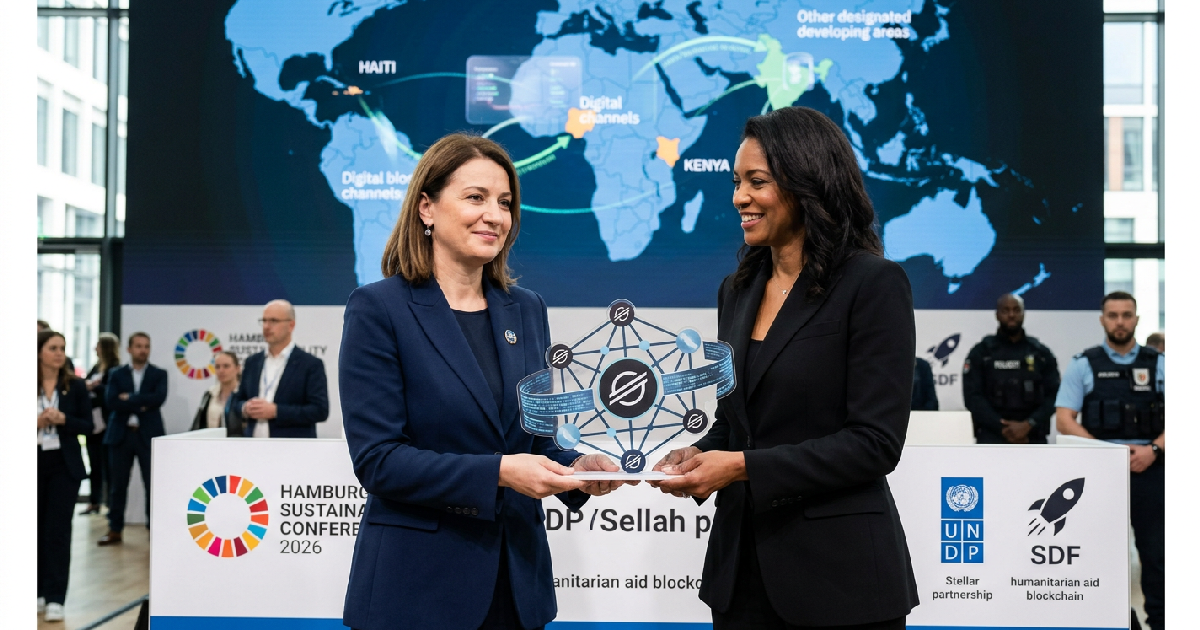

The United Nations Development Programme and Stellar Development Foundation will standardize Stellar blockchain payments for global aid by July 6, 2026, moving beyond experimental pilots.
The announcement, made during the Hamburg Sustainability Conference 2026, involves key figures including UN Assistant Secretary-General Ivana Živković and Stellar Development Foundation CEO Denelle Dixon, who aim to scale digital infrastructure across humanitarian sectors through 2027.
Stellar blockchain payments proven in conflict zones
This initiative builds upon nearly two years of rigorous field testing across 17 countries, with completed pilots in Haiti, Syria, Kenya, Guatemala, and The Gambia. The new phase moves beyond “proof of concept” trials to establish permanent governance frameworks and implementation playbooks.
The coordination remains centered at the UNDP Alternative Finance Lab (AltFinLab) at its Istanbul Regional Hub, where officials plan to integrate existing payment tools into specific national programs to improve economic resilience.
The shift to a standard operational tool follows measurable success in challenging environments where traditional banking access is often thin. In Aleppo, Syria, a “Cash for Work” program utilizing the Stellar blockchain demonstrated the network’s efficiency by reducing distribution costs from 10% via conventional methods to just 2%.
Every participant in the Syrian pilot received their payments satisfactorily, highlighting the potential for XRP speculative activity and general blockchain utility to solve real-world logistical hurdles.
Haiti provided a different technical benchmark, where the Stellar-based system achieved a 100% success rate in processing payments despite a total failure of the local cellular network during testing. Such resilience is critical for the UNDP, which frequently operates in regions where the macro outlook for physical infrastructure is unstable.
The system also creates a permanent record on the blockchain, providing the transparency that donors require for humanitarian funding.
Building infrastructure for global deployment
Under the terms of the agreement, the Stellar Development Foundation will supply technical advice and coordinate with ecosystem developers to ensure functional digital payment infrastructure. The UNDP retains full responsibility for running the programs, focusing on creating a structure for onboarding and governance.
This collaborative effort aims to reach the 650 million people in Africa who lack access to a bank account but can access stablecoins via smartphones.
Robert Pasicko, Project Manager of the Alternative Finance Lab at UNDP, noted that nearly 1 billion people worldwide already use digital wallets. This existing adoption provides a foundation for humanitarian sectors to drive meaningful change.
The partnership also links to broader efforts like the Sustainable Development Goals (SDG) Blockchain Accelerator and the Blockchain Advisory Group, which launched last month at the Proof of Talk conference in Paris.
Establishing the standard for international aid
The expansion is grounded in a specific set of countries where technologies have been validated through pilots or working prototypes. The UNDP confirmed the following progress across its key regions:
- Haiti: Delivered 100% success rate for aid payments during infrastructure outages.
- Syria: Reduced Aleppo program overhead costs by 80% using blockchain logging.
- Kenya, Guatemala, and The Gambia: Completed initial pilots for national cash transfers.
- Colombia and Papua New Guinea: Developed working prototypes for regional aid distribution.
By the time the agreement concludes in 2027, the UNDP and Stellar Development Foundation intend to have operational guidance that makes blockchain payments a standard capability globally. As altcoin market trends continue to evolve, the focus here remains on providing secure, low-cost digital solutions that shield aid recipients from inflation.
This transition marks a move toward a more transparent and accountable development system for the world’s most vulnerable populations.
The driving force behind blockchain adoption
The decision to move beyond pilot phases stems from the tangible results seen in various challenging environments. Candace Kelly, Chief Legal & Policy Officer at the Stellar Development Foundation, emphasized the network’s capacity to foster equitable economic growth and strengthen resilience in developing nations.
The Stellar network, according to CEO Denelle Dixon, is specifically designed to support access to the global financial system for everyone, irrespective of their geographical location. She stated, “Partnering with UNDP to leverage blockchain technology for international development and financial inclusion aligns perfectly with our mission.”
Dixon added that this collaboration represents the kind of transformative impact the Stellar Development Foundation was created to achieve. They are excited to be part of a crucial effort to drive innovation and empower communities worldwide.
Impact beyond cost savings: financial inclusion
While cost reduction and operational efficiency are significant benefits, the deeper impact of this partnership lies in financial inclusion. Former UN under-secretary-general Vera Songwe has highlighted how stablecoins are becoming more crucial than traditional aid in some developing economies. Her argument points to accessibility: stablecoins reach people that conventional banks do not.
Songwe noted at the World Economic Forum in January that 650 million people in Africa remain unbanked. But with a smartphone, these individuals can access stablecoins, allowing them to save in currencies that are not exposed to high inflationary fluctuations. This capability provides a vital safeguard for personal wealth in volatile economic conditions. It’s a powerful argument for broader blockchain integration, especially in regions battling economic instability.
A new blueprint for humanitarian action
The extended partnership, which was initially announced on January 27, 2025, and has now been running for over 16 months, sets a clear precedent. It’s about creating a replicable model for humanitarian organizations looking to digitalize their aid distribution.
The UNDP’s plan to develop comprehensive governance frameworks, implementation modes, and operational guidance ensures that these digital assets aren’t just a temporary solution. Instead, they are being integrated as a permanent, scalable capability across UNDP’s global programs. This systematic approach aims to overcome the initial hurdles of technology adoption and make blockchain a mainstay in global humanitarian efforts.
Key challenges and future outlook
Despite the successes, scaling such an initiative across numerous countries presents inherent challenges. Each country office has unique operational environments, regulatory landscapes, and local banking integrations to consider. The UNDP’s focus on integrating existing payment tools into each country’s programs demonstrates an awareness of these complexities, aiming for a seamless transition rather than a disruptive overhaul.
By 2027, the objective is not just to have systems in place, but to have a robust, adaptable framework that can address these varying conditions effectively. The ongoing technical advice from the Stellar Development Foundation and coordination with ecosystem developers will be critical in navigating these challenges, ensuring continuous improvement and wider adoption. This comprehensive strategy, rooted in flexibility and localized integration, suggests a strong path forward for blockchain in humanitarian settings worldwide.