
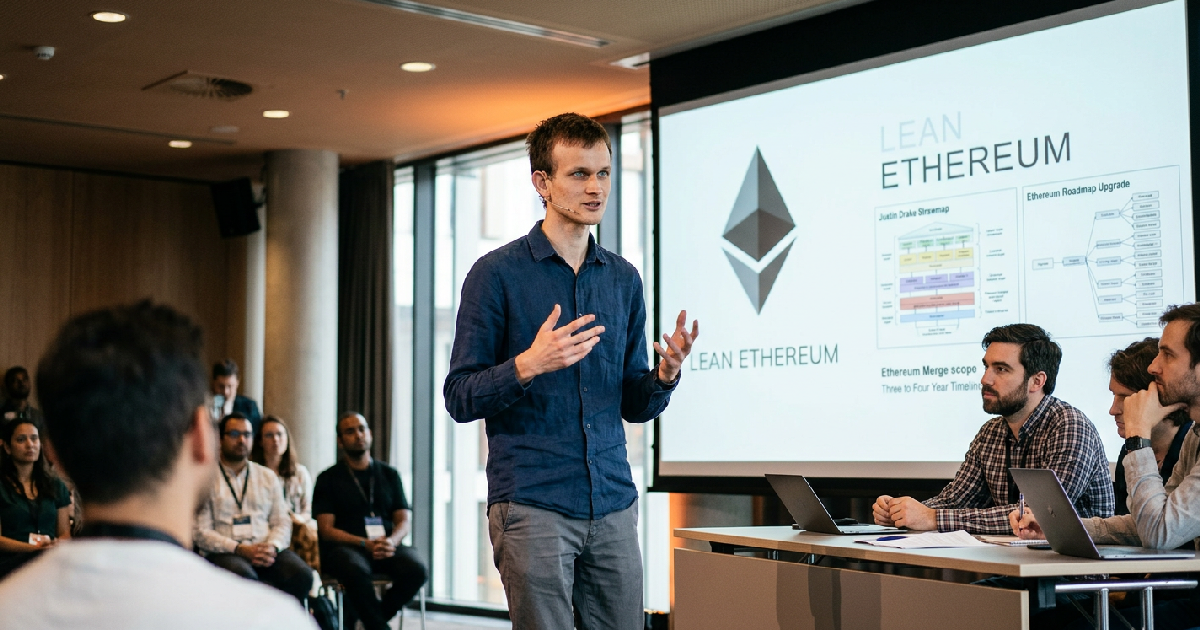

Ethereum co-founder Vitalik Buterin has announced that the network’s next major overhaul, an initiative titled “Lean Ethereum,” will take three to four years to complete and rival the scope of the 2022 Merge. Speaking following a meeting of Ethereum researchers in Berlin this June, Buterin described the project as the protocol’s third major iteration, intended to rebuild nearly every core layer of the blockchain.
The ambitious plan addresses fundamental aspects of the network, including transaction verification, data storage, and the cryptography required to protect the chain from future quantum computers. The initiative builds upon a draft long-term roadmap known as the “strawmap,” which Ethereum Foundation researcher Justin Drake introduced in February. That document outlined seven specific upgrades extending through 2029, signaling a shift toward a more streamlined protocol architecture.
Lean Ethereum addresses protocol storage and quantum security
Vitalik Buterin identified the planned storage redesign as the most disruptive component of the Lean Ethereum initiative. Currently, the network stores all state data, ranging from complex smart contract code to simple token balances, in a single expensive format.
Under the new proposal, this system would remain for complex applications like Uniswap, but a new, cheaper storage tier would be introduced for simpler tokens and NFTs.
This tiered approach could significantly lower the barrier to entry for basic digital assets. According to Buterin, migrating to this new system could cut transaction fees by more than tenfold. Such a reduction would be a vital development as Ethereum network outlook depends heavily on maintaining competitive costs for decentralized applications and retail users alike.
Security is also seeing a major shift in focus, with quantum resistance becoming a top priority for the Ethereum Foundation (EF). Researchers have been working on quantum-safe “blob” designs for several months to ensure the network remains secure against future computing threats.
Furthermore, Buterin stated that privacy has been elevated to a “first-class goal,” moving away from its previous status as an afterthought in protocol design.
Debate over development timelines and foundation restructuring
The proposed three-to-four-year timeline has sparked internal debate among the research community. Ethereum Foundation researcher Dankrad Feist criticized the window as “very slow,” suggesting that the work could be compressed into roughly a year through the use of AI-assisted development. This tension comes as the Ethereum recovery outlook remains a key concern for investors navigating price volatility and technical support levels.
The roadmap’s execution coincides with a major financial reset for the Ethereum Foundation. The organization recently cut 20% of its staff and 40% of its budget, aiming to reduce annual spending from 15% of treasury assets to roughly 5% by the year 2030.
These cuts reflect a broader effort to make the foundation’s operations sustainable over the long term, even as the protocol undergoes its most complex transition since moving to proof-of-stake.
Market conditions remain challenging for the ecosystem during this transition period. Ether was recently trading at $1,765, marking a decline of over 40% year-to-date. This downturn follows a period where crypto liquidations rise alongside treasury yields, putting pressure on the foundation to deliver technical improvements that could restore market confidence.
The Hegota fork, scheduled for later this year, is expected to be the final “pre-Lean” hard fork before the rebuild begins in earnest.
Future virtual machine and transaction finality
Looking further ahead, Buterin suggested that Ethereum will eventually require an alternative virtual machine to handle execution more efficiently. The most likely contenders for this role are currently RISC-V and leanISA. A transition to these architectures would represent a departure from the current Ethereum Virtual Machine (EVM), potentially offering leaner execution and better performance for developers building on the protocol.
The Lean Ethereum plan also targets how quickly transactions reach finality. By touching the verification layer, researchers aim to ensure that the network can handle high volumes without compromising the speed at which a transaction becomes permanent. As the foundation moves forward with these plans, the next few years will determine if this total protocol rebuild can deliver the efficiency Buterin has promised.