
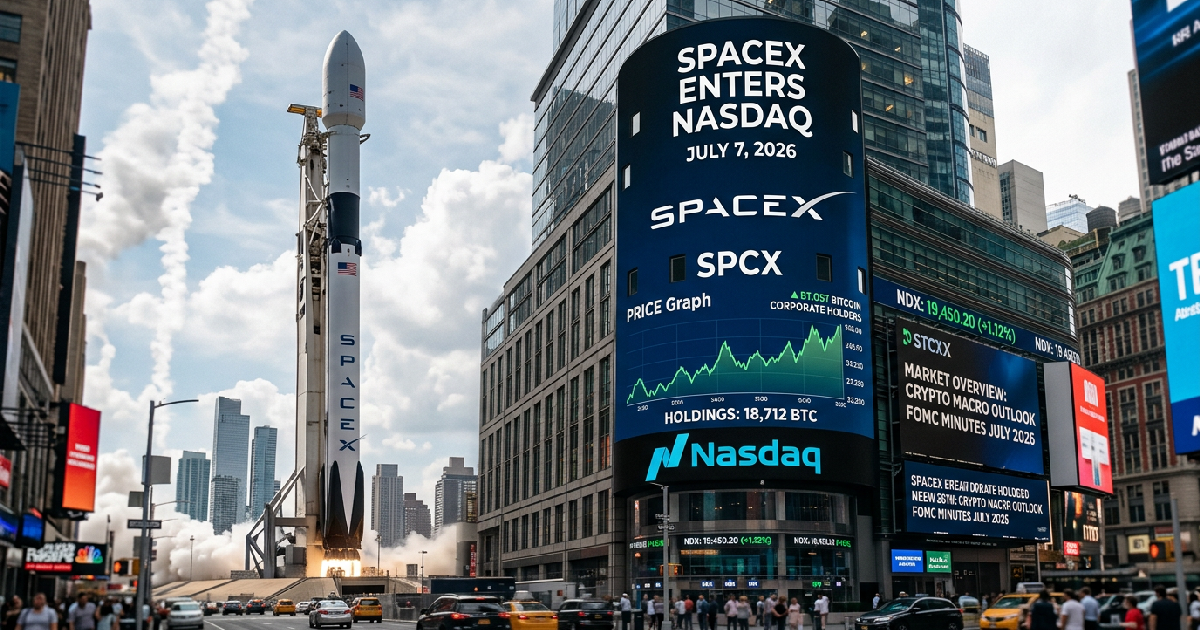

SpaceX is set to join the Nasdaq 100 index on July 7, 2026, marking a pivotal moment for Elon Musk’s aerospace firm and the broader digital asset market.
By entering this elite tech-heavy index, SpaceX becomes the fourth major constituent to hold substantial bitcoin reserves on its balance sheet, following in the footsteps of Tesla (TSLA), MicroStrategy (MSTR), and Mercado Libre (MELI).
SpaceX joins Nasdaq 100 as a major bitcoin holder
The move is expected to trigger a wave of institutional demand as tracker funds and passive investment vehicles are required to buy the stock to mirror the index’s composition.
The addition of SpaceX, which trades under the ticker SPCX, arrives during a week packed with high-stakes macroeconomic events. Investors are closely watching for the release of the Federal Open Market Committee (FOMC) minutes on July 8 at 2:00 p.m. ET.
These minutes will provide a deeper look into the Federal Reserve’s private deliberations from last month’s rate-decision meeting. For the cryptocurrency sector, these developments offer a dual catalyst: a boost in the legitimacy of bitcoin-holding corporations and a clearer picture of the interest-rate environment that dictates liquidity in the digital asset space.
SpaceX enters the Nasdaq 100 with a significant presence in the crypto world, reportedly holding 18,712 BTC. This portfolio places the company in a unique tier of institutional adoption.
Unlike some smaller firms, SpaceX’s weight in the index is expected to be more substantial than that of Mercado Libre or MicroStrategy, though it remains to be seen how it will eventually scale against Tesla.
Key details
The automated buying from index-tracking funds provides a permanent floor for the stock, indirectly linking more mainstream capital to a company with significant bitcoin exposure.
The inclusion also highlights the growing acceptance of companies that treat digital assets as a treasury reserve. For years, bitcoin was viewed as a liability for publicly traded or large private entities due to its volatility. Now, as bitcoin exchange supply maintains multi-year lows, the narrative has shifted toward scarcity.
SpaceX’s entry into the Nasdaq 100 reinforces the idea that holding bitcoin is no longer a barrier to inclusion in the world’s most prestigious technology benchmarks.
Beyond the index move, the crypto equities market is seeing other structural shifts. American Bitcoin (ABTC) managed to avoid a Nasdaq delisting this week after executing a 1-for-15 reverse stock split. This move reduced the total outstanding shares to approximately 73 million, helping the company meet minimum price requirements.
These maneuvers indicate a sector that is maturing and fighting to maintain its foothold in traditional financial markets despite the rigorous compliance standards of the Nasdaq.
FOMC minutes and the search for interest rate clarity
While SpaceX captures the corporate headlines, the macro landscape remains dominated by the Federal Reserve. The July 8 release of the FOMC minutes will be scrutinized for “hawkish” or “dovish” signals. Market participants are looking for consensus—or a lack thereof—regarding the timing of potential rate cuts.
If the minutes suggest that the Fed is satisfied with the progress on inflation, risk assets like bitcoin and ethereum could see a surge in buying pressure as the “higher for longer” narrative loses its grip.
Recent data suggests that the broader economy is in a delicate balancing act. Earlier this week, the U.S. S&P Global Services PMI for June came in with an estimate of 51.3, up from the previous 50.7, while the ISM Services PMI sat at 54.5.
Key details
These figures indicate continued resilience in the services sector, which may give the Fed more room to keep rates elevated. However, as macro warning signs emerge alongside rising Treasury yields, the crypto market remains sensitive to any hint of economic cooling that could force a policy pivot.
The connection between traditional finance and crypto has never been more apparent than in the current correlation between bitcoin and the Japanese yen. Analysts have noted an unusually high negative correlation between the BTC/USD pair and the USD/JPY exchange rate. Essentially, as the yen weakens against the dollar, bitcoin has shown a tendency to rise.
This relationship suggests that bitcoin is increasingly being used as a hedge against currency debasement in global markets, particularly as the yen continues its downward trajectory.
Network upgrades and token unlocks to watch
Away from the Nasdaq and the Fed, the blockchain ecosystem is moving forward with technical milestones. Berachain (BERA) is scheduled to undergo its PoL Next upgrade on July 7. This technical shift is part of the network’s evolution in proof-of-liquidity consensus.
Such upgrades often lead to increased volatility in native tokens as traders speculate on the improved efficiency and security of the underlying protocol. It also comes at a time when ethereum network outlook strengthens due to increased activity in AI-driven decentralized exchanges.
Token management is also a theme for the week, with several high-value unlocks scheduled to hit the market. On July 6, Hyperliquid (HYPE) unlocked 0.2% of its circulating supply, valued at roughly $30.39 million. Looking further ahead, Rain (RAIN) will see a massive 7.64% supply unlock on July 11, worth an estimated $786.9 million.
Key details
Finally, on July 12, PUMP is set to release a staggering 29.12% of its circulating supply, worth $130.2 million. These events are often viewed as bearish catalysts in the short term as they increase the available supply on exchanges.
Governance activity within Decentralized Autonomous Organizations (DAOs) remains high. The Arbitrum DAO is currently voting on a proposal to establish a “Fast Feed,” which would provide a paid, low-latency data stream for transaction data.
This represents an attempt to monetize the sequenced data generated on Arbitrum One, highlighting the trend toward more professionalized data infrastructure within Layer-2 solutions. Meanwhile, Nexus Mutual DAO is debating a 12-month budget that exceeds $1 million USDC to fund its marketing and product development through mid-2027.
Global economic indicators and geopolitical factors
The later part of the week will shift focus to labor and international data. On July 9, the U.S. will release Initial Jobless Claims for the period ending July 04, with the previous figure standing at 215,000.
Any significant increase in unemployment claims could signal that the labor market is finally softening under the weight of high interest rates, potentially accelerating the timeline for a Fed rate cut.
Fed Governor John Williams is also scheduled to deliver a keynote speech on market liquidity, which could provide clues on how the central bank plans to manage its balance sheet in the coming months.
Key details
On the international front, China’s Consumer Price Index (CPI) for June is due on July 8, with a previous reading of 1.2% year-over-year. Low inflation in the world’s second-largest economy often indicates weak domestic demand, which has historically led to stimulus measures that can indirectly benefit the global crypto market through increased liquidity.
Likewise, Canada’s unemployment rate for June, scheduled for release on July 10, will provide a regional benchmark for North American economic health.
As the week progresses, the combination of SpaceX’s mainstream financial integration and the Federal Reserve’s transparency report creates a complex environment for traders. The crypto market is no longer an isolated island; it is now deeply integrated with the Nasdaq 100’s performance and the Fed’s monetary decisions.
Whether through corporate treasury moves or DAO governance, the “Crypto Week Ahead” reflects a sector that is increasingly defined by its relationship with traditional global finance.