
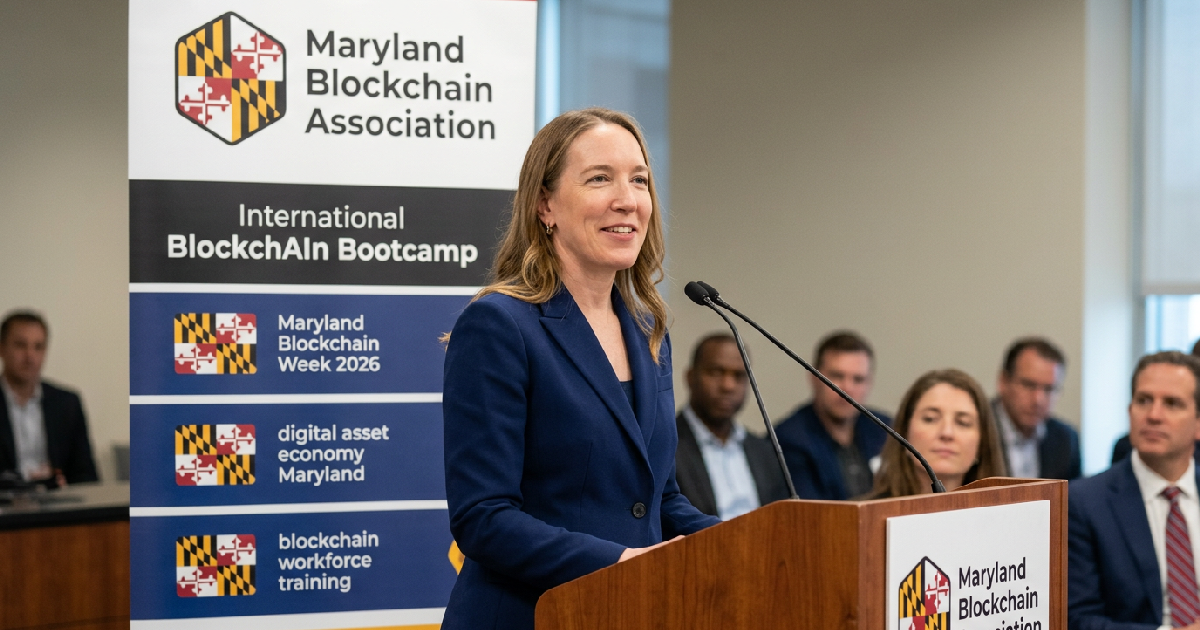

The Maryland Blockchain Association (MDBA) will host the inaugural International BlockchAIn Bootcamp and Workforce Expo at Capitol Technology University from July 13 to July 17, 2026.
This weeklong summit, co-hosted by the Blockchain Legal Institute, serves as the centerpiece of Maryland Blockchain Week 2026 and aims to position the Mid-Atlantic region as a premier hub for digital innovation. The event brings together high-level federal regulators, including US SEC Commissioner Hester M.
High-profile speakers join Maryland Blockchain Association event
Peirce, alongside industry pioneers to bridge the gap between technical theory and career development.
Organizers have structured the summit around the theme “Building Careers, Blockchain, Investment & Business” to address what the association identifies as a $10 billion opportunity in Maryland’s digital asset economy. Jacqueline Cooper, Chief Executive Officer of the Maryland Blockchain Association, stated that the primary goal is to transform curiosity into tangible careers.
By convening students, practitioners, and lawmakers, the MDBA seeks to create a sustainable talent pipeline capable of supporting the next generation of digital infrastructure while maintaining the state’s competitive edge.
The expo features a roster of over 30 speakers representing the intersection of policy, academia, and private industry. US SEC Commissioner Hester M. Peirce, who leads the SEC’s Crypto Task Force, is slated to provide regulatory perspective during the five-day event. Joining her are Dr. W.
Scott Stornetta and Stuart Haber, widely recognized as the co-developers of early blockchain technology, providing attendees with access to the foundational thinkers of decentralized systems. Such high-level engagement is critical as market resistance remains a key focus for institutional and retail participants alike.
Key details
Industry leaders from Fortune 500 companies and regional development agencies will also be present, including Dale Chrystie, a blockchain strategist at FedEx, and Graham Dodge, Vice President at TEDCO. The event also draws significant political support from Maryland lawmakers such as US Senator Angela Alsobrooks and State Senator Dr. Ron Watson.
Delegates Adrian Boafo and Pam Queen are also confirmed to participate, ensuring that local legislative priorities align with the rapid pace of technological advancement in the AI and Web3 sectors.
Academic and workforce focus at Capitol Technology University
Choosing Capitol Technology University as the host venue underscores the event’s commitment to academic integration and workforce readiness. Unlike typical tech conferences, the BlockchAIn Bootcamp focuses on six hours of daily interactive workshops.
These sessions are designed for a broad demographic, including high school students, educators, and guidance counselors, as well as career professionals like lawyers, accountants, and real estate agents. This push for professional development comes as large financial institutions report rising exposure to digital assets, necessitating a more literate workforce.
The workshop tracks are diverse, covering AI agents for business, cybersecurity, and the fintech ecosystem. Specialized sessions for non-profits and government blockchain fundamentals aim to show that these technologies have utility far beyond the financial sector.
Furthermore, the event offers continuing education credits for legal and real estate professionals, incentivizing traditional workers to integrate digital asset literacy into their existing practices. This educational foundation is essential as the technical outlook for major networks continues to evolve, requiring practitioners to stay updated on the latest shifts.
Strategic initiatives for the digital asset economy
The Maryland Blockchain Association plans to use the expo as a platform for two major policy and educational announcements. First, the organization is launching a Global Petition aimed at eliminating the statute of limitations for victims of digital asset crime.
This reform initiative calls on legislative bodies worldwide to ensure that the passage of time no longer shields bad actors in the digital economy. It represents a significant effort to strengthen consumer protection and foster trust within the emerging digital asset landscape.
The second initiative involves the publication of a post-event E-Book. This digital resource will compile insights, presentations, and contact information from every speaker involved in the summit.
By distributing this material, the MDBA aims to extend the educational impact of the bootcamp beyond the five days of the event, providing a permanent reference for students and entrepreneurs who are building companies within the Mid-Atlantic tech corridor.
Key details
The program is backed by partners including the Digital Chamber, the Maryland Tech Council, and Chainlink Labs.
Networking through AI-driven matchmaking
To facilitate the complex logistics of connecting hundreds of attendees across different sectors, the event has partnered with the networking app Thrilld. The application uses AI-driven matchmaking to pair founders with investors and developers with legal experts based on specific, shared goals.
This technological approach to networking mirrors the conference’s focus on AI and automation, allowing participants to streamline their schedules and discover the full agenda while on-site at the Maryland campus.
The summit is supported by an extensive network of regional and national partners. Academic backing from the Robert H. Smith School of Business at the University of Maryland and Morgan State University further validates the curriculum offered during the bootcamp.
These partnerships ensure that the hackathons, exhibits, and side events—such as CryptoMondays and BitAngels—are rooted in real-world application. Participation from groups like the Virginia Blockchain Council and Constellation Network further establishes the event as a collaborative regional effort.
Future outlook for Maryland’s technological talent pipeline
The BlockchAIn Bootcamp 2026 represents a pivot point for a state traditionally known for its proximity to federal agencies and healthcare institutions. By aggressively targeting the $10 billion digital asset market, Maryland is attempting to diversify its economy and retain talent that might otherwise migrate to other tech hubs.
The emphasis on upskilling young people ensures that the local workforce is prepared for a future where AI and blockchain are standard tools rather than niche technologies.
As the conference approaches its July 13 opening date, the MDBA and its partners are positioning this event as a model for other states to follow. By combining regulatory dialogue with vocational training, the bootcamp attempts to solve the talent gap that currently exists in the technology industry.
For participants, the expo is not just an opportunity to learn about new tools, but a structured gateway into a new professional landscape defined by the intersection of decentralized ledgers and artificial intelligence.