
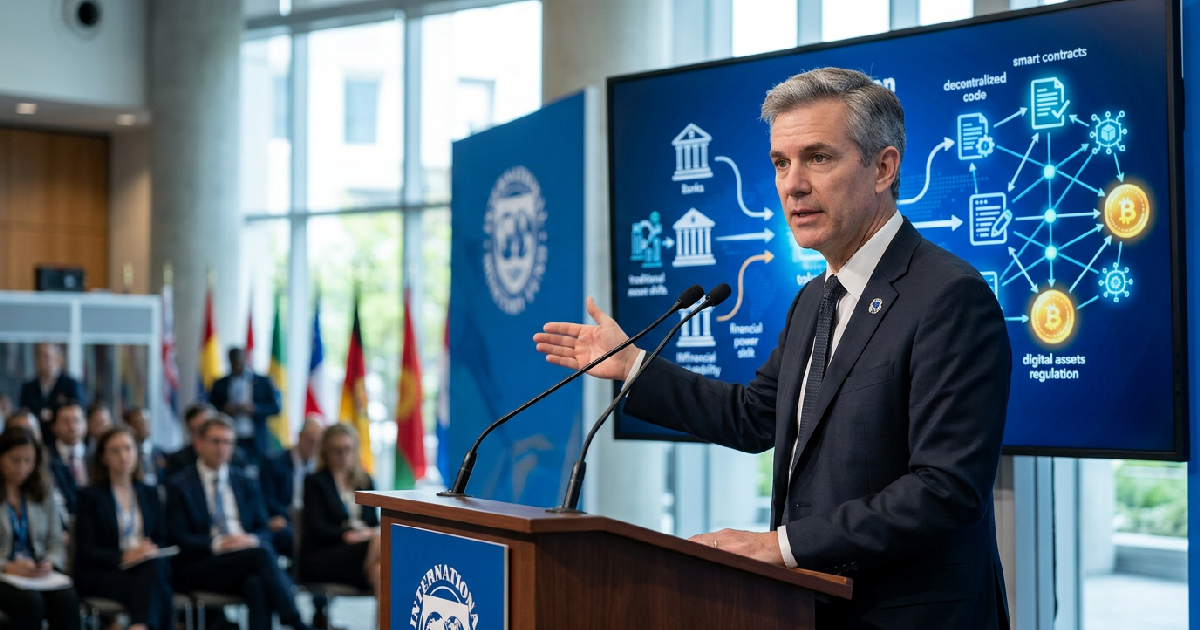

The International Monetary Fund (IMF) has issued a sharp warning that tokenization, the technology fueling the digital asset boom, is set to fundamentally reshape the global financial system. This structural shift, which goes far beyond a simple technological upgrade, could transfer significant financial power and inherent risk from traditional banks to autonomous code and digital platform operators.
Tobias Adrian, the Financial Counsellor and Director of the Monetary and Capital Markets Department at the IMF, articulated these concerns, including in a blog post published on July 2, 2026. He emphasised the urgent need for policymakers to establish robust regulatory frameworks to manage the profound implications of this transformation.
tokenization accelerates risk propagation
Traditional financial systems are built with inherent delays in processes like execution, clearing, and settlement. These sequential steps, often involving multiple intermediaries, create crucial buffers. While sometimes seen as inefficient, these delays act as vital safety brakes, allowing time for intervention during market stress or errors.
But tokenization collapses these functions onto shared digital ledgers, where self-executing smart contracts enable near real-time settlement. This speed reduces costs and boosts efficiency, yet it simultaneously eliminates those traditional buffers. As Adrian highlighted in the IMF paper “Tokenized Finance” (IMF Note 2026/001), published on April 2, 2026, this structural shift means financial risk will propagate at the speed of programming code.
loss of traditional safety brakes
The speed of automated code drastically narrows the window for authorities to intervene during financial turbulence. Unlike traditional systems, where procedural delays allow central banks to respond to liquidity crunches, a tokenized environment can see liquidity demands materialise in real-time.
Automated collateral calls could trigger rapid cascades through interconnected systems before human oversight can react. This means failures could propagate faster than institutions or supervisors are able to respond, posing a critical challenge to financial stability.
shifting accountability to code and platforms
A central concern for the IMF is where financial danger ultimately resides in a tokenized world. It’s shifting away from the balance sheets of traditional banks and investment funds, migrating instead to the companies managing services and market infrastructures, and to the smart contracts themselves.
This redefines accountability, challenging existing regulatory frameworks designed around institutional entities. The IMF has even raised the alarming prospect that some critical smart contracts could become “too important to fail,” echoing the designation applied to large banks during the 2008 financial crisis.
legal uncertainties persist for digital assets
Beyond the technical and regulatory hurdles, the legal landscape for tokenized assets remains largely unsettled. Courts have yet to definitively determine who truly owns these assets when a deal is primarily recorded in code on a distributed ledger.
Clarity is critically needed on whether tokenized records constitute irrefutable proof of ownership and if on-ledger settlement carries finality. Without these fundamental legal definitions, the underlying stability of a robust tokenized financial system remains in question. This is a complex area, especially as market sentiment shifts as the CLARITY Act advances through congressional committees in some jurisdictions.
the IMF’s proposed policy framework for stability
Recognising both the immense potential and inherent dangers, the IMF isn’t just issuing warnings; it’s actively proposing a comprehensive policy framework. This framework aims to ensure that tokenization supports global financial stability and inclusion, rather than fostering fragmentation and new systemic risks.
International coordination is paramount, according to the IMF. Policymakers face critical decisions on the future roles of public and private money, the desired degree of interoperability between different tokenized systems, and the establishment of robust legal and governance frameworks. They also need to re-evaluate existing liquidity backstops in this new environment.
global regulatory coordination needs
The IMF proposes a five-pillar framework to guide this transition. First, it advocates grounding settlement in safe monetary assets, such as wholesale Central Bank Digital Currencies (CBDCs) or tightly regulated tokenized deposits. Second, consistent global regulatory standards are crucial to prevent fragmentation and regulatory arbitrage across incompatible platforms, which could otherwise become new sources of systemic risk.
Third, establishing clear legal clarity for tokenized instruments is non-negotiable. This involves defining proof of ownership and settlement finality on digital ledgers. Fourth, fostering interoperability through international collaboration will prevent isolated digital silos and promote a more unified, resilient financial ecosystem. Finally, crisis management and liquidity tools need retooling for a continuously operating, automated environment, moving beyond traditional business-day cycles to machine-speed interventions.
adapting crisis management for a 24/7 world
One of the most significant challenges is adapting crisis management to a financial system that operates 24/7 at machine speed. Current central bank backstops are typically designed for business-day cycles. In a tokenized world, these interventions may need to operate directly within the tokenized systems themselves, potentially at machine speed, to be effective.
The IMF also recommends that regulators supervise robust code governance for systemically important smart contracts. This includes mandatory formal verification, independent audits, transparent change management protocols, and the ability to pause execution under predefined emergency conditions. Auditing smart contracts and stress testing tokenization algorithms become as crucial as auditing balance sheets in traditional finance.
industry optimism meets regulatory caution
Despite the IMF’s cautious stance, the financial industry continues its march towards tokenization. While specific market figures were not provided by the IMF, the concept of tokenized assets and stablecoins represents a substantial and growing segment of the digital economy. However, the IMF’s warnings underscore that this expansion brings with it new vulnerabilities.
The push for cheaper, faster, and more open markets championed by industry proponents contrasts sharply with the IMF’s focus on systemic stability. The organisation’s concern is that the very speed and automation that make tokenization attractive could also turn a localised failure into a global financial contagion before regulators have a chance to intervene.
balancing innovation and stability
The coming years will see critical decisions regarding regulation, which will likely shape the trajectory of tokenized finance more than technological advancements alone. As Tobias Adrian stated, “Policy choices made now will shape whether tokenization strengthens or fragments the financial system.”
Key details
For emerging and developing economies, the stakes are particularly high. Faster and cheaper cross-border payments, a hallmark of tokenization, could lead to volatile capital movements, rapid currency substitution, and a potential erosion of monetary sovereignty, especially if privately issued global stablecoins gain widespread dominance. Regulators worldwide are now tasked with the difficult balance of fostering innovation while safeguarding financial stability.
The IMF, headquartered in Washington, D.C., continues to publish extensive research and policy recommendations on digital finance. Its warnings, including the July 1, 2026, IMF Note on new trends in payments and asset tokenization, reinforce the urgency for global policymakers to collaborate.
The aim is to build a resilient and inclusive financial system fit for the digital age, where the benefits of stablecoin regulation and other tokenized assets can be harnessed without unleashing uncontrolled systemic risks.