
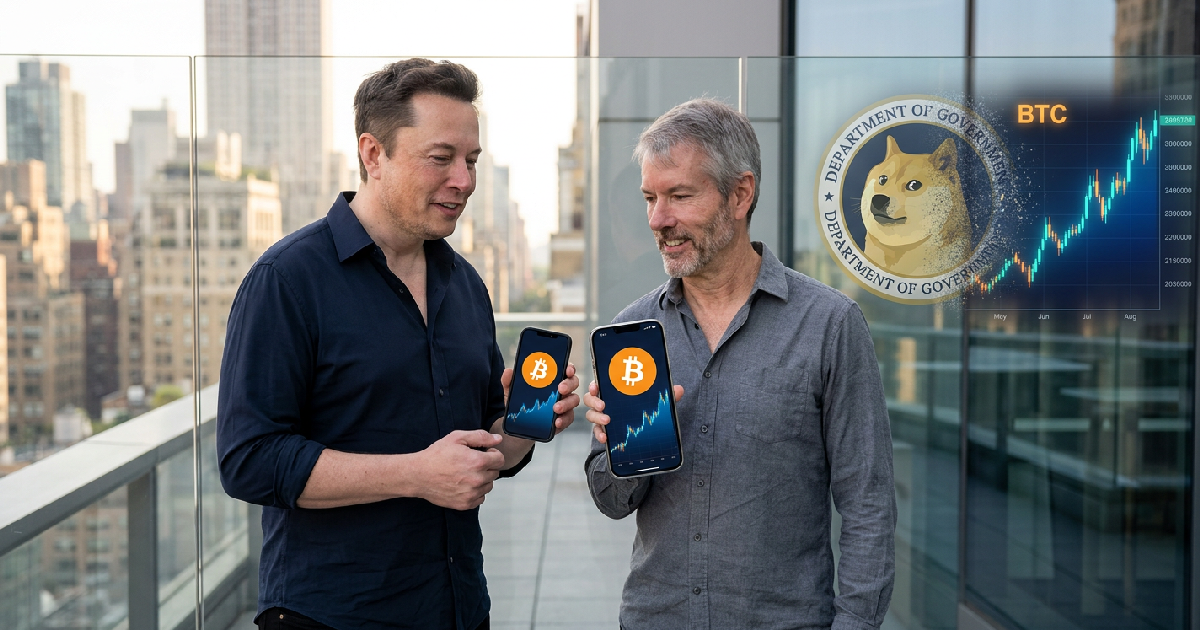

Independence Day on July 4, 2026, sparked significant Bitcoin speculation across the cryptocurrency market, primarily driven by social media posts from prominent figures Elon Musk and Michael Saylor. This surge of interest coincided with the official termination of the Department of Government Efficiency (DOGE), a temporary organization established by President Donald Trump’s executive order in January 2025.
While the federal program, with former co-leader Elon Musk, concluded its mandate, both tech moguls used their platforms to subtly, or overtly, pivot the conversation towards Bitcoin (BTC). The timing has analysts and investors debating whether this marks a symbolic shift from meme coins and government reform efforts to a more serious focus on sound money principles.
Bitcoin Speculation: DOGE’s Quiet Conclusion and Unfulfilled Promise
The Department of Government Efficiency (DOGE) reached its sunset date on July 4, 2026, precisely as stipulated in President Donald Trump’s executive order. Created as a temporary body, its mandate was to streamline federal operations and identify cost savings across government agencies.
However, the program didn’t quite live up to its ambitious initial goals. DOGE had reportedly dissolved as a centralized entity back in November 2025, several months ahead of its official termination. Its public savings tracker also ceased updating after January 1, 2026, leaving many questions unanswered about its true impact.
The commission did claim to have generated $215 billion in savings, which it calculated at approximately $1,335 per taxpayer. While a considerable sum, this still only represented about 3% of one year’s $7 trillion federal budget, a notable shortfall from the $2 trillion Elon Musk had initially suggested in October 2024.
Office of Management and Budget (OMB) Director Russ Vought later confirmed to lawmakers that no official closing report for DOGE is currently planned, wrapping up the initiative with little fanfare.
Musk’s Patriotic Post and Saylor’s Bitcoin Response
On July 4, Elon Musk, CEO of Tesla (TSLA) and SpaceX (SPCX), shared an Artificial Intelligence (AI)-generated patriotic video montage on X (formerly Twitter). The video, a cover of “God Bless USA” produced by Heavy Pulp, quickly amassed over 2.2 million views within hours.
Notably, Musk’s post made no explicit reference to the winding down of DOGE, an initiative he once co-led and famously said would eventually “delete itself.” His silence on DOGE’s conclusion, despite his prior involvement, created a vacuum that Michael Saylor, co-founder and Executive Chairman of Strategy (MSTR), was quick to fill.
Saylor replied directly to Musk’s video with a concise, pointed message: “We can still make something Ƀetter,” pointedly replacing the letter ‘B’ with the Bitcoin symbol. This wasn’t a new tactic for Saylor, who often uses US holidays to promote Bitcoin as a pillar of American economic strength.
He famously urged Musk in December 2020 to shift Tesla’s balance sheet into Bitcoin, a move Tesla made two months later with a $1.5 billion purchase.
This history gives Saylor’s latest comment significant weight. For many in the crypto community, his reply wasn’t just a holiday flourish; it signalled a symbolic handoff from government reform to the pursuit of sound money principles embodied by Bitcoin. It’s an argument that innovation, particularly in the digital asset space, can offer more tangible and lasting benefits than bureaucratic efficiency drives.
Market Reaction and Shifting Sentiments
The exchange between Musk and Saylor quickly resonated through the crypto markets. Bitcoin was trading robustly around $62,425.78 to $62,584 on July 4, showing a roughly 1% gain over 24 hours. The sentiment was further buoyed by U.S. spot Bitcoin ETFs, which registered net inflows of $223 million, marking a positive shift after ten consecutive days of outflows.
This renewed optimism around Bitcoin stands in stark contrast to the performance of Dogecoin (DOGE), a cryptocurrency often associated with Musk due to his past endorsements. On July 4, Dogecoin was trading at $0.078697, with a daily range between $0.076605 and $0.078722. Its price has seen a significant decline of -52.09% over the past 12 months, with its 52-week range spanning $0.069647 to $0.483816.
Crypto experts estimate Dogecoin’s average trading price for July 2026 to be around $0.0794, with a peak rate of $0.0836. These figures suggest a stable, but far less explosive, trajectory compared to its earlier meme-coin fueled rallies. Analysts continue to forecast DOGE price movement, but the buzz seems to have moved on.
Corporate Crypto Holdings Under Scrutiny
The posts also brought renewed attention to the substantial Bitcoin holdings of companies linked to Musk and Saylor. MicroStrategy (MSTR), under Saylor’s leadership, remains the largest corporate holder with a staggering 847,363 BTC, valued at approximately $52.9 billion. This aggressive accumulation strategy underscores Saylor’s unwavering conviction in Bitcoin’s long-term value.
Elon Musk’s companies also hold significant Bitcoin. SpaceX, which went public in June 2026 with a record-breaking initial public offering (IPO), holds 18,712 BTC, valued at roughly $1.17 billion. Tesla (TSLA) retains 11,509 BTC, worth about $718.5 million. Combined, Strategy, SpaceX, and Tesla hold approximately $54.8 billion in Bitcoin, representing a massive institutional stake in the cryptocurrency’s future.
However, MicroStrategy itself isn’t without its own market dynamics. The company faces questions over a reported 491 BTC sale and a dividend policy that JPMorgan has labeled as risky. Saylor continues to champion MSTR as a superior investment, even pitting it against the ‘Magnificent 7’ tech stocks in terms of returns and innovation.
These corporate holdings highlight how deeply intertwined the fates of these companies are with Bitcoin’s performance.
The Enduring Debate: Innovation versus Sound Money
The July 4 exchange underscores an ongoing philosophical debate within the digital asset community. Does true progress lie in government-led initiatives for efficiency, or in the decentralized, immutable principles offered by cryptocurrencies like Bitcoin? While DOGE aimed to reform existing structures, Saylor’s response champions a fundamental shift towards a new monetary paradigm.
Musk, despite his past dalliances with Dogecoin and his leadership role in DOGE, has consistently positioned himself as an innovator, often disrupting traditional sectors. His silence on DOGE’s end, coupled with Saylor’s direct Bitcoin pitch, suggests a tacit acknowledgment that the future of efficiency and value creation might reside outside conventional governmental or even meme-driven crypto frameworks.
It remains to be seen whether this brief July 4th exchange will translate into further corporate Bitcoin acquisitions or a renewed focus by Tesla on integrating Bitcoin payments. For now, the crypto world watches closely, parsing every subtle signal from its most influential proponents as the narrative of digital assets continues to evolve beyond fleeting trends.