
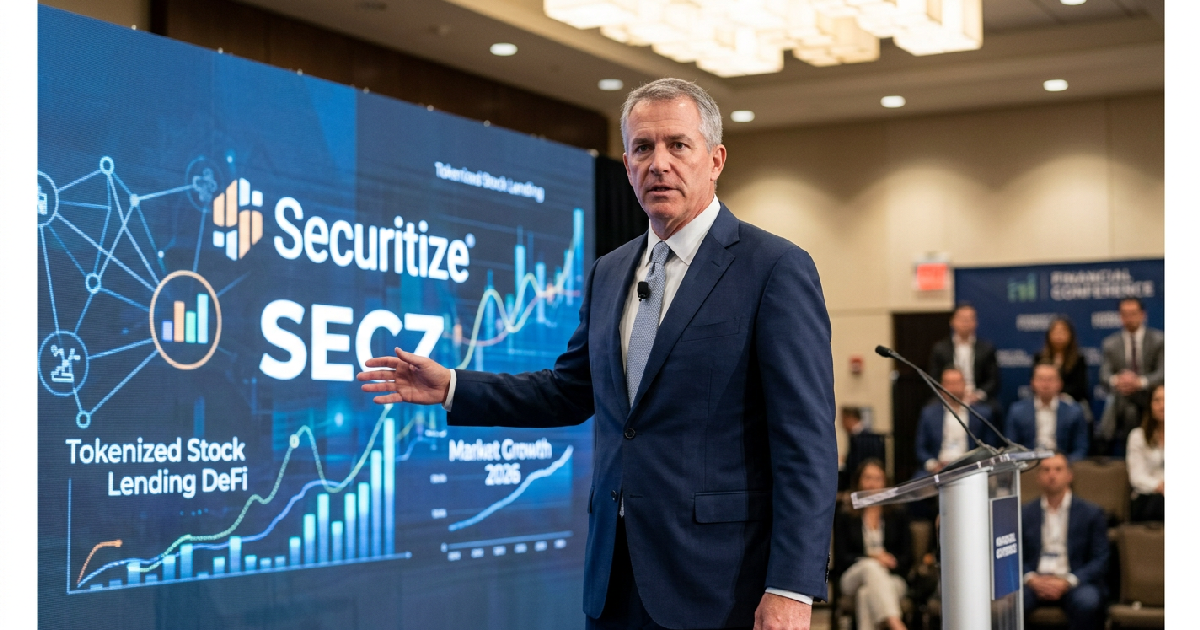

Securitize President Brett Redfearn is challenging the traditional financial order, arguing that the tokenization of real-world assets will eventually dismantle the long-standing brokerage monopoly over stock lending. As a former Securities and Exchange Commission (SEC) director of trading and markets who joined the firm in April, Brett Redfearn believes disintermediation is the key to returning profit margins to everyday investors.
The timing of these remarks is pivotal as Securitize Corp. reaches a critical regulatory milestone. The company is expected to debut on the New York Stock Exchange (NYSE) on July 2, 2026, under the ticker symbol “SECZ.”
Disrupting the traditional stock lending model
This public listing follows the successful merger with Cantor Equity Partners II (Nasdaq: CEPT), a business combination slated to close on July 1, 2026, that is anticipated to deliver approximately $400 million in gross proceeds.
For Securitize Corp., the move to the public markets represents the culmination of a period of rapid institutional adoption. The firm currently manages over $4 billion in tokenized assets, anchored by its stewardship of BlackRock’s BUIDL money market fund, which holds over $3 billion in value.
These partnerships with legacy giants like Apollo, KKR, and BNY Mellon demonstrate that tokenization has shifted from a fringe experiment into a foundational component of modern financial infrastructure.
In the current retail landscape, major brokerages often generate significant revenue by lending out idle customer shares to short-sellers. However, these profits rarely reach the pockets of the actual asset owners. Brett Redfearn notes that firms like Robinhood reportedly keep as much as 85% of associated revenue, while Charles Schwab typically captures a 50% split.
Key details
Tokenization changes this equation by allowing investors to maintain direct control over their digital holdings.
By moving these assets on-chain, they transition from static entries in a database to programmable collateral. Redfearn argues that this “totally disruptible” business model can be replaced by decentralized finance (DeFi), where tokenized securities can be used for automated lending or smart contract strategies.
This shift is already visible in projects like Ondo Finance and other real-world asset protocols, which aim to provide higher transparency and efficiency than legacy brokerages.
The speed of these transactions also represents a major leap forward. While settling a stock loan through a traditional middleman can take several business days, blockchain-native assets allow for loan origination in seconds. This accelerated velocity of capital, combined with on-chain finality, forces traditional firms to confront the limitations of their own fee-heavy structures as more liquidity moves toward transparent decentralized platforms.
Institutional growth and the Solana expansion
The financial scale of Securitize underscores the growing appetite for tokenized instruments. During the first nine months of 2025, the company reported $55.6 million in revenue, a massive 841% increase compared to just $5.9 million in the same period of 2024.
This growth is being driven by the realization that public blockchains provide a superior ledger for regulated securities, a trend that continues to support the Ethereum network outlook as a hub for institutional finance.
Securitize is also actively diversifying its technological footprint beyond a single chain. On June 12, 2026, the company expanded its Securitize Tokenized AAA CLO Fund (STAC) to the Solana blockchain. This move recently attracted a $250 million allocation from Ethena Labs, highlighting the demand for high-grade collateral in Web3 ecosystems.
By utilizing public blockchains, Securitize allows unaffiliated developers to build new financial products around these regulated tokens.
Key details
The path forward involves more than just issuing assets; it requires a robust ecosystem for active trading. Securitize recently collaborated with Jump Trading Group and Jupiter to launch fully on-chain, regulated trading for tokenized equities. This partnership leverages Jump Trading Group’s liquidity through a PropAMM on Solana, providing a Web3 swap-style experience for shares that are recorded directly on an issuer’s cap table.
Regulatory frameworks and market projections
A “compliance-first” strategy has been essential to Securitize’s ability to operate in both the U.S. and Europe. The firm is an SEC-registered broker-dealer and transfer agent, and it holds a regulated settlement license under the EU DLT Pilot Regime.
CEO Carlos Domingo maintains that the industry’s central challenge is now whether these assets can trade at scale while meeting public market standards. Even as broader crypto liquidations rise alongside Treasury yields, tokenized RWAs are viewed as a stabilizing force for institutional capital.
Market analysts are increasingly bullish on the long-term potential of the tokenization sector. Citigroup projects the market will grow to $5.5 trillion by 2030, while Boston Consulting Group estimates the balloon could reach $19 trillion by 2033. As of mid-2026, the broader tokenized asset market has already tripled over the past year to surpass $30 billion, suggesting that the migration of traditional finance is accelerating.
The successful listing of Securitize Corp. on the NYSE marks a turning point for the industry. It provides public market exposure to a company that manages the essential plumbing for the next generation of finance. If tokenization can truly deliver on the promise of disintermediation, the tight grip that Wall Street has held on products like stock lending for decades maybe be nearing its end.