
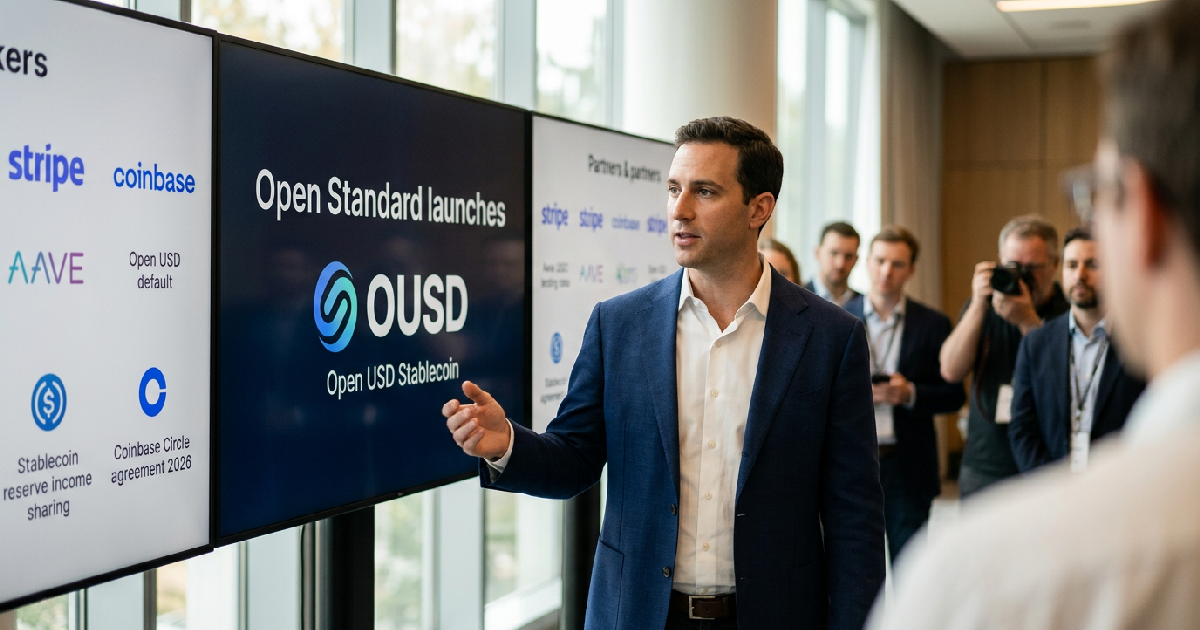

Open USD (OUSD), a new programmable stablecoin framework developed by Open Standard, launched on Tuesday, June 30, 2026. This arrival has sparked immediate discussion regarding its potential impact on decentralized finance (DeFi) yields, particularly for those supplying USD Coin (USDC) to the Aave protocol. By offering a shared reserve income model, OUSD aims to attract corporate partners who currently facilitate settlement using Circle’s USDC, a shift that could diminish the borrowing demand necessary to sustain high lending rates.
The new token was introduced with a consortium of more than 140 corporate backers, including payments giant Stripe and major crypto entities like Coinbase and Aave itself. Zach Abrams, a co-founder of the stablecoin infrastructure firm Bridge—which Stripe acquired for $1.1 billion in 2025—is among the leadership at Open Standard. While incumbents like Circle retain the majority of reserve income, OUSD is designed to route that income back to its partners, giving businesses a clear financial incentive to transition their payment flows.
How Open USD influences Aave utilization rates
Lending rates in DeFi are driven by utilization, which measures the percentage of a supplied pool that is currently being borrowed. On Aave, USDC suppliers do not receive interest from the issuer; instead, they earn from borrowers who pay to withdraw the asset for market-making or settlement. When utilization spikes, supply rates climb to attract more deposits. According to DefiLlama data, USDC suppliers on Aave’s main Ethereum market currently earn approximately 3.4%, a figure that has fluctuated as high as 18% during periods of heavy demand.
The entrance of Open USD threatens this equilibrium by targeting the demand side of the equation. If major settlement providers move their volume to OUSD, the utilization of USDC could drop significantly. Lower utilization typically correlates with lower lending yields over time. For decentralized lenders, this development mirrors the broader macro outlook for 2026, where institutional shifts in liquidity frequently redefine where capital can earn a return.
Strategic shifts by Stripe and Coinbase
Stripe and Coinbase represent the most significant potential catalysts for OUSD adoption. Will Gaybrick, President of Technology and Business at Stripe, confirmed in the announcement that Open USD will serve as the default stablecoin for businesses operating on the Stripe platform. This move leverages the infrastructure from the Bridge acquisition and could immediately redirect a significant volume of merchant settlement away from USDC.
Coinbase’s involvement is equally critical. The exchange currently has a distribution agreement with Circle that is reportedly set for renewal in August 2026. In 2024, Circle paid Coinbase $908 million to distribute USDC, and the exchange keeps the reserve income on balances held on its platform.
However, Coinbase is now a backer of the OUSD consortium. If the exchange decides to transition user balances or internal liquidity toward OUSD to exert more control over its revenue streams, it would represent a notable departure from its historical partnership with Circle. com/bitcoin-exchange-supply-eight-year-lows-analysis/”>bitcoin exchange supply remains low and platforms are increasingly seeking sovereign control over their financial products.
Circle’s defense and the network effect moat
Circle Chief Executive Jeremy Allaire has responded to the competition by highlighting the substantial “moat” built by USDC over the years. Allaire argued that stablecoin networks function as platform businesses that benefit from long-term network effects. USDC currently maintains a supply of roughly $73 billion and holds deep liquidity across both centralized and decentralized exchanges. Furthermore, Circle has secured extensive licenses across the U.S. and Europe, maintaining its regulatory standing even as competitors like Tether (USDT) face challenges in the European region.
Circle also points to history as a cautionary tale for new consortium-backed assets. In 2019, Facebook’s Libra project launched with backing from several major payment networks, only for those firms to walk away within months following regulatory pushback. While OUSD has launched with a massive list of 140 backers, it remains to be seen if this alliance will remain cohesive as the full rollout progresses later in 2026.
DeFi users should monitor Aave’s live utilization dashboards in the coming months. If OUSD successfully pulls enough demand from USDC to affect rates, lenders may need to explore new growth trends in decentralized exchange activity or alternative yield strategies. The upcoming renewal of the Coinbase-Circle deal in August will likely serve as the definitive signal for how quickly the stablecoin yield landscape will shift.