
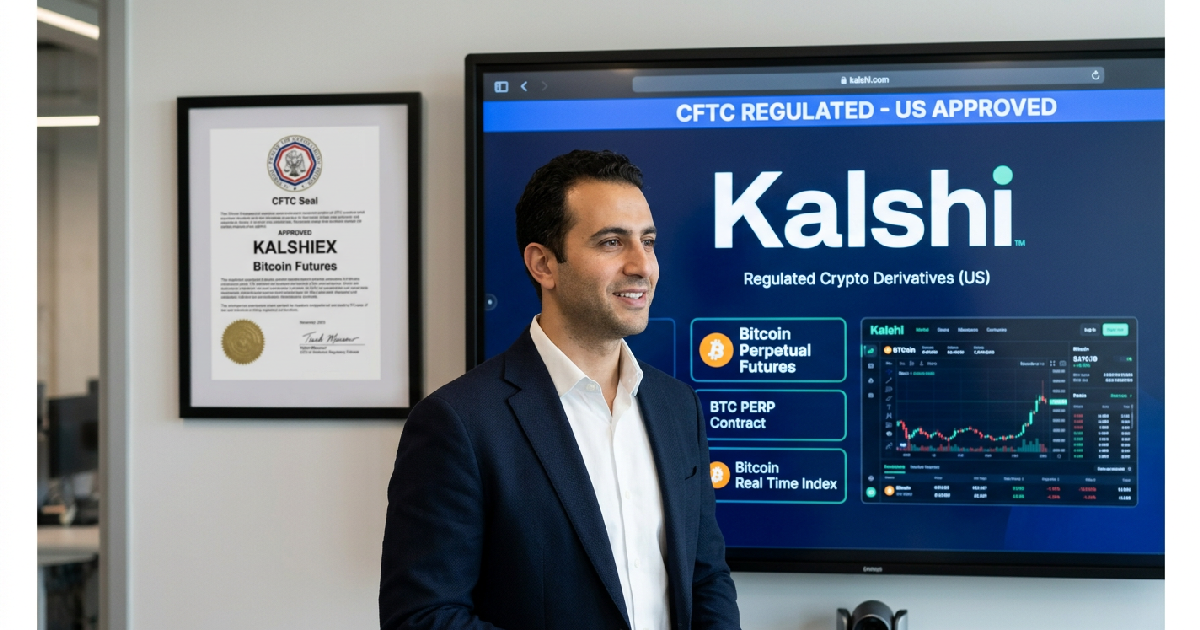

The U.S. Commodity Futures Trading Commission (CFTC) has officially cleared KalshiEX LLC (Kalshi) to launch the first regulated Kalshi Bitcoin perpetual futures contracts in the United States. This federal approval allows Kalshi, a Manhattan-based prediction market and Designated Contract Market (DCM), to list cash-settled derivatives that reference the spot price of Bitcoin.
Known by the ticker BTCPERP, the product provides a domestic, oversight-backed alternative to the high-volume “perps” that have historically been dominated by offshore, unregulated platforms.
CFTC approval for Kalshi Bitcoin perpetual futures
For American businesses and investors, the move offers a compliant pathway to utilize instruments once viewed as the “Wild West” of crypto trading. CFTC Chairman Mike Selig previously signaled a policy shift in March 2026, setting the stage for the formal Order for Approval issued on May 29, 2026.
This decision effectively repatriates a portion of the massive global derivatives market, where offshore perpetual futures volumes reached an estimated $90 trillion annually by 2026. By bringing these trades under the Commodity Exchange Act, the regulator aims to improve domestic risk management and capital allocation.
The approval of BTCPERP marks a watershed moment for market structure, as it introduces a “true” Bitcoin-referenced perpetual contract to a CFTC-registered exchange for the first time. Unlike traditional futures that expire monthly or quarterly, these contracts are perpetual, meaning they do not have a set end date.
To keep the contract price aligned with the underlying asset, Kalshi utilizes a funding rate mechanism where payments are exchanged between long and short position holders every eight hours.
Key details
Kalshi CEO Tarek Mansour has described perpetual futures as the “purest form of trading,” particularly for price discovery. The BTCPERP contract specifically references the CF Benchmarks Bitcoin Real Time Index (BRTI), which provides a high-frequency metric that updates every second based on spot price data.
While this domestic venue adds institutional-grade protections, crypto liquidations remain a factor in volatile periods, and traders on the platform must apply for a separate margin account to access the required leverage.
The platform is entering the market aggressively by offering zero trading fees during its initial launch phase, which officially began on June 3, 2026. This strategy targets the growing volume of the derivatives sector, which reportedly rose 29% globally between 2025 and 2026.
Kalshi co-founder Luana Lopes Lara and the executive team are positioning the exchange as a cornerstone of the U.S. digital asset hub, aiming to attract liquidity that had previously migrated to foreign venues due to a lack of local regulated options.
Impact on institutional and retail participation
The primary benefit of a regulated perpetual market is the ability for American companies to hedge Bitcoin exposure without the legal hurdles of navigating offshore exchanges. During an appearance on CNBC on June 1, 2026, CEO Tarek Mansour emphasized that the goal is to provide a “regulated pathway” for risk management.
As Bitcoin exchange supply maintains multi-year lows, the introduction of deep, regulated liquidity pools in the derivatives space may provide much-needed stability for large-scale capital holders.
Since these contracts are cash-settled in U.S. dollars, no physical Bitcoin changes hands, simplifying the operational requirements for participants who do not wish to manage private keys. However, the CFTC has made it clear that federal oversight does not eliminate the inherent risks of trading with leverage.
Key details
The reliance on the BRTI benchmark ensures a manipulation-resistant price feed, but high volatility can still trigger margin calls and liquidations if traders do not manage positions carefully.
Looking ahead, the successful rollout of Bitcoin perpetuals could lead to the expansion of other digital asset derivatives on Kalshi’s platform. Market participants are already gauging interest in potential offerings for other major assets, such as Ethereum.
For now, the launch of BTCPERP stands as a clear signal that the United States is integrating complex crypto instruments into the established financial system through the same rigorous frameworks that govern traditional commodities like gold and oil.