
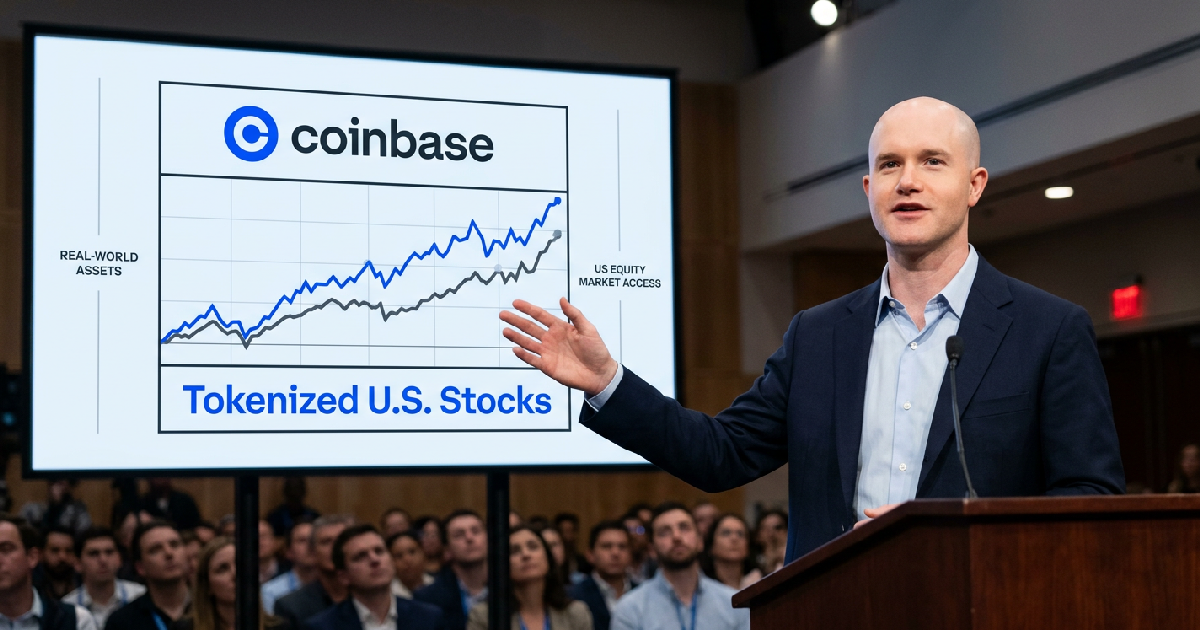

In a recent CNBC interview, Coinbase CEO Brian Armstrong reiterated his position that tokenization is a \”win for everyone,\” highlighting its potential to grant roughly 4 billion \”unbrokered\” people global access to U.S. equity markets. Brian Armstrong argued that the current financial infrastructure leaves half the planet unable to invest in high-quality companies like Tesla or Nvidia, forcing them to hold cash or lower-tier local assets.
The push to bring every asset on-chain is central to the \”everything exchange\” vision at Coinbase (COIN). In mid-June 2026, the firm unveiled plans for 1:1 backed tokenized U.S. stocks, alongside expansions into pre-IPO assets and equity perpetuals. Unlike existing synthetic derivatives, these tokenized shares are designed to provide true ownership, including dividend upside, while operating on a 24/7 trading cycle that offers near-instant spot settlement.
Driving global access to U.S. equity markets
The core of the argument presented by Brian Armstrong hinges on democratizing access for the 4 billion people who currently lack brokerage accounts. While wealthy individuals in countries like Argentina can often navigate international hurdles to trade U.S. stocks, the vast majority of the global population remains excluded. Tokenization addresses this by enabling fractional ownership, allowing users to buy small portions of shares that would otherwise be out of reach.
Brian Armstrong specifically described accredited investor laws as \”the most regressive tax\” because they lock unbrokered people out of private market gains. He believes that shifting to a blockchain-based infrastructure will \”totally change the world\” by facilitating very small, frequent transactions. This is particularly relevant as Ethereum network outlook strengthens with increased activity in decentralised finance sectors that support these digital assets.
The financial stakes are significant. Research from Binance suggests that crypto platforms could funnel roughly $2 trillion in new capital into global stock markets by 2031. While the market cap for tokenized stocks currently sits at $1.5 billion, adoption is accelerating. Transfer volumes doubled to $8 billion this month, and the number of holders grew by 33% to reach 390,000 in the last 30 days.
Efficiency gains through near-instant settlement
Beyond expanding the user base, Brian Armstrong emphasized that tokenization improves utility for existing stockholders. Digital assets on a blockchain enable continuous trading without the constraints of traditional market hours. This eliminates the multi-day delays associated with T+1 or T+2 settlement cycles, which in turn reduces counterparty credit risk and back-office fees.
This efficiency is crucial for the future of automated operations. Coinbase currently has approximately 1,200 full-time equivalent AI agents handling tasks like coding and customer feedback. Brian Armstrong envisions a system where every AI agent has its own financial account to handle micro-transactions, a feat that traditional banking systems struggle to support cost-effectively.
The broader market for real-world assets (RWAs) is already showing rapid momentum. The tokenized RWA market grew 263% year-over-year in 2025 and saw an additional 30% growth in the first quarter of 2026. Experts like Larry Fink, CEO of BlackRock, previously predicted that tokenization would be a $1 trillion industry by the end of the decade, while other forecasts suggest the total could reach $16 trillion by 2030.
Legal battles and regulatory uncertainty
Despite the optimistic projections, the sector faces significant legal and legislative hurdles. On June 15, the firm tZERO, which claims to be a pioneer in the space, sent a cease-and-desist letter to Securitize. The dispute involves allegations of patent infringement. Currently, Securitize is the third-largest issuer of tokenized assets, trailing only Ondo and xStocks.
The regulatory environment also remains a significant bottleneck. A planned \”innovation exemption\” from the Securities and Exchange Commission (SEC) was delayed last month following pressure from traditional financial players. Although David Schwartz joins XRPL Foundation at a time when digital asset adoption is rising, federal rules for on-chain equities are still not solidified.
Furthermore, uncertainty regarding the CLARITY Act could complicate the effort to establish clear rules for the segment. While market sentiment shifts as CLARITY Act advances through various committees, the lack of a final unified framework may delay the \”unlock\” Brian Armstrong anticipates. Coinbase plans to launch its 1:1 backed tokenized stocks in non-U.S. markets first, building a proof-of-concept while waiting for domestic regulatory clarity.