
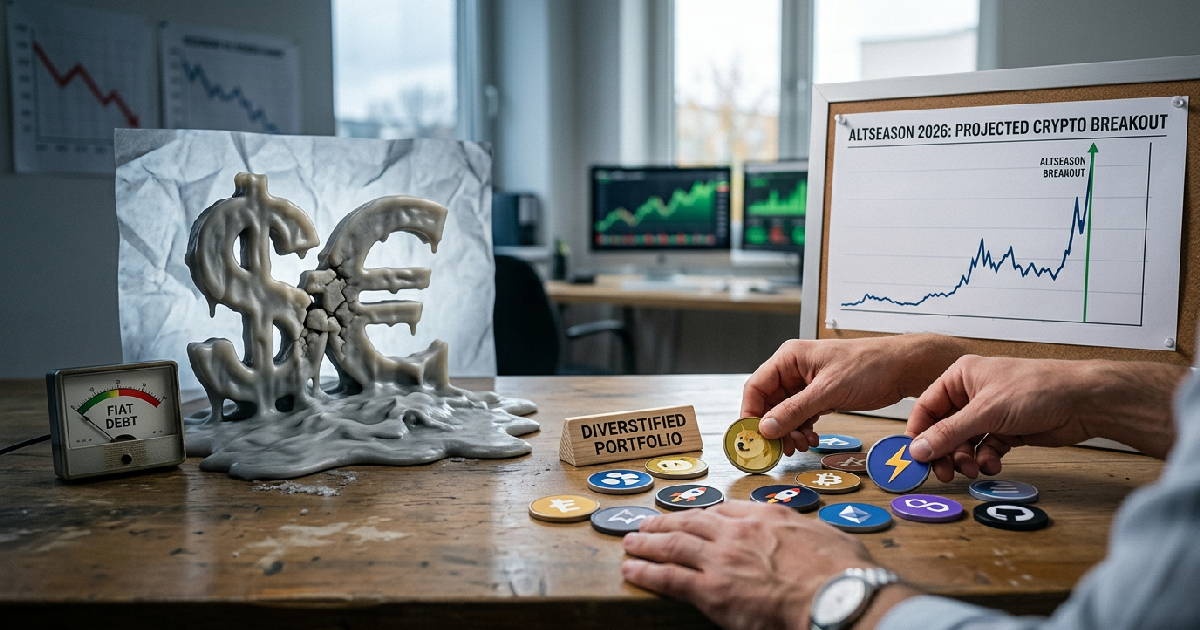

Cryptocurrency proponents are increasingly rallying behind the narrative that the “fiat matrix is melting,” a term used to describe the eroding trust in government-issued currencies. This sentiment is driving a renewed focus on the potential for a localized market breakout, with many analysts eyeing Altseason 2026 as the next major cyclical event for digital assets.
The shift in sentiment suggests that as traditional fiat structures face perceived instability, investors are looking toward diversified altcoin and memecoin portfolios to hedge against inflation.
Projecting market dynamics for Altseason 2026
While the broader market remains focused on Bitcoin’s dominance, the anticipation for Altseason 2026 centers on a structural rotation of capital. This phenomenon historically occurs when investors move liquidity from established assets into higher-risk categories, seeking greater returns.
Industry observers are currently monitoring five specific categories of altcoins and memecoins that could potentially lead this movement, as decentralized finance (DeFi) continues to position itself as an alternative to the traditional banking system.
The timeline for the next significant surge is firmly set on 2026, contrasting with shorter-term speculative cycles. This longer-term outlook is shaped by the belief that the expansion of global debt will force a permanent transition into decentralized assets.
Key details
Unlike previous cycles, the current market is supported by sophisticated infrastructure that facilitates the movement of capital across various blockchain networks. And as Ethereum network outlook remains a central point of discussion, the growth of decentralized exchanges (DEXs) is providing the necessary liquidity for new tokens to emerge.
The concept of a “melting” fiat system isn’t just rhetoric for many traders; it represents a tactical shift in asset allocation. High-utility tokens that offer real-world financial services, such as cross-border payments and decentralized identity, are being viewed as essential pillars for the next cycle.
This movement is often accelerated during periods of macro-economic uncertainty, where the perceived “scarcity” of digital assets serves as a primary draw for both retail and larger institutional participants.
Shifting demand toward new altcoin tokens
As the market prepares for the 2026 cycle, there is a visible preference for newer projects that address specific technological gaps. We are seeing a trend where altcoin demand shifts toward new tokens, particularly those in the presale or early launch phases. These assets often capture community attention more effectively than older, established protocols that may be facing liquidity stagnation on major exchanges.
Memecoins also play a distinct role in this ecosystem by acting as a barometer for retail fervor. While often dismissed as purely speculative, these tokens provide a unique gateway for new users to enter the world of self-custody.
During an altseason, the “attention economy” dictates that the most successful projects are those capable of maintaining viral social momentum while stress-testing network infrastructure through high transaction volumes.
Regulatory considerations for the 2026 cycle
The path to Altseason 2026 is also being shaped by evolving legal frameworks across the globe. For example, lawmakers are pushing to legalize P2P crypto trade in some regions, which could significantly expand the whitelist of approved assets. Such legislative progress is critical because it reduces the “regulation by enforcement” risks that have historically suppressed altcoin valuations.
However, the risks associated with the “melting” fiat matrix include potential government crackdowns on on-and-off ramps. As decentralized finance becomes more competitive with traditional banking, increased scrutiny on reporting requirements is expected. Investors are consequently moving toward platforms and protocols that prioritize transparency and security to ensure they are not caught in liquidity “exit” scenarios common during high-volatility periods.
The future of decentralized asset accumulation
The convergence of professional-grade trading tools and decentralized ethos has created a more resilient market foundation. Analysts suggest that the 2026 cycle will favor projects with high developer activity and transparent ecosystems over “ghost chains” that lack actual users. This flight to quality ensures that the capital flowing out of traditional systems finds a stable home in protocols that offer tangible technological value.
Ultimately, the move toward Altseason 2026 represents a maturing of the digital asset class. Whether through community-driven memecoins or high-utility altcoins, the objective remains the same: finding a refuge from the perceived instability of the modern financial system. As the year 2026 approaches, the performance of these five key categories will likely determine the longevity of the next great crypto expansion.