
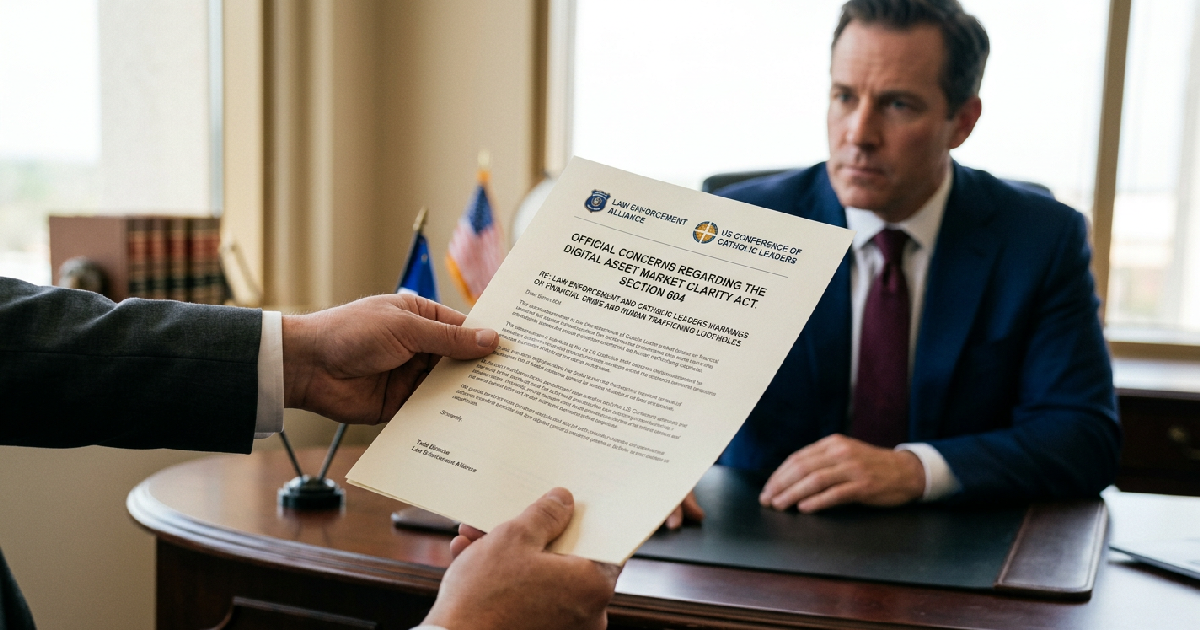

A coalition of four major law enforcement organizations and nearly 100 Catholic leaders sent formal warnings to the U.S. government on June 23 and June 24, 2026, cautioning that the Digital Asset Market Clarity Act (CLARITY Act) would create loopholes for financial crime.
The law enforcement letter was addressed to Acting Attorney General Todd Blanche and Patrick Witt, Executive Director of the President’s Council of Advisors for Digital Assets, while the Catholic group letter was sent to Senate Majority Leader John Thune and Senate Democratic Leader Charles Schumer.
Law enforcement warns Section 604 creates oversight gaps
The organizations, representing more than 70,000 prosecutors, sheriffs, and investigators, argue that Section 604 of the bill would weaken oversight tools essential for combating money laundering and human trafficking.
The coalition includes the National District Attorneys Association (NDAA), the National Association of Assistant United States Attorneys (NAAUSA), the International Association of Chiefs of Police, and the National Sheriffs’ Association. They contend that the CLARITY Act legislative progress could inadvertently shield illicit actors by exempting certain infrastructure providers from money transmitter status.
The primary concern for federal and local investigators is Section 604, which incorporates the Blockchain Regulatory Certainty Act (BRCA). This provision establishes that developers or infrastructure providers who cannot move or control a user’s digital assets are not classified as money transmitters under federal law.
Key details
While industry proponents argue this protects software coders from prosecution, law enforcement groups counter that the exemptions are too broad and risk “creating gaps in oversight and accountability.”
The coalition clarified that their concern is not with individuals who merely write or publish code, but with language that could exempt mixers, tumblers, and certain decentralized finance (DeFi) businesses from Anti-Money Laundering (AML) and Know-Your-Customer (KYC) requirements.
They noted the bill does not establish suspicious activity monitoring and reporting obligations comparable to traditional financial intermediaries. Such oversight is critical as the global push to legalize p2p trade continues to evolve.
Gary Kalman, Executive Director of Transparency International U.S., described the current framework as “window-dressing type regulation.” He argued that light-touch oversight might lead the public to believe the system is safe while failing to provide the investigative tools needed to stop organized crime. These warnings come as lawmakers prepare for a July 17 hearing in New York to discuss the market structure bill.
Catholic leaders highlight exploitation and trafficking risks
A separate letter signed by approximately 80 Catholic organizations and leaders, including the Alliance to End Human Trafficking and the Jesuit Conference’s Office of Justice and Ecology, was delivered to Senate leadership this week. The signatories, which include dozens of Catholic sisters and survivor advocates, warned that human traffickers are quick to exploit new technologies when federal oversight fails to keep pace with financial innovation.
The religious coalition argued that the CLARITY Act’s current regulatory gaps could make it significantly harder to trace financial flows tied to child exploitation and organized crime. By potentially exempting tools like mixers and tumblers from strict reporting, the bill could facilitate the anonymous movement of proceeds from predatory criminal networks.
This internal pressure from religious groups adds a moral dimension to the technical debate over blockchain infrastructure.
Legislative outlook and the 60-vote Senate threshold
The CLARITY Act (H.R. 3633) previously passed the House of Representatives in July 2025 by a 294-134 vote and cleared the Senate Banking Committee 15-9 on May 14, 2026. However, its path to final passage remains difficult as it requires 60 votes to overcome a Senate filibuster.
Senators Mark Warner of Virginia and Catherine Cortez Masto of Nevada have tied their support to law enforcement’s sign-off on Section 604, making these opposition letters a direct threat to the bill’s chances.
White House cryptocurrency advisor Patrick Harker (also referred to as Patrick Witt or Patrick Wright) defended the legislation, insisting it “supports regulation and supports law enforcement” by setting proactive U.S. standards. Harker emphasized that the U.S. must lead in setting these rules or risk accepting standards from other countries. In contrast, Rep.
Key details
Tom Emmer dismissed law enforcement objections earlier in May, prioritizing the legal certainty developers need to remain in the United States.
As the debate intensifies, stakeholders remain divided over the balance between protecting innovation and preventing financial crime. Digital Chamber CEO Cody Carbone argued that Section 604 is necessary for non-custodial developers, while the National Sheriffs’ Association has maintained its objections since May.
The upcoming hearing and potential floor vote later this year will determine if the Senate can reconcile the concerns of the law enforcement community with the legislative goals of the Trump administration.