
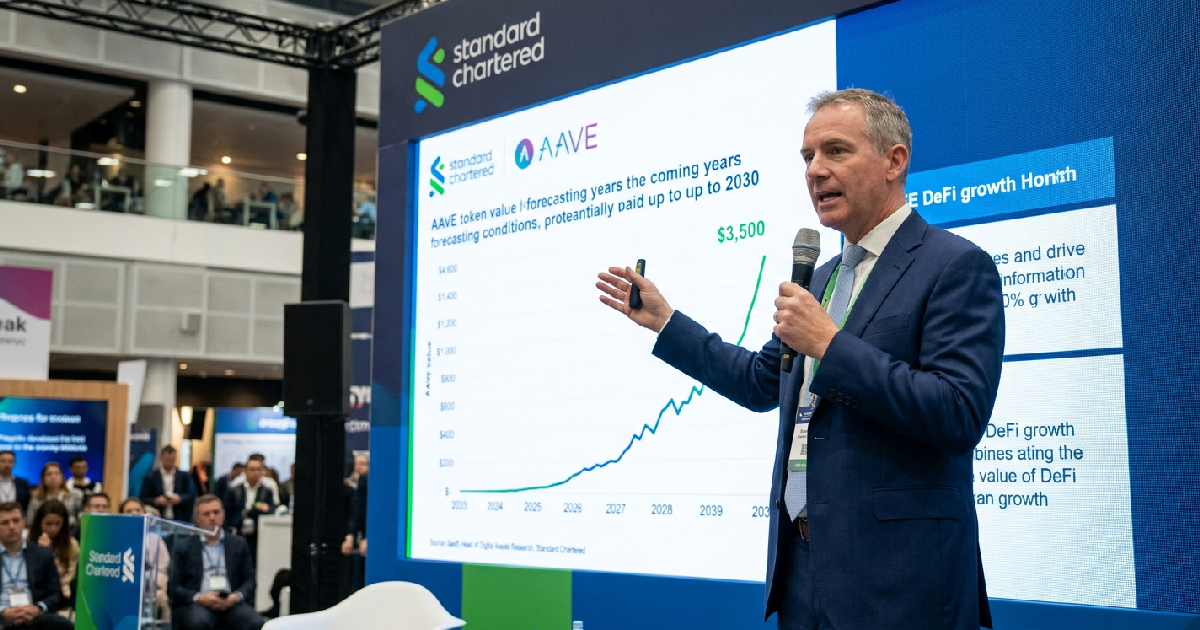

Standard Chartered analyst Geoff Kendrick has predicted that the Aave (AAVE) token could surge to $3,500 by the end of 2030, representing a roughly 50-fold increase from its current valuation.
The forecast, released in a research report today, June 2026, suggests that the premier decentralized lending protocol is positioned to outperform both Bitcoin and Ether as the broader decentralized finance (DeFi) sector undergoes a significant expansion over the next several years.
Standard Chartered analyst eyes massive Aave price growth potential
Geoff Kendrick, who serves as the Head of Digital Assets Research at the London-headquartered bank, noted that the protocol has successfully moved past the market disruption caused by an April cybertheft incident. While the sector has faced volatility, Kendrick maintains that Aave’s underlying revenue model and its dominance in on-chain lending make it the primary beneficiary of the migration toward tokenized real-world assets (RWAs).
The $3,500 price target rests on the assumption that the Aave protocol will capture a major share of a rapidly expanding DeFi market. Standard Chartered expects the total value of tokenized assets on-chain to reach $4 trillion by the end of 2028, split equally between stablecoins and RWAs.
As these assets become more liquid, the bank anticipates their active use within DeFi protocols will jump from current levels to approximately 30% by 2030.
Key details
For Aave, which functions much like an automated, blockchain-based bank, this growth translates directly into protocol revenue. Unlike traditional financial institutions, the platform operates without employees or discretionary management, relying instead on smart contracts to facilitate lending and borrowing.
At its peak in October 2025, the protocol held roughly $75 billion in deposits, a figure that rivals some of the largest traditional banks in the United States.
Despite the ambitious nature of the forecast, Kendrick argues that Aave’s market position is remarkably resilient. By the end of 2025, the protocol controlled more than 61% of all active decentralized loans.
This dominance allows it to scale more efficiently than competitors as traditional financial assets are brought onto the blockchain through tokenization initiatives, often avoiding the macro conditions that lead to mass liquidations in less established protocols.
Recovery from the KelpDAO exploit and rsETH market disruption
A key pillar of the Standard Chartered outlook is Aave’s recovery following the April 2026 collapse of KelpDAO’s rsETH bridge. During that incident, attackers used roughly $290 million of stolen tokens as collateral on Aave to borrow real assets.
This event sent shockwaves through the ecosystem and left the protocol facing potential losses of up to $230 million as vulnerabilities in bridge protocols spread across the DeFi space.
The incident underscored the interconnected risks of decentralized finance, as attackers leveraged the protocol’s own lending mechanics. Deposits on the platform fell to about $12 billion after the April incident, a decrease from the more than $30 billion seen at its 2025 peak.
However, Geoff Kendrick noted that Aave has now moved past this disruption, with assets beginning to return to the platform as investors regain confidence in its lending model.
To prevent future systemic issues, the Aave community has focused on permissioned environments. The “Horizon” initiative is specifically designed to allow players to borrow against tokenized real-world assets within a regulated framework. This move toward hybrid DeFi—combining the efficiency of blockchain with the security requirements of traditional finance—is expected to be a major catalyst for the token’s long-term valuation.
Driving AAVE token value through revenue and buybacks
Beyond external market growth, several internal factors are expected to drive the AAVE price toward the $3,500 target. Kendrick pointed to the potential restart of the protocol’s token buyback program as a significant catalyst. This mechanism would use a portion of the protocol’s earnings to purchase tokens, effectively rewarding holders as the platform scales its 37-fold growth forecast for the total DeFi market.
The revenue figures remain strong despite the spring’s disruptions. Aave generated $907 million in revenue across the full year of 2025 and has already booked $333 million year-to-date in 2026. Furthermore, its native stablecoin, GHO, continues to find traction, contributing over $14 million in annualized revenue by the end of last year.
This prevents the protocol from relying solely on speculative activity, even when Ethereum price outlooks weaken due to technical factors.
Standard Chartered’s confidence suggests that the infrastructure for this transition is already largely in place. The bank sees Aave not just as a crypto project, but as a foundational layer for the “future of money” where traditional assets and digital native assets coexist.
Should Aave maintain its roughly 50% share of total value locked, the protocol could eventually manage trillions in assets, making the $3,500 target feasible within the context of global finance.